
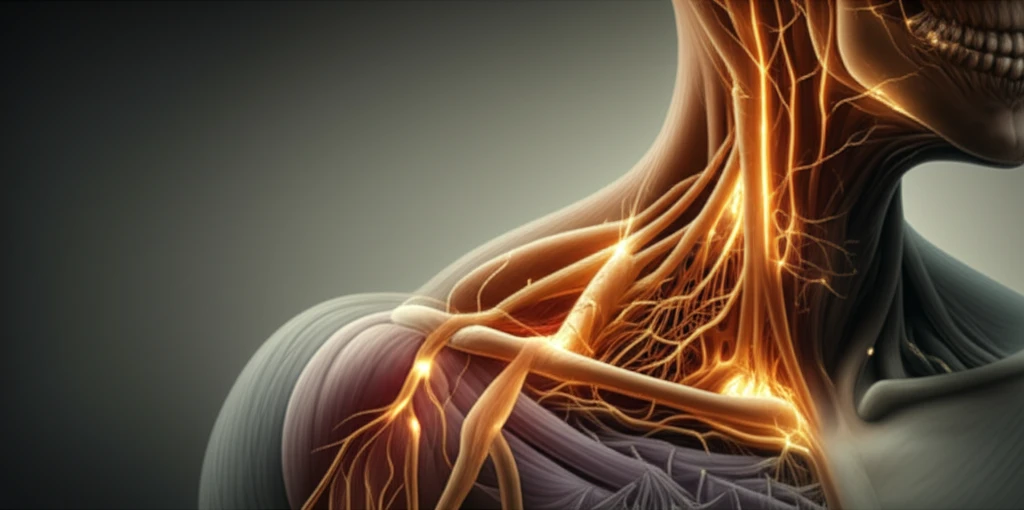
Surreal illustration of interconnected nerves and roots symbolizing complex shoulder pain.

Decoding Shoulder Pain: Uncommon Causes and Novel Treatments

"Beyond rotator cuff tears: Exploring nerve entrapment, referred pain, and innovative solutions for persistent shoulder discomfort."


Shoulder pain is a common complaint, often attributed to rotator cuff injuries or simple overuse. However, when the usual treatments don't provide relief, it's time to consider that something else might be at play. From nerve entrapments to referred pain from seemingly unrelated conditions, a variety of less common issues can manifest as persistent shoulder pain.

This article dives into some of these unexpected causes of shoulder pain, drawing from recent medical research and case studies. We'll explore conditions like axillary nerve entrapment, Bertolotti syndrome affecting the hip and spine but causing shoulder discomfort, and even the rare phenomenon of parameniscal cysts in the knee contributing to pain elsewhere in the body.

Beyond identifying these unusual culprits, we'll also highlight innovative treatment approaches. Whether it's nerve decompression surgery or cutting-edge injections of micro-fragmented adipose tissue, there's hope for finding relief and regaining function, even when dealing with complex or previously undiagnosed conditions. If you're struggling with persistent shoulder pain that hasn't responded to typical treatments, this exploration might shed light on the root cause and potential solutions.

Axillary Nerve Entrapment: When a Shoulder Nerve Gets Trapped

Surreal illustration of interconnected nerves and roots symbolizing complex shoulder pain.

One often-overlooked cause of posterior shoulder pain is axillary nerve entrapment, particularly at the teres minor muscle. This condition occurs when the axillary nerve, which controls the deltoid and teres minor muscles, becomes compressed or entrapped.

A recent case highlights how this can happen: A 48-year-old man experienced persistent posterior left shoulder pain following a fall. Initial treatments like shoulder injections and physical therapy provided limited relief. Over time, he developed shoulder weakness, prompting further investigation.

  • An EMG (electromyography) revealed polyphasicity and decreased recruitment in the teres minor muscle, indicating nerve dysfunction.
  • Despite MRI findings of supraspinatus and infraspinatus tendinosis, the EMG results pointed towards a specific nerve issue.
  • The patient underwent open quadrilateral space decompression to relieve the pressure on the axillary nerve.
  • Post-surgery, the patient experienced improved strength and decreased shoulder pain.
This case underscores the importance of considering nerve entrapment in patients with persistent shoulder pain, especially when weakness is present. Quadrilateral space syndrome, the specific type of axillary nerve compression in this case, involves compression of the axillary nerve or posterior humeral circumflex artery. Early diagnosis and treatment, including decompression surgery and physical therapy, can lead to significant improvement.

Beyond the Usual Suspects: A New Perspective on Diagnosing Shoulder Pain

Persistent shoulder pain can be a frustrating experience, especially when initial treatments fail to provide relief. By considering less common causes like nerve entrapment, referred pain from other areas of the body, and even seemingly unrelated conditions like parameniscal cysts, healthcare providers can develop more targeted and effective treatment plans.

The case studies discussed highlight the importance of thorough evaluation, including advanced imaging and electrodiagnostic studies, to identify the underlying cause of shoulder pain. Furthermore, innovative treatments like micro-fragmented adipose tissue injections and nerve decompression surgery offer hope for patients who have not responded to traditional approaches.

If you're experiencing persistent shoulder pain, don't give up hope. By exploring these less common causes and innovative treatments with your healthcare provider, you can work towards finding lasting relief and getting back to your active life.

About this Article -

This article was crafted using a human-AI hybrid and collaborative approach. AI assisted our team with initial drafting, research insights, identifying key questions, and image generation. Our human editors guided topic selection, defined the angle, structured the content, ensured factual accuracy and relevance, refined the tone, and conducted thorough editing to deliver helpful, high-quality information.See our About page for more information.

Everything You Need To Know

1

What is axillary nerve entrapment and how is it diagnosed and treated?

Axillary nerve entrapment occurs when the axillary nerve, which controls the deltoid and teres minor muscles, becomes compressed. This can cause posterior shoulder pain and weakness. Diagnosis often involves an EMG (electromyography) to detect nerve dysfunction in the teres minor muscle. Treatment may include open quadrilateral space decompression to relieve pressure on the nerve, followed by physical therapy to restore strength and function.

2

How can Bertolotti syndrome, typically associated with the hip and spine, lead to shoulder pain?

Bertolotti syndrome, while primarily affecting the hip and spine, can cause referred pain that manifests as shoulder discomfort. This is because musculoskeletal issues in one area of the body can sometimes create pain in seemingly unrelated areas due to shared nerve pathways or compensatory movement patterns. While parameniscal cysts in the knee are mentioned as another potential source of referred pain, Bertolotti syndrome is not directly linked to these cysts; they are distinct conditions that can independently contribute to shoulder pain.

3

What does quadrilateral space decompression involve and how does it alleviate shoulder pain?

Quadrilateral space decompression is a surgical procedure used to relieve pressure on the axillary nerve when it is compressed within the quadrilateral space. The quadrilateral space is an anatomical area in the shoulder through which the axillary nerve and posterior humeral circumflex artery pass. This decompression surgery aims to alleviate nerve compression and restore normal nerve function, ultimately reducing pain and improving strength. Post-operative physical therapy is typically required to maximize recovery.

4

What is the role of an EMG in diagnosing the cause of persistent shoulder pain?

An EMG, or electromyography, is a diagnostic test used to evaluate the electrical activity of muscles and nerves. In the context of shoulder pain, an EMG can help identify nerve dysfunction, such as that seen in axillary nerve entrapment. Specifically, the presence of polyphasicity and decreased recruitment in the teres minor muscle during an EMG suggests a problem with the axillary nerve's ability to properly stimulate the muscle. This helps differentiate nerve-related issues from other potential causes of shoulder pain, like rotator cuff problems.

5

What are micro-fragmented adipose tissue injections and how might they help with shoulder pain?

Micro-fragmented adipose tissue injections are mentioned as a cutting-edge treatment option for shoulder pain, suggesting a regenerative approach. While the provided text doesn't detail its mechanism, this type of injection likely involves using a patient's own fat tissue, processed to reduce inflammation and promote tissue repair. Injections of this tissue into the shoulder are intended to reduce pain and improve function by regenerating damaged tissues. The specifics of this treatment for the described conditions are not explicitly mentioned, leaving open questions about their role in treating nerve entrapment or referred pain.

Newsletter Subscribe

Subscribe to get the latest articles and insights directly in your inbox.