
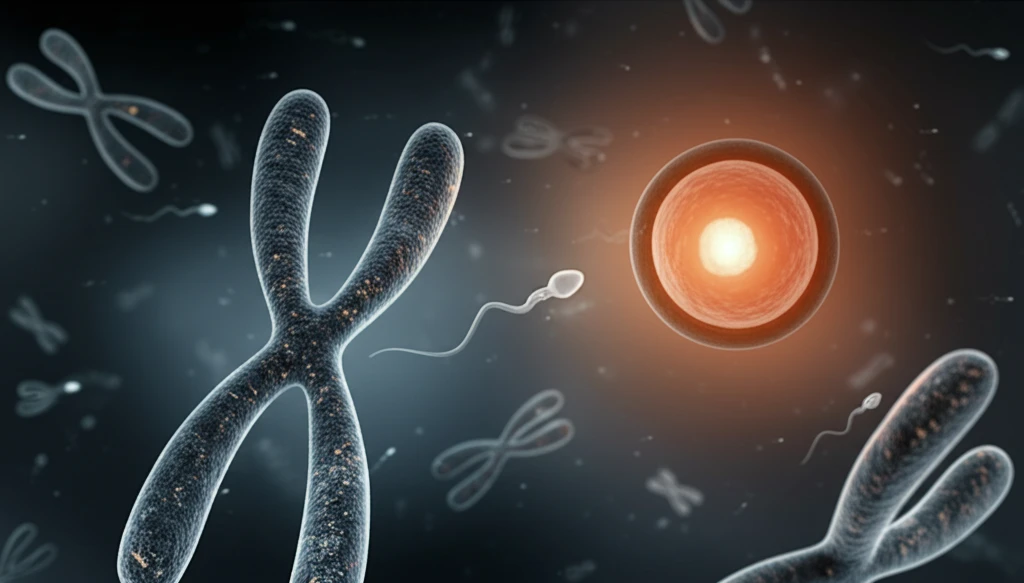
Decoding Male Infertility: Can Chromosomal Translocations Impact Your Chances of Conception?

"A Comprehensive Guide to Understanding the Link Between Chromosomes, Semen Quality, and Male Fertility"
For couples dreaming of parenthood, infertility can be a heartbreaking challenge. While many factors contribute, chromosomal translocations are a significant, yet often overlooked, genetic cause of male infertility. These translocations, where pieces of chromosomes swap places, can disrupt the delicate process of sperm production, leading to difficulties in conception.
Understanding the intricate relationship between chromosomal translocations and semen quality is crucial for those navigating the complexities of male infertility. Recent research sheds light on specific translocations and chromosomal regions that are more directly associated with sperm defects. This knowledge paves the way for improved detection methods and potential treatment strategies.
This article delves into the findings of a study examining 144 men with chromosomal translocations. By exploring the impact of these translocations on semen quality, we aim to empower you with the information you need to understand your fertility challenges and make informed decisions about your reproductive health.
Chromosomal Causes of Male Infertility
Reviews identify chromosomal aneuploidy, structural and numerical karyotype abnormalities, and Y-chromosomal microdeletions as important areas in the chromosomal basis of male infertility. A June 2025 review examines known chromosomal anomalies that cause male-factor infertility and the cytogenetic diagnostic tests used to evaluate affected men. Publication activity in chromosomal aberrations and male infertility is tracked across years by the Nature Index, while a separate 2026 statistics compilation reports that it aggregates data from peer-reviewed studies, official statistics, industry databases, and recognized institutions.
Testing and Its Limits
Current reviews describe technical approaches for defining chromosomal defects and discuss their clinical consequences in infertile men. These approaches address numerical and structural chromosomal anomalies, while broader assessments may also consider environmental exposures, lifestyle factors, and age-related genetic changes that can disrupt spermatogenesis. A key limitation of FISH for translocation detection is that it cannot simultaneously evaluate all 24 chromosomes for aneuploidy, leaving open the possibility of an additional copy-number error in a chromosome unrelated to the translocation.
A Developing Field
The understanding of chromosomal contributions to male infertility has developed through increasingly detailed examination of chromosome number, structure, and diagnostic patterns. Progress in this area appears to have been gradual rather than defined by a single universally established milestone. Historical interpretations should therefore be treated as an evolving account of genetic discovery and clinical practice.
What are Chromosomal Translocations and Why Do They Matter for Fertility?
Chromosomal translocations occur when segments of two chromosomes break off and exchange positions. There are two main types:
- Reciprocal Translocations (RCT): Involve an exchange of segments between two non-homologous chromosomes.
- Robertsonian Translocations (ROBT): Occur when the long arms of two acrocentric chromosomes (chromosomes 13, 14, 15, 21, and 22) fuse together.
Recent Evidence
A 2024 analysis examined cytogenetic data from 2,500 infertile males referred to the Royan Research Institute between 2009 and 2022; 391 cases met the inclusion criteria for balanced chromosomal rearrangement. A case report on asthenozoospermia associated with a reciprocal translocation highlights the complex relationship between chromosomal rearrangements and male infertility and calls for further research. A 2025 narrative review likewise focuses on technical methods for defining chromosomal anomalies and their clinical consequences in a wider group of infertile men.
Limits of Current Evidence
The available evidence does not support treating every chromosomal rearrangement as having the same reproductive consequence. Differences in rearrangement type, affected chromosome, and individual clinical presentation may complicate broad conclusions. As a result, interpretations of infertility risk should remain appropriately cautious and dependent on the specific abnormality being evaluated.
Different Rearrangements, Different Risks
Chromosomal rearrangements have long been associated with effects on fertility and miscarriage risk, but advances in molecular diagnostics are making it more difficult to characterize the reproductive risk of a given abnormality using broad categories alone. A 2012 study specifically examined how different types of chromosomal translocations relate to semen quality, testicular volume, and hormone levels. A 2022 review discusses genetic principles underlying male infertility and the proper clinical use of proven genetic assays.
Taking Control of Your Fertility Journey
Understanding the impact of chromosomal translocations on semen quality is a powerful step toward addressing male infertility. Armed with this knowledge, you can engage in informed discussions with your healthcare provider, explore appropriate testing options, and consider assisted reproductive technologies to increase your chances of a successful pregnancy. Remember, you're not alone, and resources are available to support you on your path to parenthood.
Translocations and Semen Quality
Chromosomal translocations are recognized genetic causes of male infertility. A study of 144 cases addressed whether particular translocations or chromosomal regions are more directly associated with sperm defects. This focus supports a more individualized interpretation of reproductive effects rather than assuming that all translocations carry identical consequences.
Toward Precision Evaluation
Recent work describes major advances in understanding the molecular basis of male infertility, including genetic and epigenetic mechanisms and their effects beyond reproduction. A separate review identifies emerging management tools such as seminal oxidative-stress testing, sperm-DNA-fragmentation testing, genetic and epigenetic tests, genetic manipulations, artificial intelligence, personalized medicine, and telemedicine. Together, these developments point toward increasingly individualized evaluation and management, although their clinical roles continue to evolve.
A Multifactorial Challenge
Chromosomal translocations are one part of a broader male-infertility landscape that may involve genetic, biological, and clinical factors. The complexity of these overlapping influences can make diagnosis and reproductive-risk assessment difficult. Broader conclusions should therefore be framed cautiously and tied to the individual clinical context.
From Genetic Finding to Family Experience
A 2022 case report described a man with teratozoospermia whose wife had experienced a miscarriage; testing identified a balanced reciprocal translocation, t(17;22)(p11.2;q11.2), along with a microduplication in region 10q23.31. Another case study described Mr. Ely, a 38-year-old man with obesity and type 1 diabetes, who had been trying unsuccessfully to conceive with his 28-year-old spouse for 1.5 years. These cases illustrate how infertility and chromosomal findings can intersect with individual medical histories and reproductive experiences.