
Unlocking Shoulder Secrets: What Your Pain Might Be Telling You

"From Simple Strains to Complex Deformities: A Guide to Understanding Shoulder Pain and When to Seek Help"
Shoulder pain. It's a common complaint, affecting people of all ages and activity levels. Whether it's a dull ache that lingers or a sharp stab that takes your breath away, shoulder pain can disrupt your daily life, making simple tasks feel impossible. But what's causing the pain? Is it a simple muscle strain, or something more complex?
This article dives into the world of shoulder pain, exploring various conditions and their potential causes. We'll look at common issues like rotator cuff injuries and impingement, and also shed light on less frequent problems such as Sprengel's deformity. Our goal is to help you understand your shoulder pain better, empowering you to take the right steps towards relief.
We'll break down the information in a clear, easy-to-understand manner, offering practical advice and guidance. Remember, this article is for informational purposes and should not be considered medical advice. Always consult with a healthcare professional for diagnosis and treatment.
Why Shoulder Pain Matters
Shoulder pain is a common health concern that can interfere with movement, work, sleep, and everyday activities. Its causes vary, so the meaning of pain depends on factors such as how it began, which movements provoke it, and whether mobility is restricted. Persistent, worsening, or unexplained symptoms warrant professional assessment rather than relying on pain location alone.
A Structured Evaluation
A 2024 clinical approach recommends triaging atraumatic shoulder pain according to whether active and passive range of motion are preserved or lost. Loss of both types of motion may point toward adhesive capsulitis or glenohumeral arthritis, with imaging helping distinguish between them. For traumatic pain, standard radiographs are recommended as an initial imaging study, while suspected rotator-cuff pathology may be evaluated with MRI, MR arthrography, or ultrasound. Physical examination also remains important: pain or weakness during a loaded 90-degree abduction test may indicate supraspinatus pathology.
An Evolving Understanding
Understanding of shoulder pain has developed from focusing primarily on visible structures toward combining symptom patterns, physical examination, and imaging. The shoulder’s broad range of motion and limited bony stabilization help explain why clinicians have continued refining how they evaluate it. Modern approaches therefore tend to emphasize matching examination findings with the person’s symptoms rather than treating a scan in isolation.
Common Culprits: Understanding the Sources of Shoulder Pain
Shoulder pain can arise from numerous sources, and pinpointing the cause is crucial for effective treatment. Let's explore some of the most common culprits:
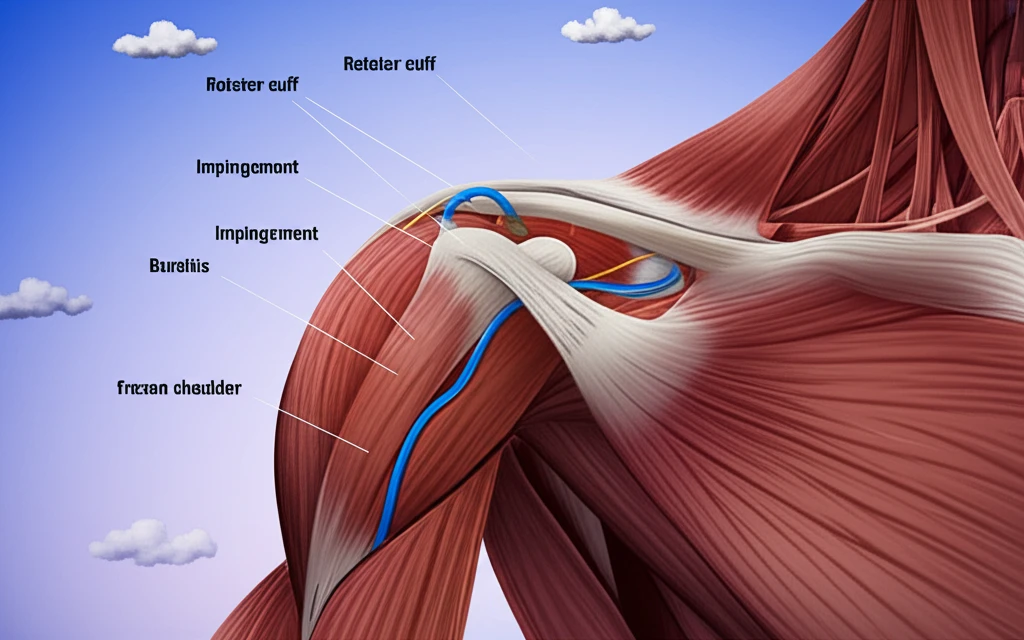
- Rotator Cuff Injuries: The rotator cuff is a group of muscles and tendons that surround the shoulder joint, enabling a wide range of motion. Tears or inflammation in these tendons are a frequent cause of shoulder pain, especially among athletes and those who perform repetitive overhead movements.
- Shoulder Impingement: This occurs when the tendons of the rotator cuff become pinched in the space between the shoulder blade and the upper arm bone. This can lead to inflammation and pain, particularly when lifting the arm.
- Bursitis: Bursae are fluid-filled sacs that cushion the joints. Inflammation of these sacs (bursitis) in the shoulder can cause pain and swelling.
- Osteoarthritis: Like other joints, the shoulder can be affected by osteoarthritis, a degenerative condition that causes cartilage breakdown, leading to pain, stiffness, and reduced range of motion.
- Frozen Shoulder (Adhesive Capsulitis): This condition involves stiffness and pain in the shoulder joint, gradually restricting movement.
- Muscle Strains: Overuse or sudden movements can strain the muscles around the shoulder, causing pain and tenderness.
- AC Joint Problems: The acromioclavicular (AC) joint, where the collarbone meets the shoulder blade, can be a source of pain due to injury or arthritis.
- Fractures: A broken collarbone or upper arm bone can cause severe shoulder pain, often resulting from falls or direct impacts.
Where Research Is Moving
Recent reviews describe shoulder pain as arising from a wide range of conditions, including rotator-cuff tendinosis or tears, calcific tendinopathy, labral or capsuloligamentous injuries, and glenohumeral degenerative changes. A 2026 systematic review examined Mobilization With Movement for chronic shoulder pain and included controlled trials identified across five databases through August 2, 2024. Contemporary non-operative reviews generally describe non-operative care as first-line treatment, with surgery reserved for refractory symptoms or specific structural indications. A 2026 review also reported a shift toward the umbrella term subacromial pain because imaging findings may correlate poorly with symptoms.
Function Cannot Be Reduced to a Scan
Research on people of working age with shoulder pain highlights that limitations can affect both personal daily life and professional activities. The patient experience may differ between primary-care and secondary-care settings, suggesting that clinical impact is not uniform. The studies also identify a gap in research distinguishing daily-life limitations from work limitations. These findings challenge approaches that measure success only through structural diagnoses or isolated clinical findings.
Comparing Treatment Strategies
For rotator-cuff-related shoulder pain, a network meta-analysis is comparing combination therapy involving exercise plus manual therapy with single-modality physiotherapy interventions. Another 2026 study addresses the uncertainty surrounding exercise therapy compared with passive conservative treatments. Separate systematic-review research compares hyaluronic acid with corticosteroids, platelet-rich plasma, and physical therapy for chronic shoulder pain. Together, these studies show that treatment comparisons are evaluating both active rehabilitation and injection-based options rather than assuming one approach works equally well for every patient.
Taking Action: When to Seek Professional Help
Shoulder pain can often be managed with rest, ice, and over-the-counter pain relievers. However, certain symptoms warrant a visit to a healthcare professional. If you experience severe pain, limited range of motion, numbness or tingling, or if your pain persists for more than a few weeks, it's essential to seek medical attention. A doctor can perform a thorough examination, order imaging tests if needed, and recommend the appropriate treatment plan to get you back on the path to pain-free movement.
Putting the Person First
Qualitative research indicates that many people understand shoulder pain primarily through a biomechanical lens, and those beliefs can shape treatment decisions. They may influence how patients interpret imaging, what education they seek, and which treatments they expect. An international expert consensus on the kinetic chain likewise addresses terminology, clinical reasoning, examination, and treatment. The broader message is that effective care should connect shoulder findings with the individual’s beliefs, goals, and movement context.
The Next Questions
Future shoulder-pain research is likely to focus on more individualized assessment, better links between symptoms and imaging, and clearer comparisons among rehabilitation and non-operative treatments. Progress will depend on studies that evaluate meaningful outcomes such as function, work participation, and quality of life alongside pain scores. As evidence develops, clinicians may be better able to match treatment intensity and type to each person’s presentation.
Beyond the Joint
Shoulder pain sits at the intersection of physical symptoms, work demands, access to care, diagnostic resources, and beliefs about injury. Differences between primary-care and secondary-care experiences suggest that setting can shape how limitations are recognized and managed. A broader approach must therefore consider not only the shoulder’s structures but also the person’s daily responsibilities and ability to obtain appropriate evaluation and treatment.
When Shoulder Pain Signals More
Case reports show why shoulder pain should be interpreted in its wider clinical context. One emergency-department case involved shoulder pain that was ultimately associated with a sickle cell crisis, emphasizing the importance of careful history taking and examination. A 2025 NEJM Evidence report described a 47-year-old woman with left shoulder pain, fever, and fatigue, using structured assessment and diagnostic testing to refine the differential diagnosis. Other case-based resources similarly demonstrate that presentations, examination findings, imaging, and management can vary substantially between patients.