
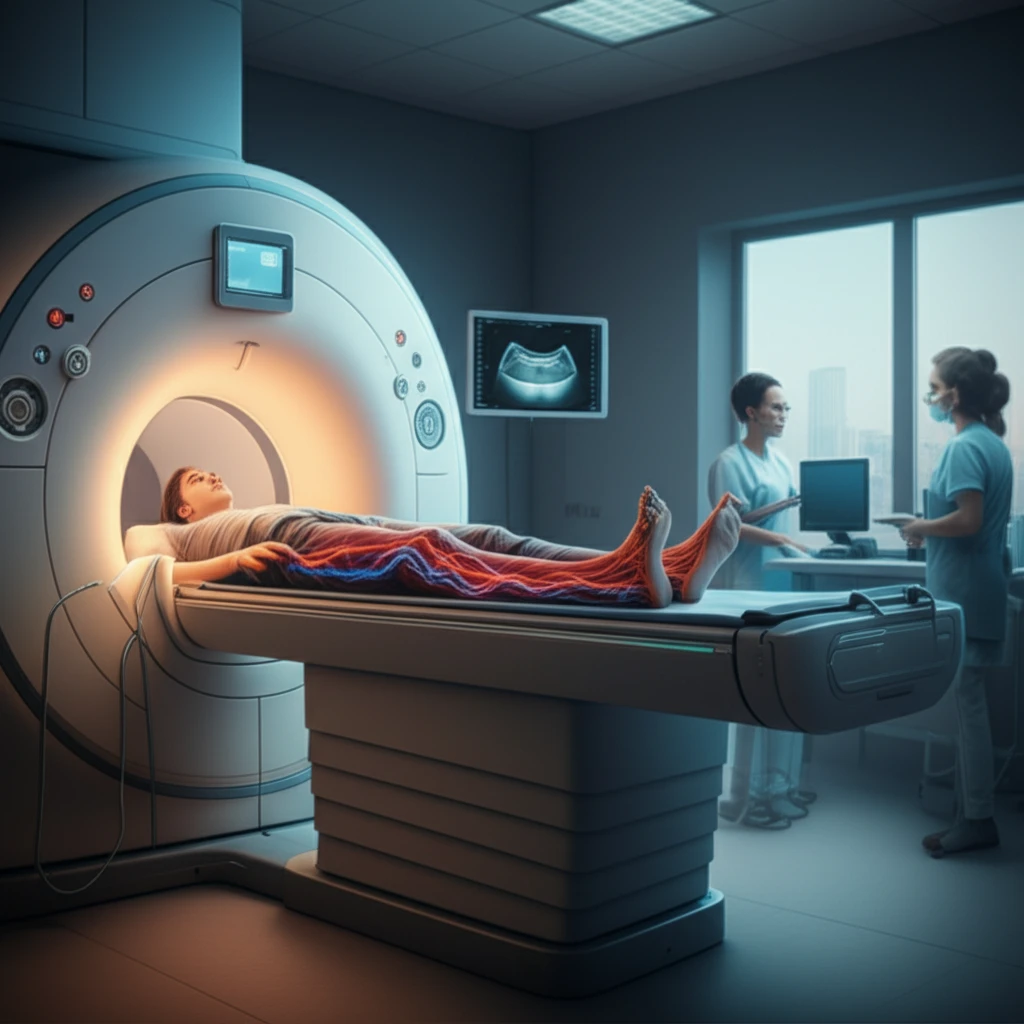
Illustration of a 3T MRI machine visualizing arteries for PAD detection, symbolizing a breakthrough in leg health.

Unlocking Healthy Legs: Advanced Imaging Protocols Revolutionize Peripheral Artery Disease Detection

"Groundbreaking research reveals how non-invasive 3T MR angiography is transforming the diagnosis and management of lower extremity peripheral artery disease (PAD), offering new hope for those at risk."


Peripheral Artery Disease (PAD), a condition marked by reduced blood flow to the limbs, affects millions worldwide. Often, it leads to pain, limited mobility, and in severe cases, amputation. Early and accurate diagnosis is critical for effective treatment and management. Traditional methods, however, often come with limitations, including the use of contrast agents and potential risks. This article delves into a revolutionary shift: the use of advanced, non-invasive 3T MR angiography protocols for the precise detection of PAD.

Imagine a future where detecting PAD is as straightforward as a quick, comfortable scan, eliminating the need for invasive procedures or potentially harmful contrast agents. This is the promise of the non-gadolinium (Gd)-enhanced 3T MR angiography protocols. This innovative approach is not only safer but also offers high diagnostic accuracy, paving the way for earlier interventions and improved patient outcomes. We'll explore how these advancements are changing the landscape of PAD diagnosis.

This article will uncover the groundbreaking findings of recent research comparing these new protocols with established methods. We'll examine their effectiveness, accuracy, and how they are transforming the way healthcare professionals approach PAD diagnosis. This offers not just an update on a new technology but also a beacon of hope for those living with or at risk of this challenging condition.

The Evolution of PAD Diagnosis: From Invasive to Non-Invasive

Illustration of a 3T MRI machine visualizing arteries for PAD detection, symbolizing a breakthrough in leg health.

Historically, diagnosing PAD has often involved invasive procedures, such as angiography, which uses catheters and contrast dyes. These methods, while effective, carry risks like allergic reactions, kidney damage, and arterial damage. The emergence of non-invasive techniques, such as MR angiography, marked a significant turning point, offering a safer alternative. However, initial MR angiography protocols often relied on gadolinium-based contrast agents, which, while generally safe, have been linked to rare but serious side effects like nephrogenic systemic fibrosis in patients with kidney issues. This prompted the development of non-contrast MR angiography, a major step forward in patient safety.

The research highlights two specific non-contrast protocols: QISS (quiescent-interval single-shot) and QIR/ECG-FSE (quadruple inversion recovery/electrocardiogram-gated fast spin echo). These protocols, designed for 3T (Tesla) MRI scanners, offer enhanced image quality and diagnostic capabilities compared to earlier generation methods. 3T MRI scanners provide a stronger magnetic field, leading to better image resolution and detail, crucial for visualizing the intricate blood vessels in the legs.

  • Reduced Risk: Eliminates the need for contrast agents, reducing the risk of adverse reactions.
  • High Accuracy: Delivers precise images, comparable to traditional methods.
  • Improved Patient Comfort: Non-invasive, leading to a more comfortable experience.
  • Early Detection: Facilitates early diagnosis, leading to timely interventions.
The study compared the diagnostic accuracy of QISS and QIR/ECG-FSE with the traditional Gd-enhanced MR angiography at 3T. The results demonstrated that both QISS and QIR/ECG-FSE protocols provided comparable diagnostic accuracy to the traditional method, particularly in terms of detecting significant abnormalities and assessing the severity of the disease. This is a significant finding, as it validates these non-contrast methods as reliable alternatives, especially for patients where the use of gadolinium is not ideal.

A Brighter Future for Leg Health

The research presented signifies a major advancement in PAD diagnosis. With the advent of reliable, non-invasive 3T MR angiography protocols, healthcare professionals are better equipped to provide early and accurate diagnoses, improving patient outcomes and quality of life. This shift not only underscores the importance of technological innovation but also offers a hopeful message to those at risk or living with PAD: a future where diagnosis is safer, more accessible, and more effective than ever before.

About this Article -

This article was crafted using a human-AI hybrid and collaborative approach. AI assisted our team with initial drafting, research insights, identifying key questions, and image generation. Our human editors guided topic selection, defined the angle, structured the content, ensured factual accuracy and relevance, refined the tone, and conducted thorough editing to deliver helpful, high-quality information.See our About page for more information.

Everything You Need To Know

1

What is Peripheral Artery Disease (PAD), and why is early detection so important?

Peripheral Artery Disease (PAD) is a condition where reduced blood flow to the limbs occurs, affecting millions worldwide. Early detection is critical because it allows for timely interventions such as lifestyle changes, medication, or procedures to restore blood flow and prevent severe complications like amputation. The goal of early detection is to reduce pain, improve mobility, and enhance overall quality of life. Untreated PAD can lead to significant health issues, making early diagnosis and management essential.

2

How do 3T MR angiography protocols improve upon traditional methods for diagnosing PAD?

3T MR angiography protocols, specifically QISS and QIR/ECG-FSE, offer significant advantages over traditional methods. Unlike invasive procedures like angiography, these protocols are non-invasive, eliminating risks associated with catheters and contrast dyes. They also surpass earlier MR angiography techniques that rely on gadolinium-based contrast agents, avoiding potential side effects, such as allergic reactions and kidney damage. The 3T MRI scanners used in these protocols provide a stronger magnetic field, resulting in higher image resolution and detail, which leads to more accurate diagnoses.

3

What are the key benefits of using non-contrast 3T MR angiography protocols like QISS and QIR/ECG-FSE?

The primary benefits of non-contrast 3T MR angiography protocols include reduced risk, high accuracy, improved patient comfort, and early detection. The elimination of contrast agents minimizes the risk of adverse reactions, and the protocols provide precise images comparable to traditional methods. Being non-invasive, they offer a more comfortable patient experience, and their effectiveness facilitates earlier diagnosis, enabling timely interventions. Overall, these protocols provide a safer and more efficient way to diagnose and manage Peripheral Artery Disease (PAD).

4

Can you explain the differences between QISS and QIR/ECG-FSE protocols, and how they contribute to PAD diagnosis?

Both QISS (quiescent-interval single-shot) and QIR/ECG-FSE (quadruple inversion recovery/electrocardiogram-gated fast spin echo) are non-contrast 3T MR angiography protocols used for PAD diagnosis, each with its specific approach. QISS is known for its speed and efficiency, capturing images quickly. QIR/ECG-FSE uses electrocardiogram gating to synchronize imaging with the heart's rhythm, which improves image quality. Both protocols provide high-resolution images of blood vessels, enabling accurate assessment of blood flow and the detection of abnormalities. These protocols are designed to be safer alternatives to traditional methods while maintaining a high level of diagnostic accuracy.

5

How does the accuracy of QISS and QIR/ECG-FSE compare with traditional Gd-enhanced MR angiography in diagnosing PAD?

Studies have shown that both QISS and QIR/ECG-FSE protocols offer comparable diagnostic accuracy to traditional Gd-enhanced MR angiography when diagnosing Peripheral Artery Disease (PAD). This means these non-contrast methods can accurately detect significant abnormalities and assess the severity of the disease, similar to methods that use gadolinium contrast agents. This validation is especially crucial because it demonstrates that these safer protocols can be reliably used, especially for patients where gadolinium is not ideal, enhancing the safety and accessibility of PAD diagnosis.

Newsletter Subscribe

Subscribe to get the latest articles and insights directly in your inbox.