
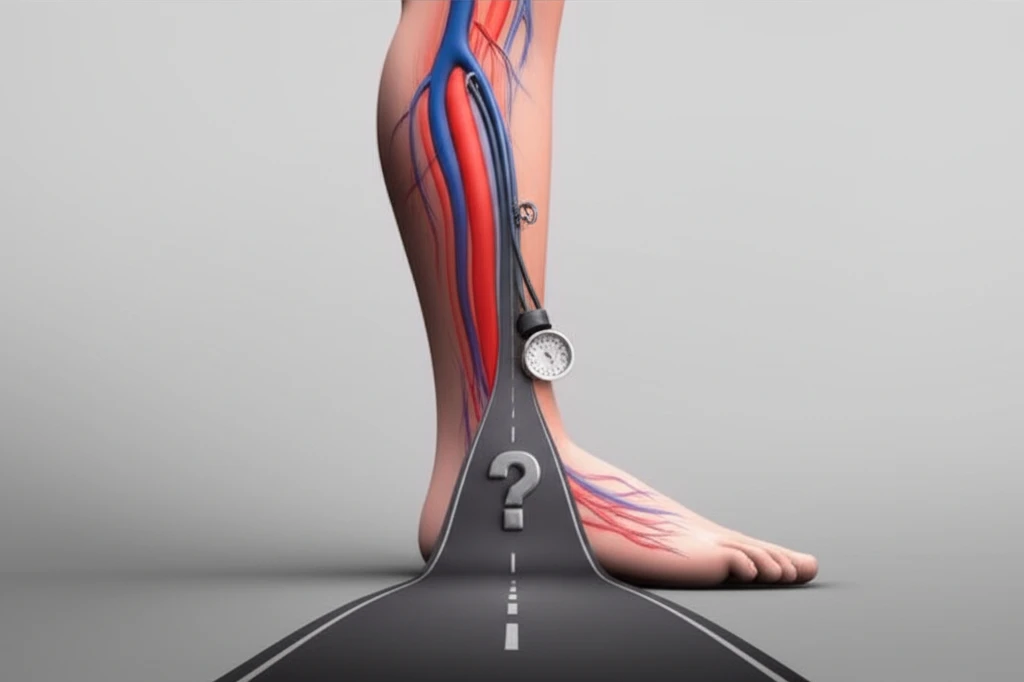
Peripheral Artery Disease: Are You Getting Accurate Ankle Brachial Index Results?

"New research reveals how factors like diabetes and smoking can skew ABI readings, leading to potential misdiagnoses."
The ankle brachial index (ABI) is a common, non-invasive test used to diagnose peripheral artery disease (PAD). PAD affects millions worldwide, particularly older adults. The ABI test measures the blood pressure in your ankles and compares it to the blood pressure in your arms. This comparison helps doctors determine if there is any blockage in the arteries of your legs.
While the ABI test is generally reliable, recent studies have uncovered that the results can vary depending on individual patient characteristics. This variability, known as the 'spectrum effect' and 'spectrum bias,' means that certain factors, such as diabetes, smoking, and age, can influence the accuracy of the ABI test. This can lead to both false positive and false negative results, potentially affecting treatment decisions.
Understanding these nuances is crucial for anyone at risk of PAD, as well as for healthcare providers who use the ABI test. By being aware of the factors that can skew results, patients and doctors can work together to ensure more accurate diagnoses and appropriate care.
Global Burden and Clinical Impact
Peripheral artery disease affects approximately 236 million people worldwide, according to a January 2026 report in The New England Journal of Medicine. That report identifies an ankle-brachial index below 0.90 as diagnostic of PAD. The U.S. Preventive Services Task Force notes that PAD is associated with cardiovascular events and poor ambulatory function, even when patients have no symptoms.
How ABI Is Measured and Where It Can Fail
The ABI is a noninvasive screening tool that compares ankle and arm pressures; because ankle pressures are normally equal to or higher than ipsilateral arm pressures, a ratio of 1.0 or greater is considered normal. A 2024 study found that seated and seated-adjusted ABI measurements were inferior to supine ABI for PAD screening in a mobile outreach clinic, making supine measurement more accurate in that setting. Resting ABI can also underestimate PAD severity when vessels are noncompressible, particularly in patients with diabetes or chronic kidney disease.
From Diagnostic Ratio to Risk Marker
The ankle-brachial index is the ratio of systolic blood pressure measured at the ankle to systolic pressure measured at the brachial artery. The index was originally described by Winsor in 1950 and proposed as a noninvasive method for diagnosing lower-extremity PAD. Later findings established ABI as an indicator of atherosclerosis at other vascular sites and as a prognostic marker for adverse cardiovascular events.
Understanding the Spectrum Effect and Spectrum Bias in ABI Testing
The 'spectrum effect' refers to the way the ABI test's sensitivity and specificity (its ability to correctly identify those with and without PAD) changes across different patient groups. For example, an ABI test might be very accurate in one group of people but less so in another. The 'spectrum bias' takes this a step further. It means that these variations can significantly alter the post-test probabilities, leading to misinterpretations of the results.
- Sensitivity and Specificity Variations: The study found that sensitivity (the ability to correctly identify PAD) ranged from 61.5% to 90.9% depending on the subgroup. Specificity (the ability to correctly identify those without PAD) varied from 81.8% to 99.1%.
- Factors Influencing Results: Logistic regression analysis confirmed that factors such as the setting (primary care vs. vascular service), diabetes, smoking status, and age significantly impacted the ABI test results.
- Impact on Positive and Negative Results: Positive ABI tests were less reliable in patients with diabetes, smokers, and those over 75 years old, leading to a higher rate of false positives. Negative ABI tests were less reliable in primary care patients, non-diabetics, and smokers, potentially leading to false negatives.
Evidence on Oscillometric ABI Accuracy
A systematic review and meta-analysis examined the accuracy of oscillometric ankle-brachial index measurement for diagnosing lower-limb peripheral arterial disease. The cited record identifies the work as an article by Herraiz-Adillo and colleagues, published in 2017 in the International Journal of Clinical Practice. This evidence addresses whether oscillometric ABI can accurately identify lower-extremity PAD.
Why ABI Cannot Replace Clinical Judgment
Guidelines are intended to address the needs of most patients and should not replace clinical judgment. A large, single-center study highlighted limitations of resting ABI for diagnosing symptomatic PAD, particularly in people with diabetes mellitus or chronic kidney disease. These limitations show why a normal or inconclusive resting ABI may not fully resolve the clinical question in higher-risk patients.
Higher- versus Lower-Pressure ABI Calculations
The conventional ABI method uses the higher of the two ankle systolic pressures divided by the higher brachial pressure. An alternative method uses the lower ankle pressure, known as the LABI method, rather than the higher ankle pressure used in the HABI method. Research has evaluated whether this alternative calculation improves identification of PAD or prediction of mortality risk compared with traditional methods.
What This Means for You
If you're at risk for PAD, it's essential to discuss these findings with your doctor. Ask how your individual factors might influence the accuracy of an ABI test. This might involve additional testing or a more comprehensive evaluation of your vascular health. Remember, accurate diagnosis is the first step toward effective management and prevention of PAD-related complications. Keep the conversation open, and work with your healthcare team to ensure you're receiving the best possible care.
ABI Evidence and Screening Decisions
The resting ABI is the most commonly used screening and diagnostic test for PAD, according to the evidence review prepared for the U.S. Preventive Services Task Force. A separate systematic review summarized published evidence on ABI diagnostic accuracy as well as the benefits and harms of treatment. Together, these reviews frame ABI as a useful test whose role must be considered alongside the evidence about screening and subsequent care.
Reliable Measurement and Wider Use
A 2024 review concluded that, when used correctly, ABI remains a reliable indicator of lower-limb perfusion and a useful tool for predicting future cardiovascular events. The same review identified underutilization of ABI in clinical settings as a concern. More recent commentary describes the relationship between abnormal ABI and increased mortality as well established, reinforcing the importance of accurate measurement and appropriate follow-up.
PAD as a Systemic Vascular Warning
Peripheral artery disease is described as a prevalent and underdiagnosed atherosclerotic condition affecting over 10 million adults in the United States. It is also characterized as a marker of systemic vascular disease and a strong predictor of myocardial infarction, stroke, and mortality. Beyond cardiovascular risk, PAD is associated with mobility disability, claudication, lower-extremity amputation, and substantial reductions in quality of life.