
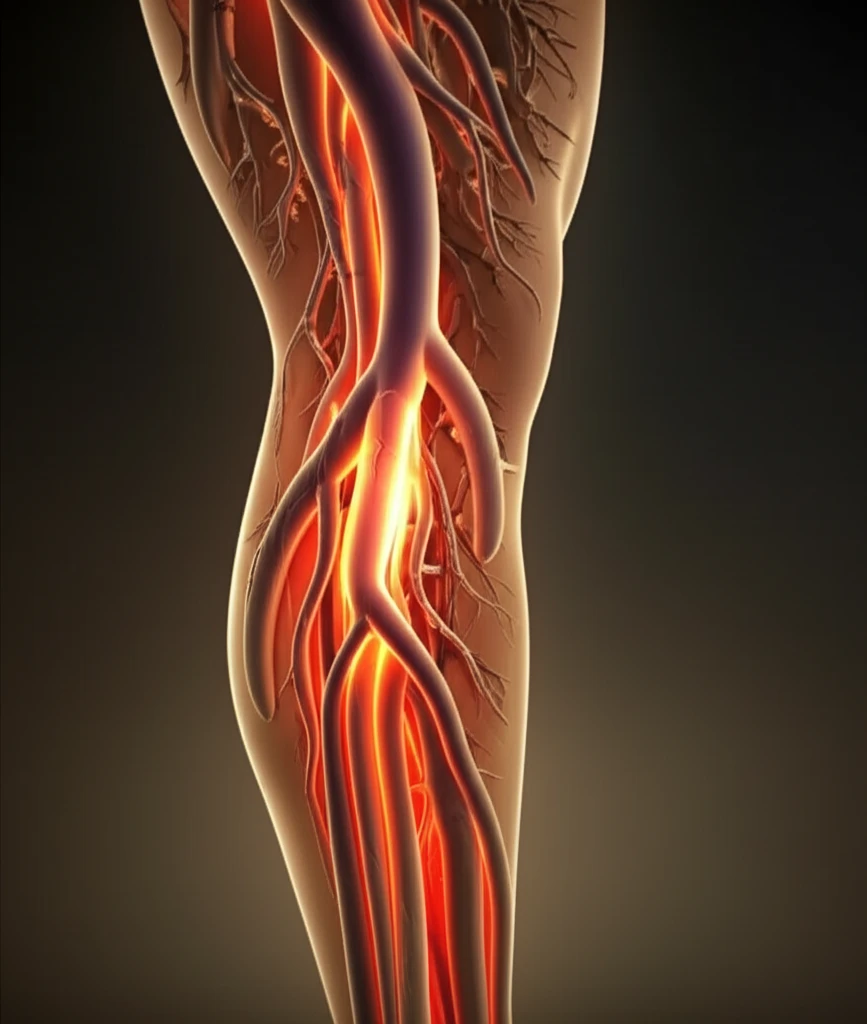
Bovine Carotid Artery Graft: A Promising Solution for Leg Bypass?

"Exploring the Long-Term Success of Artegraft in Lower Extremity Revascularization"
For years, biological grafts have played a vital role as vascular conduits in leg bypass surgeries. However, information specifically on bovine carotid artery grafts (BCAG) in lower extremity revascularization has been limited. This article explores the outcomes of lower leg bypass procedures using BCAG, offering insights into its effectiveness and long-term results.
This analysis is based on a retrospective review of a prospectively collected database, examining patients who underwent lower extremity bypass using BCAG from 2002 to 2017. The study focused on clinical outcomes, including graft patency (how long the graft stays open and functional) and limb salvage rates.
A total of 124 BCAG (Artegraft, North Brunswick, NJ) were implanted in 120 patients for lower extremity revascularization. The surgical indications varied, including disabling claudication (12%), rest pain (36%), tissue loss (48%), and infected prosthetic graft replacement (3%). In a significant number of cases (72%), the patient's own saphenous vein was either inadequate or absent, making BCAG a crucial alternative.
BCAG Case Series
Reports of bovine carotid artery grafts (BCAGs) in lower-extremity revascularization have been scarce, although biological grafts have been used as vascular conduits for leg bypass for many years. A retrospective analysis of a prospectively collected database examined 124 Artegraft BCAGs implanted in 120 patients between 2002 and 2017. Indications included disabling claudication in 12% of cases, rest pain in 36%, tissue loss in 48%, and infected prosthetic-graft replacement in 3%.
Established Bypass Options
Lower-extremity bypass generally relies on selecting an appropriate vascular conduit and connecting it around an obstructed arterial segment. The available source material does not identify a single accepted standard method or provide comparative figures for its limitations. Accordingly, the relative advantages and disadvantages of conventional approaches cannot be established from the supplied evidence alone.
Landmarks in Bypass Surgery
A 2024 review, titled “Lower Extremity Bypass for Occlusive Disease: A Brief History,” examined the development of modern lower-extremity bypass surgery. Its reported focus was the identification of critical conceptual, technological, and technical landmarks. The supplied summary does not specify those landmarks individually, so their sequence and clinical effects cannot be described reliably here.
Why Choose BCAG for Lower Extremity Bypass?
BCAG was used in 46 patients (37%) who had a prior failed ipsilateral leg bypass. The distal anastomosis, where the graft connects to the artery, was performed in different locations: above-knee popliteal artery (25%), below-knee popliteal artery (26%), and tibial artery (39%). Notably, a distal anastomotic patch was created in all tibial artery cases to allow for BCAG-tibial reconstruction.
- Compliant.
- Thromboresistant.
- Durable.
- Easy to handle with surgical manipulation and suturing.
Evidence Still Developing
The supplied source material does not include a specific recent research study or review for this subsection. It therefore does not establish current efficacy, durability, or safety conclusions for bovine carotid artery grafts. Any assessment of the latest evidence would require additional identified research sources.
Unresolved Limitations
The supplied source material does not identify specific failure rates, complications, or counterarguments concerning bovine carotid artery grafts. It consequently cannot support a quantified discussion of graft failure or comparative risk. These issues should be addressed only with studies that report relevant adverse outcomes.
Comparing Conduits
Research has compared autologous vein (AV) with bovine carotid artery graft (BCAG) in traumatic arterial injuries requiring bypass or interposition graft. A separate 2024 study analyzed alternative conduits for infrapopliteal bypass in patients with chronic limb-threatening ischemia. The supplied summaries identify these comparative questions but do not provide outcome figures, so they do not establish that AV or BCAG is superior.
The Future of BCAG in Vascular Surgery
BCAG emerges as a reliable vascular conduit, offering good long-term results in lower extremity bypass procedures. This is particularly significant for patients lacking suitable autologous vein grafts.
Evidence and Clinical Context
A 2025 systematic review and meta-analysis was designed to compare bypass surgery with endovascular interventions for peripheral artery disease using randomized controlled trials. Separately, the BCAG study addressed lower-leg bypass and noted that reports of BCAG use in lower-extremity revascularization had been scarce. Together, these sources frame BCAG within a broader debate about revascularization strategies, but the supplied summaries do not establish a definitive treatment preference.
Questions for Future Study
The supplied source material does not provide a specific forecast or research program for the future of bovine carotid artery grafts. Important future conclusions therefore cannot be assigned to a named study, date, or projected figure from the available evidence. Further work would need to define which clinical outcomes and comparisons should guide adoption.
Limited Published Experience
The available source describes biological grafts as established vascular conduits for leg bypass while emphasizing that reports of BCAG use in lower-extremity revascularization have been scarce. This limited reporting is an important context for interpreting claims about the graft's broader role. The supplied material does not identify specific access, cost, regulatory, or health-system barriers.
Patients Represented in the Series
The reported BCAG experience involved 124 Artegraft grafts implanted in 120 patients for lower-extremity revascularization. The clinical indications included disabling claudication, rest pain, tissue loss, and infected prosthetic-graft replacement, showing that the series included patients with varied and serious limb-related needs. The supplied summary does not provide individual patient narratives or enough outcome detail to characterize personal long-term experiences.
BCAG offers several advantages. Biological grafts are associated with a lower risk of infection and enhanced graft anastomotic compliance due to their vessel elasticity, while BCAG's structural elasticity and ease of handling during suturing contribute to its appeal among surgeons.
While this study provides valuable insights, further prospective research is needed to compare BCAG with autogenous vein grafts directly. This will help refine our understanding of BCAG's role in lower extremity revascularization and optimize patient outcomes.