
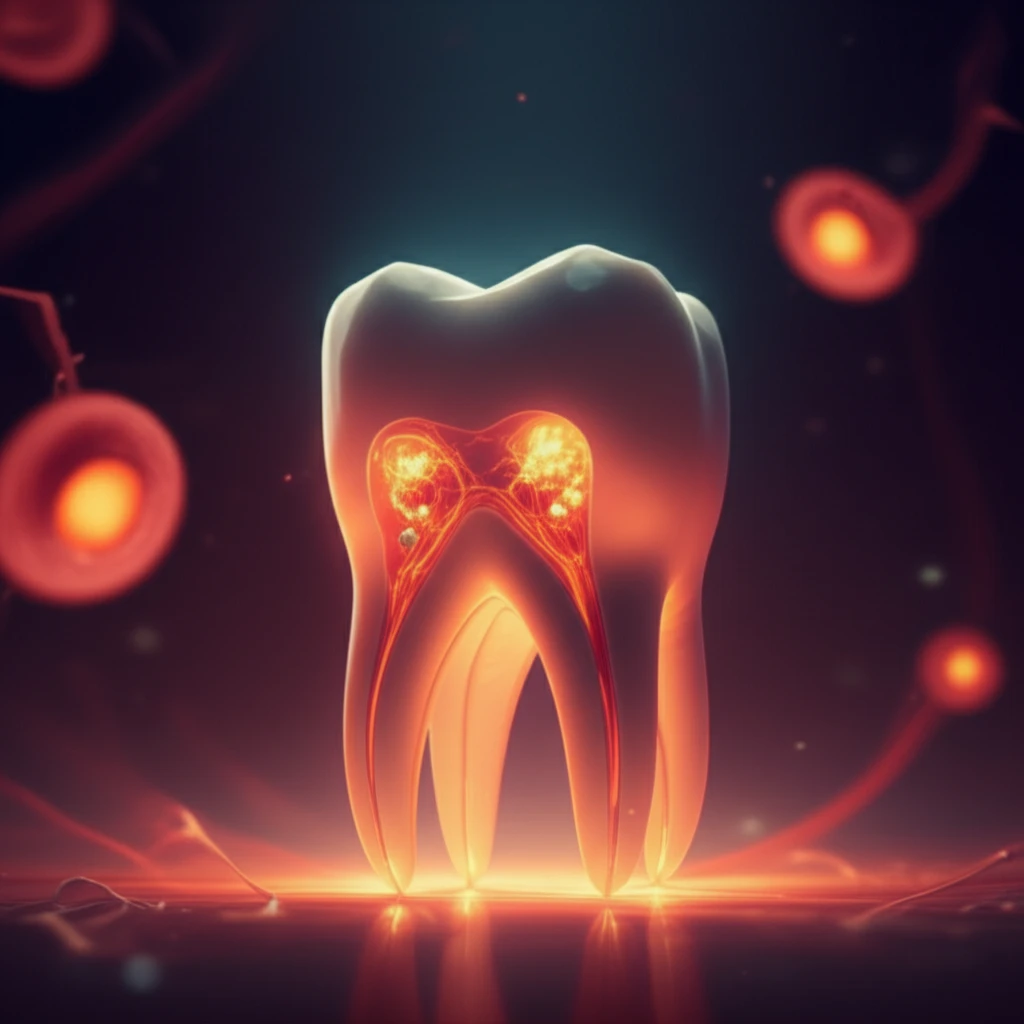
Infrared light stimulating stem cells within a tooth, promoting regeneration.

Shedding Light on Healing: Can Infrared LEDs Revolutionize Dental Treatments?

"Explore how low-level light therapy with infrared LEDs could enhance dental pulp regeneration and improve treatment outcomes."


Traditional dental procedures, while effective, can sometimes inadvertently harm the delicate pulp-dentin complex within our teeth. Moreover, some materials used in dental treatments may have cytotoxic effects, hindering the natural healing process. To counter these challenges, researchers are exploring innovative techniques to minimize pulp damage and accelerate tissue repair.

One promising avenue is phototherapy, which uses light to stimulate tissues and cells. Low-level light therapy (LLLT), employing lasers or light-emitting diodes (LEDs), has garnered attention for its potential to promote tissue regeneration and modulate cellular activity in various dental applications. This includes stimulating tertiary dentin formation, enhancing cell viability and modulating inflammation.

This article delves into a study investigating the effects of infrared LED irradiation on stem cells derived from human exfoliated deciduous teeth (SHEDs). By examining different energy densities, the research aims to determine the optimal parameters for stimulating cell viability, proliferation, and mineralized tissue production, ultimately paving the way for enhanced pulp regeneration strategies.

Infrared LED: A Beacon of Hope for Pulp Regeneration?

Infrared light stimulating stem cells within a tooth, promoting regeneration.

The study focused on understanding how different energy densities of infrared LED light affect stem cells from human exfoliated deciduous teeth (SHEDs). These stem cells are crucial for tissue regeneration and repair within the dental pulp. The researchers exposed SHEDs to varying energy densities of infrared LED light and then assessed cell viability, proliferation, and the formation of mineralized nodules – a key indicator of tissue regeneration.

The results indicated that infrared LED irradiation can indeed enhance cell viability, proliferation, and mineralized nodule formation in SHEDs. Specifically, certain energy densities showed more promising outcomes:

  • Cell Viability: A specific energy density of 4 J/cm² significantly increased cell metabolism after 72 hours, suggesting enhanced cellular activity.
  • Cell Proliferation: All energy densities tested led to increased cell proliferation after 12 hours, with 4 J/cm² showing the most significant boost.
  • Mineralized Nodule Formation: Energy densities of 8 and 15 J/cm² yielded the best results in promoting mineralized nodule formation after 72 hours, indicating enhanced tissue regeneration potential.
These findings suggest that infrared LED irradiation can positively influence the behavior of pulp cells, making it a potential tool for promoting pulp healing and regeneration.

Illuminating the Future of Dental Healing

This research provides compelling evidence for the potential of infrared LED therapy to stimulate stem cells and promote tissue regeneration within the dental pulp. By carefully controlling the energy density of the light, it may be possible to optimize cell viability, proliferation, and mineralized tissue formation, ultimately leading to improved pulp healing outcomes.

While these findings are promising, further research is needed to fully understand the long-term effects of infrared LED therapy on pulp regeneration. Future studies could explore different wavelengths, irradiation times, and treatment protocols to refine the technique and maximize its therapeutic benefits. Additionally, in vivo studies are necessary to validate these findings in a clinical setting.

As the field of phototherapy continues to advance, infrared LED therapy holds immense potential to revolutionize dental treatments, offering a minimally invasive and effective approach to promoting pulp healing and preserving the natural tooth structure. With further research and development, this innovative technique may soon become a valuable tool in the arsenal of dental professionals.

About this Article -

This article was crafted using a human-AI hybrid and collaborative approach. AI assisted our team with initial drafting, research insights, identifying key questions, and image generation. Our human editors guided topic selection, defined the angle, structured the content, ensured factual accuracy and relevance, refined the tone, and conducted thorough editing to deliver helpful, high-quality information.See our About page for more information.

This article is based on research published under:

DOI-LINK: 10.1590/0103-6440201300148, Alternate LINK

Title: Dose-Responses Of Stem Cells From Human Exfoliated Teeth To Infrared Led Irradiation

Subject: General Dentistry

Journal: Brazilian Dental Journal

Publisher: FapUNIFESP (SciELO)

Authors: Ana Paula Silveira Turrioni, Liege Aldrovandi Montoro, Fernanda Gonçalves Basso, Leopoldina De Fátima Dantas De Almeida, Carlos Alberto De Souza Costa, Josimeri Hebling

Published: 2015-08-01

Everything You Need To Know

1

What is low-level light therapy (LLLT) and why is it being explored in dental treatments?

Low-level light therapy (LLLT) uses light, such as that emitted by light-emitting diodes (LEDs), to stimulate tissues and cells. It has shown promise in promoting tissue regeneration and modulating cellular activity. In the context of dental treatments, LLLT using infrared LEDs is being explored for its potential to enhance dental pulp regeneration and improve healing outcomes, potentially minimizing damage to the pulp-dentin complex during procedures and counteracting the cytotoxic effects of some dental materials.

2

What are infrared LEDs being used for in this dental research?

Infrared LEDs are used in this research to stimulate stem cells from human exfoliated deciduous teeth (SHEDs). The study investigates how different energy densities of infrared LED light affect these cells. These SHEDs are crucial for tissue regeneration and repair within the dental pulp. The goal is to find optimal parameters for cell viability, proliferation, and mineralized tissue production, which can enhance pulp regeneration strategies.

3

How are the energy densities of infrared LED light measured, and what did the study find?

The energy densities of infrared LED light are measured in J/cm². The study examined how varying these energy densities impact SHEDs. The research found that specific energy densities of infrared LED light significantly increased cell metabolism and mineralized nodule formation in SHEDs. For example, an energy density of 4 J/cm² boosted cell metabolism after 72 hours. Energy densities of 8 and 15 J/cm² yielded the best results in promoting mineralized nodule formation after 72 hours, indicating enhanced tissue regeneration potential.

4

What is the significance of infrared LED irradiation on pulp cells?

The study's findings suggest that infrared LED irradiation can positively influence the behavior of pulp cells, making it a potential tool for promoting pulp healing and regeneration. The research showed that infrared LED irradiation can enhance cell viability, proliferation, and mineralized nodule formation in SHEDs. This is significant because improved pulp healing can lead to better outcomes for dental procedures, potentially reducing the need for more invasive treatments like root canals.

5

Why is this research on infrared LEDs important for the future of dental treatments?

This research is significant because it provides evidence for the potential of infrared LED therapy to stimulate stem cells and promote tissue regeneration within the dental pulp. By carefully controlling the energy density of the light, it may be possible to optimize cell viability, proliferation, and mineralized tissue formation, ultimately leading to improved pulp healing outcomes and new approaches to dental tissue regeneration.

Newsletter Subscribe

Subscribe to get the latest articles and insights directly in your inbox.