
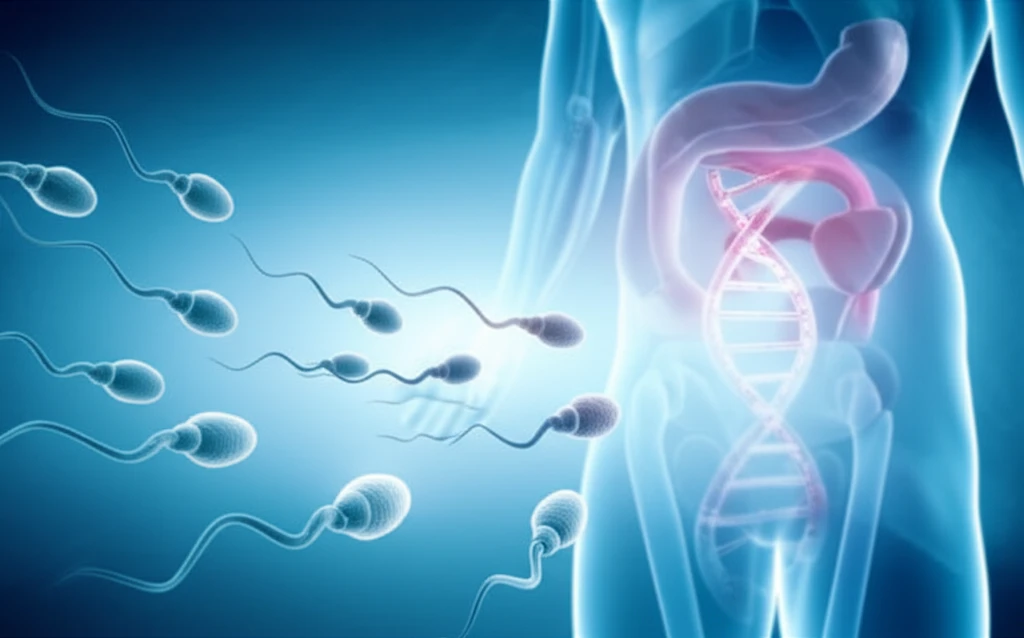
Decoding Male Infertility: Can Stem Cells Pave the Way for Personalized Treatments?

"Scientists are one step closer to understanding male reproductive health, with a new cell model that mimics early Sertoli cells."
Infertility affects millions worldwide, and for men, disorders of sex development (DSD) often play a significant role. Central to male fertility are Sertoli cells, which support sperm production. However, studying these cells has been challenging because mature Sertoli cells don't thrive in lab cultures, and existing cell models have limitations.
Now, researchers are harnessing the power of induced pluripotent stem cells (iPSCs) to create a new Sertoli cell model. iPSCs are derived from adult cells and reprogrammed to an embryonic-like state, capable of developing into any cell type in the body. This approach offers a promising avenue for understanding Sertoli cell development and function, and for developing personalized treatments for male infertility.
This article explores the development and characterization of this novel Sertoli cell model, its potential applications in understanding DSD, and the promise of personalized medicine in male reproductive health.
SCOS and Its Impact
A 2026 review describes Sertoli cell-only syndrome (SCOS), also called Del Castillo syndrome, as the most severe histological phenotype of male infertility: seminiferous tubules contain Sertoli cells but lack germ cells. The review reports that SCOS affects 26.3% to 57.8% of men with azoospermia. Sertoli cells also help determine the number of Leydig cells and spermatogonial stem-cell niches in mammalian testes, and a reduction in Sertoli-cell number or proliferation can reduce germ- and Leydig-cell numbers, with consequences for fertility and health.
From Description to Molecular Research
Enrico Sertoli first identified Sertoli cells in the adult testis in the mid-nineteenth century. A 2018 review marked 50 years of spermatogenesis research focused on Sertoli cells and their interactions with germ cells, following the 150th anniversary of their original description. Over those five decades, research moved beyond morphology toward molecular questions, with investigators seeking to understand Sertoli-cell roles in spermatogenesis and apply that knowledge to male fertility.
How are Sertoli-like Cells Made from Stem Cells?
The researchers started with human fibroblasts (HFs), common connective tissue cells, and reprogrammed them into iPSCs using a cocktail of reprogramming factors. This process effectively turns back the clock, reverting the specialized fibroblasts into versatile cells with the potential to become any cell type.
- Embryoid Body Formation: iPSCs were cultured in special conditions to form three-dimensional aggregates called embryoid bodies (EBs).
- Mesoderm Commitment: The EBs were treated with bone morphogenetic protein 4 (BMP4) and basic fibroblast growth factor (bFGF) to induce the formation of mesoderm, a germ layer that gives rise to reproductive organs.
- Differentiation into SLCs: The mesoderm-committed EBs were further cultured with fibroblast growth factor 9 (FGF9), prostaglandin D2 (PGD2), and activin A, which are known to promote Sertoli cell development.
Building Human Gonadal-Niche Models
A review titled “Building a human pluripotent stem cell-based gonadal niche: improving in vitro systems with in vivo insights” examines efforts to improve laboratory models of the human gonadal niche. Its cited work includes studies by Lan et al. (2013), Kjartansdóttir et al. (2015), Liu et al. (2016), Sepponen et al. (2017), Rodríguez Gutiérrez et al. (2018), Knarston et al. (2020), Hart et al. (2022), Pryzhkova et al. (2022), and Gonen et al. (2023). The review snippet also notes that some studies used transcription-factor overexpression approaches.
Limits of Existing Sertoli-Cell Models
Mature primary Sertoli cells cannot proliferate in prolonged in-vitro culture, while available Sertoli-cell models have limitations because they derive from mouse or human cancer tissues. Commercially available human Sertoli cells may support models of healthy adult cells, but they cannot mimic the developing gonad or identify mechanisms behind developmental disorders such as differences of sex development (DSDs). A further complication is that some testes classified as Sertoli cell-only contain small patches of active spermatogenesis and spermatogonial stem cells, so the apparent absence of spermatogenic cells may not describe every tubule.
Cellular Crosstalk and Emerging Approaches
A 2020 review evaluates how peptides facilitate crosstalk between Sertoli cells and germ cells to support spermatogenesis and fertility. A 2024 review instead focuses on embryonic Sertoli-cell genesis and its key regulators, connecting that work to sex determination in male mammals and the molecular differentiation of Sertoli cells in the male reproductive ridge. A 2026 report describes messenger RNA delivery into Sertoli cells as a potential fertility-restoration approach, while noting that common assisted-reproduction methods depend on haploid germ cells and that gene therapy faces concerns about germline transmission.
The Future of Fertility Treatment: Patient-Specific Solutions
This new Sertoli cell model represents a significant step forward in understanding male infertility and DSD. By creating SLCs from patient-derived iPSCs, researchers can now study the specific genetic and functional characteristics of Sertoli cells in individual cases.
A Changing Picture of Sertoli-Like Cells
A 2026 multi-omic analysis reports that a subset of testicular interstitial cells in androgen-deprivation-therapy-treated testes began expressing the Sertoli-cell marker WT1 and acquired a Sertoli-like transcriptomic state. This finding describes a cell-state change observed in that treatment context; the supplied report does not establish that these cells restore fertility. A separate 2026 bibliometric study frames Sertoli-cell research as relevant to understanding spermatogenesis and male infertility, while a 2025 review excerpt links metabolic influences on Sertoli cells and the blood-testis barrier to infertility.
Research Priorities
A 2026 bibliometric analysis of Sertoli-cell research identifies current emphasis on molecular mechanisms, environmental impacts, and therapeutic applications. It recommends interdisciplinary approaches, translational studies on male infertility, and investigation of environmental stressors affecting Sertoli-cell function. The study presents these as priorities for future research aimed at addressing declining male fertility worldwide.
Exploring Cell Therapy for Testicular Injury
A 2024 study describes inflammation-induced testicular damage as a contributor to infertility and notes that traditional treatments during the inflammatory phase often fail to achieve desired fertility outcomes. The researchers explored the in-vivo properties of intravenously administered Sertoli cells as a possible cell-therapy intervention. The supplied study summary identifies the approach and its rationale but does not report a clinical fertility benefit in people.
This patient-specific approach opens the door to personalized medicine in male reproductive health. Imagine being able to identify the precise cause of Sertoli cell dysfunction in a patient and then tailor treatments to address the specific issue.
While further research is needed, this novel cell model holds great promise for improving the diagnosis and treatment of male infertility, and for unraveling the complexities of sex development.