
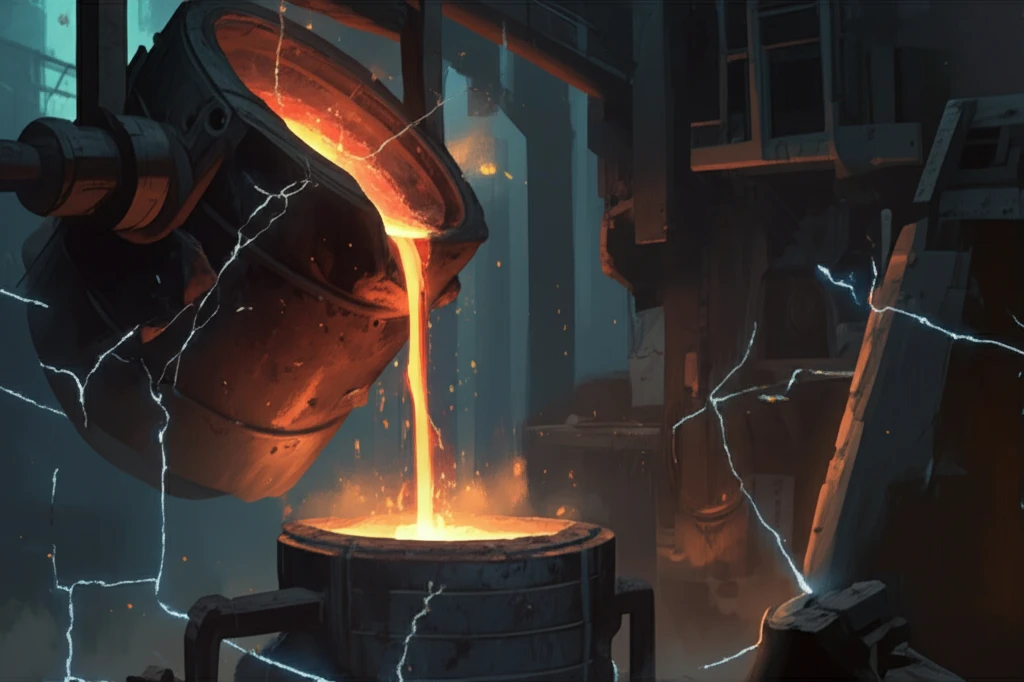
Revolutionizing Steelmaking: The Electroslag Remelting Breakthrough You Need to Know

"How a New Current Conductive Stationary Mold Technology is Poised to Transform Material Quality and Manufacturing Processes"
In the relentless pursuit of higher-performance materials, industries are constantly seeking innovative methods to refine their production processes. Electroslag remelting (ESR) has long been a cornerstone of high-quality alloy production, prized for its ability to enhance purity, compactness, and uniformity. However, traditional ESR methods have limitations, particularly in balancing surface quality with internal integrity.
Enter a groundbreaking advancement: Electroslag Remelting with Current Conductive Stationary Mold (ESR-CCSM). This technology represents a significant leap forward, promising to address the shortcomings of conventional ESR by optimizing current flow and thermal distribution during the solidification process. The implications are far-reaching, potentially impacting industries from aerospace to automotive, where material performance is paramount.
This article will explore the principles behind ESR-CCSM, how it differs from traditional ESR, and the potential benefits it offers. Join us as we delve into the science and engineering that could reshape the future of material production.
A Multi-Billion-Dollar Market in the Making
Electroslag remelting (ESR) is the industrial route to high-purity alloys, remelting metals to remove impurities and enhance both the purity and structural integrity of the final product. The commercial scale of this technology is substantial: one market research report values the electroslag remelting furnace market at $1.8 billion in 2025, with projections reaching $3.1 billion by 2034 at a 6.2% CAGR. That trajectory implies sustained demand for equipment and technologies designed to produce high-quality alloys for demanding applications. Market analyses describe the ESR equipment space as encompassing the remelting technologies behind these refined metals, underscoring the process's widening industrial footprint.
How ESR Works — and Where It Still Struggles
At its core, ESR is a secondary refining process in which a consumable electrode is remelted through a molten slag into a water-cooled copper mold, transforming it into an ultra-pure ingot. Because the approach targets the inclusion problem at its root, it enables alloys to perform closer to their theoretical limits. In practice, quality depends heavily on process control, and producers optimize slag selection, arcing methods, and remelting parameters — often through furnace upgrades such as those documented on a 15-ton ESR unit — to manage ingot surface quality. Yet the method has limits: a control-method study for 9Ni steel ingots above 30 tons reports that non-metallic inclusions in existing ingots do not consistently meet standards, requiring an electroslag remelting production route plus additional measures to bring inclusion levels into compliance.
From a 1960s Idea to a Global Standard
The physics behind electroslag remelting is straightforward: current passing through slag generates resistance heat, which serves as the heat source for smelting, purifying the metal and yielding ingots with a uniform, dense crystalline structure. The process took a decisive step forward in the 1960s, when Consarc's engineers conceived a new approach to electroslag remelting quite different from others in use at the time. That innovation helped ESR, alongside vacuum arc remelting, become a widely employed technique for producing defect-free ingots in ferroalloys, nonferrous metals, and superalloys. A dedicated volume on electroslag remelting toward clean steel production documents how oxygen, sulfur, and non-metallic inclusion evolution have been studied and controlled, framing a decades-long refinement agenda that continues today.
The Science Behind ESR-CCSM: A New Approach to Current Control
Traditional ESR relies on a specific current flow path: power → consumable electrode → slag → metal pool → solidified ingot → water-cooled baseplate → power. While effective, this method can sometimes lead to inconsistencies in temperature distribution and metal pool depth, affecting the final product's quality. ESR-CCSM reimagines this flow by directly linking the current to the mold. This innovation allows for more precise control over heat generation and distribution within the system.
- Enhanced Temperature Uniformity: More consistent heating reduces the risk of localized defects.
- Shallower Metal Pool: Promotes directional solidification and reduces segregation.
- Improved Surface Quality: Controlled cooling minimizes surface imperfections.
- Optimized Crystallization: Encourages the formation of desirable grain structures for enhanced mechanical properties.
The Push Toward Predictive Control
Recent research has moved ESR from trial-and-error toward predictive engineering, with a review of modeling and simulation work framing the process as an advanced technology for producing high-quality materials such as hot work tool steels and nickel-base alloys. Simulation studies now treat the process as a coupled system of interacting physical fields — electromagnetic, flow, temperature, and concentration — because no single field can be understood in isolation. On the chemistry side, researchers are reviewing methodologies for controlling reactive alloying elements, since effectively managing their loss during remelting is essential to controlling their content in ESR ingots. Together these efforts aim to close the gap between laboratory understanding and industrial reproducibility.
Where ESR Hits Its Limits
ESR is not a cure-all, and even its proponents concede where it falls short. Studies of the very-high-cycle fatigue response of AISI H13 steel show that material cleanliness plays a major role, and while refinement processes such as ESR can significantly enhance performance, residual cleanliness issues can still limit the benefit remelting delivers. For alloying that requires nitrogen, conventional ESR cannot reach the needed concentrations — a pressurized electroslag remelting process using silicon nitride (Si3N4) as a nitrogen source was developed specifically to achieve nitrogen percentages beyond the solubility limit. There are also commercial frictions: market analyses point to pricing intelligence gaps, where a lack of transparent pricing data complicates cost benchmarking and risks overinvestment or underpricing among stakeholders.
Why ESR Competes — and How It Gets Cheaper
Against other remelting equipment, the electroslag remelting furnace's main advantages trace back to its operating principle: heat generated by electric current passing through high-resistance molten slag melts the metal, a configuration that lends itself to efficient refining. This specialized equipment is credited with producing high-quality ingots that deliver superior mechanical properties, which is why it remains a fixture in premium alloy production. Producers also keep finding ways to improve its economics — rotating the electrode during ESR has been reported to reduce production costs, with productivity rising about 25 percent thanks to improved hydrodynamic conditions. Those gains matter in demanding services, where ESR has been studied as an alternative to other methods of increasing the service life of parts operating under hydrogen-sulfide corrosion conditions.
The Future of Steelmaking: ESR-CCSM and Beyond
Electroslag Remelting with Current Conductive Stationary Mold represents more than just an incremental improvement; it signals a paradigm shift in how we approach material production. As industries increasingly demand higher-performance alloys with greater consistency and fewer defects, technologies like ESR-CCSM will become indispensable. By embracing these innovations, manufacturers can unlock new levels of material quality, efficiency, and sustainability, paving the way for a future where the possibilities of material science are limited only by our imagination.
Cleaner Is a Process, Not a Given
Expert accounts converge on one lesson: ESR delivers purity only when the process itself is deliberately engineered. In trials on 1.2083 mold steel, one process variant (Process B) produced electroslag ingots with lower oxygen content and better inclusion control than the baseline (Process A), and a further variant (Process C) reduced oxygen still more, with rolled-product inclusion ratings ultimately meeting product requirements. The implication is that slag chemistry and process design — not the furnace alone — determine cleanliness. Critical observers add a caveat about the whole supply chain: the consumable electrodes fed to VAR and ESR furnaces are commonly produced by vacuum induction melting (VIM), which still relies on the regrettably primitive technique of simply pouring molten metal into an open mold. That upstream weakness, they argue, limits how much benefit downstream refining can ultimately deliver.
Growth, Digitization, and Growing Pains
The near-term outlook for electroslag remelting is one of sustained global growth, driven by innovation, digitization, and rising participation from emerging economies. That expansion is not frictionless: supply chain bottlenecks loom, and the availability of critical raw materials such as high-quality scrap metal and alloys is a known constraint on the remelting process. On the technical front, research continues on developing ESR technology for specific grades — for example, Steel Grade 45 — with attention to microstructure, non-metallic inclusions, and mechanical properties. The combination of market tailwinds and technical maturation suggests the process will keep evolving rather than plateauing.
A Keystone of the Specialty-Steel Supply Chain
More broadly, electroslag remelting sits at the intersection of several systemic pressures affecting the specialty-metals industry as a whole. The process is energy-intensive and depends on a tightly managed chain of upstream feedstock — electrodes, fluxes, and high-grade scrap — as well as downstream certification and quality assurance. It also competes for investment and attention with alternative refining routes, so its trajectory will likely be shaped as much by economics and regulation as by metallurgy alone. Given the absence of a single authoritative overview of these systemic issues, these observations should be read as informed context rather than as settled conclusions.
From Laboratory Findings to Lighter Structures
Beyond premium tool steels, ESR research is reaching into application areas where the payoff is tangible — including lightweight steels, where the behavior of inclusions during remelting directly influences the structures that can be built. The peer-reviewed literature describes these efforts in terms of transforming research into real-world impact, with fluid flow during electroslag remelting shaping how inclusions behave in the final product. The implication is that refinements studied in the lab can translate into safer, more efficient components in service. For industries that depend on high-performance alloys, the distance between a furnace adjustment and a field-tested part is, in many cases, surprisingly short.