
Unlock the Secrets of Tribolayers: What This Microscopic World Means for the Future of Materials

"New research reveals the hidden world of tribolayers and their potential to revolutionize engineering and materials science."
Imagine a world where the lifespan of your everyday tools, machines, and even medical implants could be dramatically extended. This isn't science fiction; it's the potential unlocked by understanding tribolayers. These ultra-thin layers form on the surfaces of materials when they rub together, and they play a crucial role in determining friction, wear, and overall durability. New research is shedding light on the complex nature of tribolayers, opening doors to innovative engineering and materials science applications.
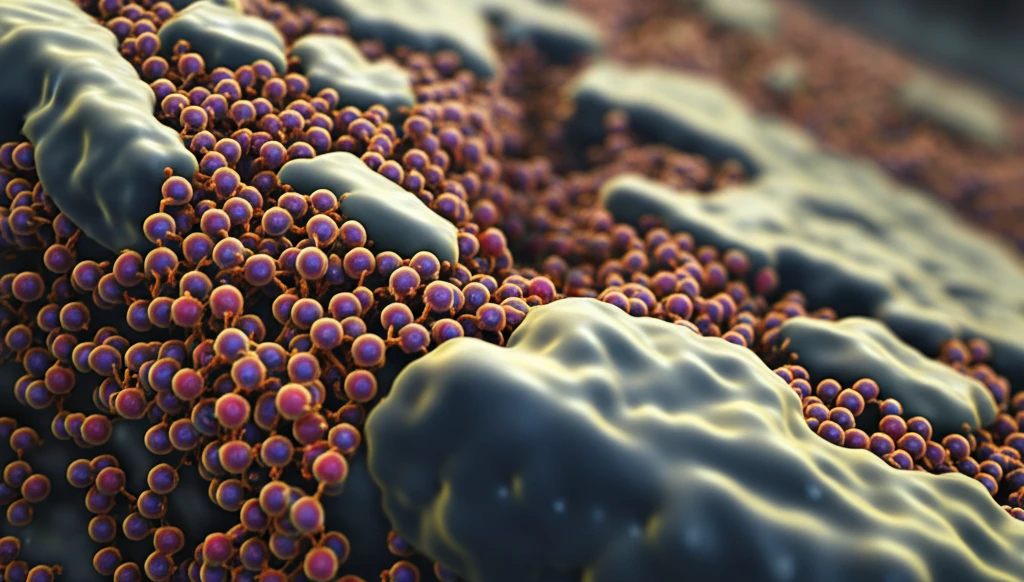
For years, scientists have studied the surfaces of materials to understand how they interact with each other. When two surfaces come into contact and slide against each other, they don’t just grind away without changing. Instead, something changes on a microscale, and that "something" is the formation of tribolayers. These layers, often just a few nanometers thick, can be vastly different in composition and structure from the underlying material. They have an outsized effect on how materials perform under stress.
Recent studies employing positron lifetime spectroscopy are revealing unprecedented details about the structure and behavior of tribolayers in various metals. This technique allows researchers to probe the atomic-level defects within these layers, providing insights into how they form and how they influence material properties. The findings are not just academically interesting; they have practical implications for industries ranging from aerospace to biomedical engineering.
The Scale and Significance of Tribology Today
Tribology—the study of friction, wear, and lubrication between moving surfaces—is a field with broad industrial and technological reach. According to Tribology International, it plays a pivotal role in technological evolution, sustainable development, and industrial transformation. The STLE describes tribology as the study of surfaces moving relative to one another, a phenomenon that affects daily life in countless ways. Tribonet further characterizes tribology as the science of interaction between moving surfaces, emphasizing its relevance to material response and operating environment in real machines.
How Tribology Is Studied and Where Methods Fall Short
Tribology research historically focuses on how surfaces interact and how friction, wear, lubrication, material response, and operating conditions influence performance. According to Tribonet, practical tribology involves examining what engineers should check when applying these concepts in real machines or laboratory tests. The field relies on understanding these interrelated factors rather than any single measurement. However, the complexity of real-world surface interactions means that laboratory findings do not always translate directly to industrial applications.
Early Foundations of the Field
The precise historical milestones of tribology are difficult to pin down with certainty from the available sources, but the discipline has long roots in engineering practice. Early work on friction and wear laid the groundwork for modern surface science. The field has evolved considerably as materials science and measurement techniques have advanced. Much of what we understand about tribological interactions today builds on decades of incremental discovery.
What Are Tribolayers and Why Do They Matter?
At its core, a tribolayer is a modified surface layer that forms during sliding contact between two materials. This layer is not merely a result of wear or damage; it’s an active participant in the tribological process (the science of friction, wear, and lubrication). The properties of the tribolayer – its composition, structure, and thickness – directly impact the friction coefficient, wear rate, and overall lifespan of the materials in contact.
- Reduced Friction: Tribolayers can create smoother surfaces, reducing the force required to slide one object over another. This is crucial in engines and machinery, where minimizing friction improves efficiency and reduces energy consumption.
- Extended Lifespan: By acting as a protective barrier, tribolayers can significantly extend the life of components subjected to wear. This is particularly important in high-stress environments like aerospace or manufacturing.
- Improved Performance: The unique properties of tribolayers can enhance the overall performance of materials in specific applications. For example, in medical implants, tribolayers can improve biocompatibility and reduce the risk of rejection.
Current Directions in Tribology Research
The specific details of the very latest tribology research findings are not covered in the available source material. The field continues to evolve, with researchers investigating new materials, coatings, and lubricant chemistries. Studies of tribolayers—thin films that form at sliding interfaces—are an active area of inquiry. However, particular recent findings and their implications remain outside the scope of the sources provided.
Challenges and Critiques in Tribological Science
Tribological research faces inherent challenges in reproducibility and real-world applicability, though specific counter arguments are not detailed in the available sources. The complexity of surface interactions means that findings can be difficult to generalize across different materials and operating conditions. Failures in tribological systems can have significant economic and environmental consequences. A deeper discussion of these critiques would require sources that address them directly.
Comparing Tribological Approaches
Without specific comparative data in the available sources, detailed comparisons between tribological approaches or materials are not possible here. Different surface treatments, lubricant formulations, and coating strategies each have distinct performance trade-offs. The field lacks a single universal framework that accounts for all tribological variables. More targeted source material would be needed to make meaningful comparisons between specific methods.
The Future of Tribolayers
The ongoing research into tribolayers is revolutionizing our understanding of material behavior. As we continue to unravel the secrets of these microscopic layers, we can expect to see even more innovative applications emerge. From self-lubricating materials to advanced coatings for medical implants, the future of tribology is bright, promising a world where materials are more durable, efficient, and sustainable. By focusing on customized designs that enhance tribological characteristics, the scope for applications is virtually endless, impacting industries worldwide.
What the Evidence Suggests
The available sources paint a picture of tribology as a mature yet evolving discipline with significant industrial relevance. Its connections to sustainability and technological progress suggest it will remain important for years to come. Expert perspectives specific to tribolayers were not captured in the provided source material. A fuller synthesis would benefit from commentary from active researchers in the field.
Where Tribology Is Headed
While the specific future directions of tribology are not detailed in the available sources, the field's connection to sustainable development and industrial transformation points toward continued growth. Advances in nanotechnology and surface engineering may open new frontiers in tribolayer design and control. However, predictions about specific future breakthroughs would require sources that address emerging research trends directly.
Tribology Within Larger Systems
Tribology intersects with broader challenges in energy efficiency, material sustainability, and industrial performance, though systemic challenges are not elaborated in the available sources. The discipline's relevance to sustainable development suggests it plays a role in addressing global resource concerns. Systemic issues such as standardization and cross-industry knowledge sharing likely remain ongoing challenges. These broader dynamics would require additional sources to explore in depth.
How Tribology Touches Everyday Life
According to the STLE, tribology affects daily life in numerous ways, though the specific human-impact dimensions are not explored in the provided sources. Friction and wear occur in everything from household appliances to transportation systems. Understanding tribolayers could lead to longer-lasting products and reduced maintenance costs. The full scope of tribology's real-world impact on people and industries warrants further exploration with dedicated source material.