
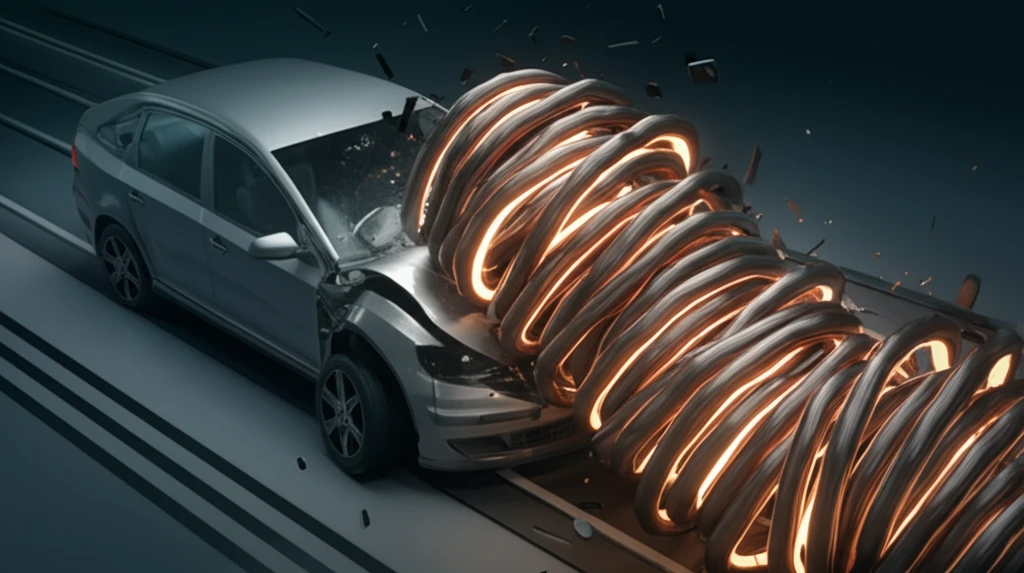
Crash Course: How Corrugated Square Tubes Are Revolutionizing Impact Absorption

"New research unveils the energy-absorbing superpowers of circumferentially corrugated square tubes, offering a safer future in transport and beyond."
In a world increasingly focused on safety and efficiency, the quest for better energy absorption technologies is never-ending. Whether it's protecting passengers in a car crash or safeguarding sensitive equipment during transit, the ability to effectively dissipate impact energy is paramount. Enter the circumferentially corrugated square tube (CCST), a novel design that's turning heads in engineering and materials science.
Traditional energy absorbers often rely on simple materials and structures, but these can be limited in their performance. Researchers have been exploring advanced geometries and materials to create more effective solutions. Thin-walled tubes, known for their excellent crashworthiness, have long been a staple in energy absorption applications. But what happens when you add corrugations and a unique profile? The results, as a recent study shows, can be quite remarkable.
A team of researchers has proposed a new take on thin-walled tubes, introducing a circumferentially corrugated square tube (CCST) with a cosine profile. This innovative design promises enhanced energy absorption capabilities, opening up new possibilities for safer vehicles, trains, and aerospace structures. Let's dive into the details of this groundbreaking research and explore how CCSTs are set to revolutionize impact protection.
Energy Absorption by the Numbers
Energy-absorbing structures fabricated from composite materials are increasingly recognized as lightweight, fuel-economical, and environmentally friendly solutions for crashworthiness applications. A broad survey of thin-walled tube research reveals that this field has expanded rapidly over the past decade, encompassing multi-cell configurations, functionally graded designs, and unconventional geometries. Recent experimental work on thermoplastic composite energy absorbers has demonstrated specific energy absorption values of up to 70 kJ/kg, indicating that composite-based solutions can deliver high crashworthiness performance relative to their mass.
Established Methods and Their Shortcomings
The force–displacement response and specific energy absorption (SEA) are widely accepted as the primary indicators for evaluating a structure's crashworthiness and its ability to protect occupants during impact. Researchers commonly manage structural geometry and material composition to control how impact energy is absorbed, aiming to balance durability and rigidity. However, traditional approaches such as variable rolled blank (VRB) and variable cross-sectional (VCS) double-hat shaped beam structures have known limitations in energy absorption capability, motivating the search for optimized and multi-objective design frameworks.
Origins of the Field
The study of how structures deform and absorb energy during collision has its roots in mid-20th-century aerospace and automotive safety research, when engineers first began systematically analyzing axial crushing of metal tubes. Over the following decades, the introduction of composite materials and advances in computational modeling transformed the field, enabling far more sophisticated analyses of crash events. While corrugated and multi-cell tubular geometries have been explored for some time, their integration into modern crashworthiness design represents a convergence of materials science, computational optimization, and bio-inspired engineering that continues to evolve.
What Makes These Corrugated Tubes So Special?
The secret to the CCST's performance lies in its unique design, which is controlled by a cosine expression. This expression incorporates several key parameters:
- The amplitude (A): This dictates the depth of the corrugations.
- The nominal side length (2Lo): This defines the overall size of the square tube.
Cutting-Edge Designs in 2025–2026
A 2026 study introduced quill-inspired bionic multi-cell tubes (QBMTs) that combine circumferential corrugations with internal bifurcated reinforcing ribs to enhance axial crashworthiness, seeking an effective balance between lightweight design, high energy absorption, and stable crushing response. Separately, researchers have proposed a novel multilevel thin-walled energy-absorbing structure whose additional energy-absorbing mechanism activates after the initial peak force, demonstrating superior performance compared to conventional single-stage structures. The latter design was analyzed using Super Folding Element (SFE) theory to derive theoretical calculations, illustrating how analytical frameworks are being paired with advanced geometries.
Open Challenges and Unresolved Questions
Despite significant progress, corrugated and multi-cell energy-absorbing structures face persistent challenges related to manufacturing complexity, cost, and scalability for mass production. The interaction between multiple design variables and crashworthiness indices is highly nonlinear, meaning that optimization for one performance metric can inadvertently degrade another. Additionally, most published results derive from axial-loading scenarios, and the performance of these geometries under oblique or off-axis impacts remains less well characterized, leaving a gap between laboratory findings and real-world crash conditions.
How Corrugated Tubes Stack Up
Corrugated square tubes occupy an interesting middle ground between simple smooth-walled tubes, which are easy to manufacture but offer limited energy absorption, and highly complex multi-cell or bio-inspired geometries, which deliver superior crashworthiness at the cost of fabrication difficulty. Studies consistently show that adding corrugations or internal ribs to a tubular cross-section increases specific energy absorption, though the magnitude of improvement depends heavily on material choice, wall thickness, and corrugation geometry. A fair comparison across designs requires standardized loading conditions and metrics, and the field is still working toward universally accepted benchmarks for evaluating heterogeneous tube architectures.
The Future of Impact Protection?
The development of CCSTs represents a significant step forward in energy absorption technology. With their superior performance and customizable design, these corrugated tubes hold immense potential for enhancing safety in a wide range of applications. As research continues and manufacturing techniques advance, we can expect to see CCSTs playing an increasingly important role in protecting lives and property.
Where the Field Stands Today
The trajectory of corrugated square tube research reflects a broader trend in crashworthiness engineering: the move from empirical trial-and-error toward computationally driven, multi-objective optimization. Bio-inspired designs such as quill-inspired multi-cell tubes suggest that nature-derived geometries can unlock performance gains that purely geometric optimization might miss. At the same time, the integration of big-data frameworks into crashworthiness design signals that the next generation of energy absorbers will be shaped as much by data science as by traditional mechanics.
Toward Greener, Smarter Energy Absorbers
A recent review highlights that the crashworthiness performance of biodegradable composites remains largely unexplored, particularly with respect to intra-yarn hybrid configurations, presenting a significant research gap. Future work is expected to focus on developing greener and more sustainable fiber-reinforced polymer (FRP) composite tubes for the automotive sector, aligning crashworthiness goals with environmental imperatives. Encouraging research into these sustainable materials could open new design spaces where ecological responsibility and occupant protection are no longer at odds.
Optimization Under Complexity
The complicated interacting mechanisms between multiple design variables and crashworthiness indices introduce substantial challenges when attempting to balance design efficiency with crashworthiness performance under transverse impact loading. For variable rolled blank and variable cross-section tubular structures in particular, the optimization space is vast and the tradeoffs between weight, cost, and energy absorption are tightly coupled. These systemic complexities underscore the need for efficient computational frameworks that can navigate high-dimensional design spaces without sacrificing practical manufacturability.
From Lab to Road
Ultimately, the value of any energy-absorbing structure is measured not in specific energy absorption figures but in the real-world protection it provides to vehicle occupants and pedestrians during collision. Translating laboratory-optimized corrugated tube designs into production vehicles requires navigating stringent regulatory standards, cost constraints, and manufacturing tolerances that academic studies do not always fully address. Bridging this gap between research innovation and deployment will require continued collaboration between materials scientists, automotive engineers, and policymakers.