
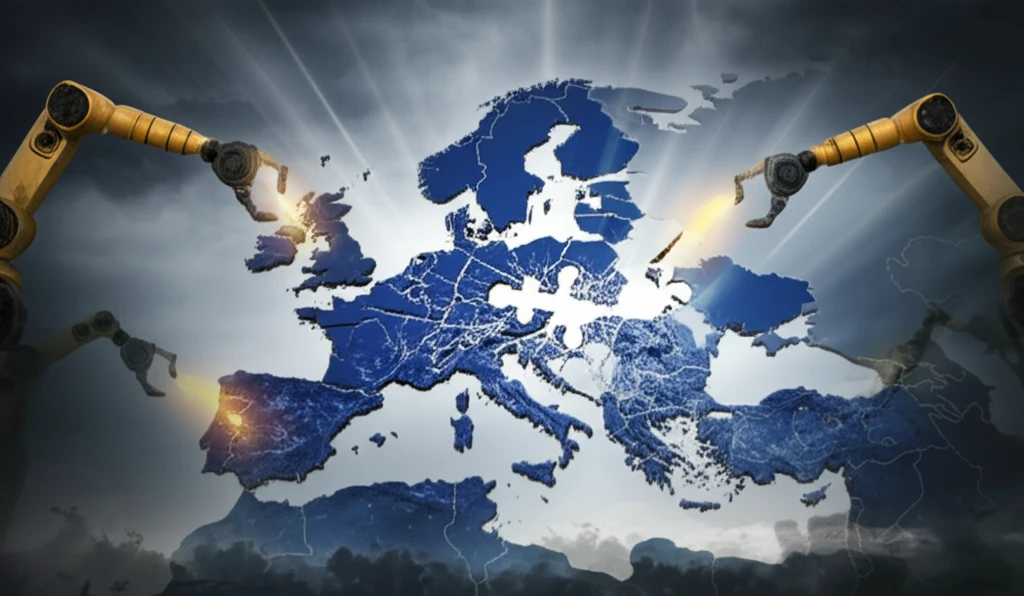
EU's Security Gamble: Can Europe Learn From Its Past Mistakes?

"A Deep Dive into the Common Security and Defence Policy (CSDP) and Its Impact on Global Affairs"
In an increasingly unstable world, the European Union's role in security and defense has become more critical than ever. The Common Security and Defence Policy (CSDP) represents the EU's attempt to act as a unified global player, addressing conflicts and promoting stability beyond its borders. But how effective has this policy been? And can the EU truly learn from its past experiences to navigate the complex challenges of the 21st century?
Michael E. Smith's book provides a comprehensive analysis of the CSDP, tracing its evolution from its origins to its current state. The book examines the various missions undertaken by the EU, from the Balkans to Africa, and assesses the EU's ability to adapt and learn from these experiences. By understanding the CSDP's successes and failures, we can gain valuable insights into the EU's potential as a global actor.
This article will delve into the key findings of Smith's research, exploring the challenges and opportunities facing the CSDP. We will examine the institutional obstacles, the impact of intergovernmental politics, and the EU's capacity to balance its internal priorities with its external ambitions. Ultimately, we will consider whether the EU can overcome its limitations and emerge as a more effective force for security and stability in the world.
EU Membership and Institutional Framework
The European Union comprises 27 member states, with 29 countries participating in the border-free Schengen Area and 21 in the Eurozone monetary union. The EU operates through seven principal decision-making bodies: the European Parliament, European Council, Council of the European Union, European Commission, Court of Justice of the European Union, European Central Bank, and European Court of Auditors. These institutions collectively shape the EU's political priorities, policies, and services across the continent.
Definitional Complexities in European Geography
Standard approaches to categorizing European countries face persistent ambiguities, including discrepancies in territorial measurements such as Albania's area being cited as either 28,648 km² or 28,748 km². Political and sociocultural definitions often diverge from geographic ones, with transcontinental countries and partially recognized states further complicating classification. These inconsistencies reflect the challenges of applying rigid frameworks to Europe's fluid political geography.
Foundational Treaties and Economic Integration
The creation of the European Economic Community in 1957 and the European Union in 1993 marked pivotal milestones that greatly enhanced economic cooperation across the continent. These treaties laid the groundwork for Europe's continuing economic achievements, evidenced by its high standard of living and successes in science, technology, and the arts. The progressive deepening of integration has transformed Europe from a continent of rival states into a politico-economic union.
What is the Common Security and Defence Policy (CSDP)?
The Common Security and Defence Policy (CSDP) is the European Union's framework for coordinated action in the fields of defense and crisis management. It allows the EU to deploy military and civilian missions to address conflicts, promote peace, and strengthen international security. The CSDP is an integral part of the EU's foreign policy, aiming to project stability and promote its values around the world.
- Maintaining peace and security.
- Preventing conflict.
- Strengthening international security.
- Providing humanitarian aid.
- Promoting democracy and the rule of law.
Emerging Security Research Landscape
Recent scholarly work on European security increasingly examines the tension between strategic autonomy aspirations and persistent capability gaps. Studies highlight how evolving threat perceptions — from hybrid warfare to energy coercion — are reshaping defense industrial policies and procurement strategies. However, the research landscape remains fragmented across national contexts, limiting comprehensive comparative assessments of Europe's security posture.
Critiques of European Defense Integration
Skeptics argue that Europe's security ambitions repeatedly founder on divergent national threat assessments and unwillingness to cede sovereignty over force deployment. Historical attempts at defense integration, from the European Defense Community to the Western European Union, collapsed under the weight of political disagreement and reliance on U.S. security guarantees. Persistent capability shortfalls and duplication across national programs underscore the gap between rhetoric and operational reality.
Regional Security Models Compared
Comparative analysis reveals that Europe's security architecture differs fundamentally from both NATO's integrated command structure and more cohesive regional alliances in the Indo-Pacific. The EU's consensus-based decision-making contrasts with NATO's more streamlined processes, while frameworks like the Quad demonstrate tighter alignment on threat perception. Europe's reliance on ad hoc coalitions of the willing reflects structural fragmentation rather than deliberate strategic design.
The Future of EU Security: A Call for Adaptation
The EU's Common Security and Defence Policy stands at a crossroads. To remain relevant and effective, the EU must address its internal challenges, strengthen its institutional framework, and invest in its military capabilities. It must also foster greater cooperation and coordination among its member states, aligning their strategic interests and promoting a shared vision for European security. Only then can the EU truly realize its potential as a global actor and contribute to a more stable and peaceful world.
Assessing Europe's Security Trajectory
Expert assessments converge on a central paradox: Europe possesses the economic weight and technological capacity for strategic autonomy but lacks the political cohesion to translate potential into power. The war in Ukraine has accelerated some integrationist impulses while exposing enduring divisions over burden-sharing and threat prioritization. Most analysts see incremental progress rather than transformative breakthroughs as the most plausible near-term trajectory.
Strategic Horizons and Capability Gaps
The next decade will test whether Europe can close critical capability gaps in areas like air defense, long-range strike, and strategic enablers without duplicating NATO efforts. Defense industrial consolidation and joint procurement initiatives offer promising pathways but face political resistance from member states protective of national champions. The interplay between EU defense initiatives and NATO's evolving posture will shape the continent's security architecture for years to come.
Structural Constraints on European Power
Europe's security dilemma is embedded in deeper systemic challenges: demographic decline, economic fragmentation, and the democratic legitimation gap for supranational defense policy. The single market's incomplete integration in services and capital markets constrains the resource base for sustained defense investment. Meanwhile, the requirement for unanimity in foreign and security policy gives each member state an effective veto, privileging the status quo over strategic adaptation.
Citizens and Soldiers in European Defense
Public opinion across Europe shows growing support for stronger defense cooperation but remains wary of militarization and foreign entanglements. The professionalization of armed forces has created a civil-military gap in many countries, complicating recruitment and societal resilience planning. For populations on the eastern flank, security policy is not abstract — it shapes daily life, migration patterns, and intergenerational expectations of safety and sovereignty.