
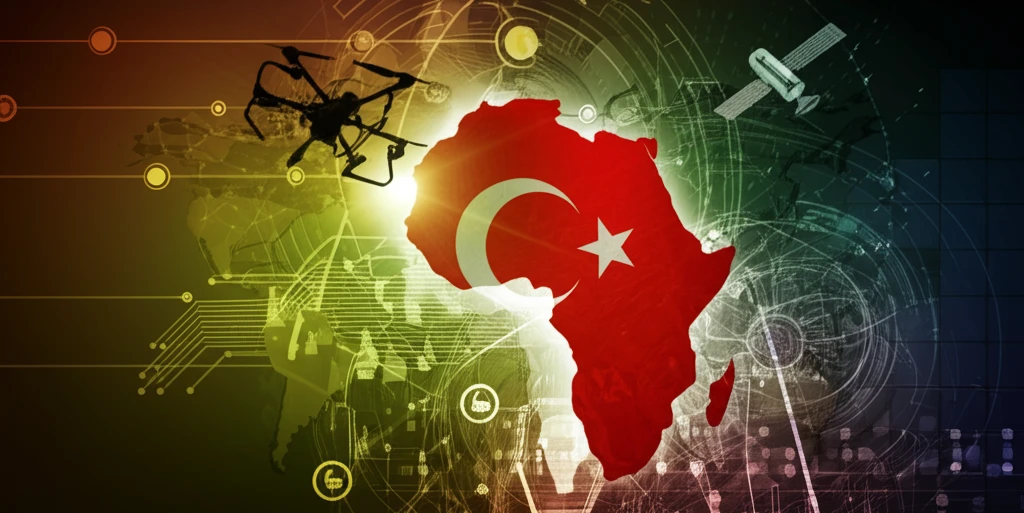
Turkey & Africa: Building a New Security Alliance?

"Exploring evolving patterns in security relations and what they mean for the future of geopolitics"
In recent years, Turkey has dramatically increased its engagement with Africa, evolving from primarily economic and humanitarian efforts to a more pronounced security partnership. This shift marks a significant development in international relations, as Turkey seeks to redefine its role on the global stage and African nations look for new allies and sources of support.
Once maintaining a limited presence with only 12 diplomatic missions in Africa before 2009, Turkey now boasts 41, signaling its deepened commitment. Economic ties have also surged, from $5.4 billion in 2003 to nearly $20 billion in 2017. Beyond trade, Turkey has become a major provider of humanitarian aid and a key investor in various African economies.
This burgeoning relationship has expanded into the security realm, with Turkey signing military, security, and defense agreements with over 25 African countries. The establishment of Turkey's largest overseas military base in Somalia in 2017 underscores the growing strategic importance of this partnership. But what are the underlying drivers and potential consequences of this evolving alliance?
An Expanding Security Relationship
Turkey-Africa relations have reached an unprecedented level across economic, political, cultural, and security domains, according to the Africa Policy Research Institute. Research on the alliance describes Turkey’s changing African policy and the growing prominence of security engagements, including effects on military modernization, external dependencies, and security arrangements. The literature attributes this emerging security strategy in significant part to Turkey’s growing economic power.
A Relational Lens
The cited research uses a relational approach to examine Turkey’s security engagement with African states rather than treating it as a simple, linear movement away from Western alliances. This framework emphasizes interconnection and multiplicity between the Global North and South, while examining Turkey’s position in NATO and the security-governance structures of the Global North. It also considers Turkey’s status as a non-Western, non-core actor and its search to alter existing power hierarchies.
From Historical Ties to Active Policy
The sources trace Turkey’s evolving Africa policy to deep historical and cultural relations with the continent. They also identify Turkey’s expanding economic power as a significant force shaping its newer security strategy. In addition, scholarship highlights soft-power tools as important in shaping Turkey’s relations with African countries.
Why Turkey's Security Interests in Africa are on the Rise?
Several factors contribute to Turkey's increasing focus on security cooperation with Africa. Historically, Turkey maintained strategic relations, but under the AK Party governments, this engagement has intensified, encompassing both low and high politics. This includes not only economic and cultural exchanges, but also defense and military cooperation.
- Historical Ties: A legacy of cultural and political connections dating back to the Ottoman Empire provides a foundation for cooperation.
- Economic Opportunities: Africa's rich resources and growing markets offer potential for Turkish businesses and investment.
- Security Concerns: Shared interests in combating terrorism and piracy create avenues for collaboration.
- Geopolitical Ambitions: Turkey aims to project power and influence in a strategically important region.
A Distinctive Security Partnership
Recent research presents Turkey as a security partner distinct from traditional powers in Africa. A 2025 study identifies defense-technology advancement, local-force training, and development as central elements of Turkey’s role. It positions this approach as a possible model for sustainable, equitable, and innovative security engagement, while related research connects the strategy to Turkey’s economic power and evolving foreign-policy identity.
Signs of Stagnation
One analysis argues that Turkey-Africa relations were experiencing short-lived stagnation. It attributes this condition to Turkey’s involvement in the Syria crisis, the FETÖ issue, and poor economic performance. The analysis therefore calls for adjustments to Turkey’s road map if Ankara is to strengthen its larger presence in Africa after 2020.
A Hybrid Security Model
The sources portray Turkey’s African engagement as combining economic power, strategic vision, soft-power diplomacy, and defense-industry initiatives. Unlike a purely military relationship, the cited research links security cooperation with training, technology, and broader political and economic ties. This makes Turkey’s approach appear distinctive, although the available material describes its motivations and potential rather than proving that it has displaced other security partners.
What Does the Future Hold for Turkey-Africa Security Cooperation?
The evolving security partnership between Turkey and Africa presents both opportunities and challenges. For Turkey, it offers a chance to expand its influence, promote its defense industry, and secure access to vital resources. For African nations, it provides an alternative source of support, diversification away from traditional Western powers, and potential for economic and security development. However, questions remain about the long-term impact of this alliance. Will it contribute to stability and prosperity in Africa, or will it exacerbate existing tensions and create new dependencies? Only time will tell.
An Ambitious but Contingent Partnership
Taken together, the available material suggests that Turkey’s African security role is expanding through a blend of diplomacy, economic engagement, defense cooperation, and soft power. Its durability remains contingent on Ankara’s ability to address political and economic constraints while responding to the priorities of African partners. The relationship is therefore better understood as an evolving partnership than as a settled alliance.
Institutional Capacity and Technology
A 2026 analysis reports that Turkey is positioning itself as Africa’s security partner through institutional capacity building and high-end technology transfer. It contrasts this approach with Russia’s focus on mercenary-based security models and argues that Turkey is developing a permanent and influential role in Africa’s security future. The source presents this trajectory as an emerging position, not an established outcome.
A Competitive Security Environment
Turkey’s engagement unfolds within a broader and changing security environment in Africa. Its prospects will likely depend on how effectively it balances security cooperation with political legitimacy, local institutional needs, and economic constraints. The available material does not establish a single outcome, so the relationship should be treated as contested and still developing.
Humanitarian and Security Entanglement
Research on Somalia, Nigeria, and Libya examines Turkey’s African relations through both humanitarian and security perspectives. The study uses soft power to analyze Turkey’s humanitarian and security policies on the continent. Its examples suggest that these dimensions are closely connected, producing a relationship that can be understood as a dichotomy between humanitarian action and security engagement.