
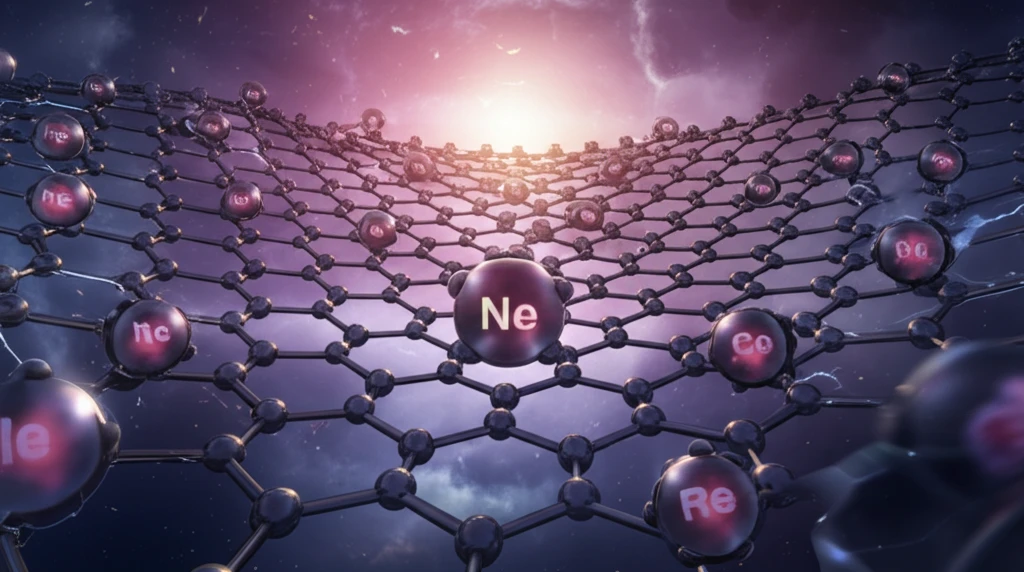
Hydrogen Storage Breakthrough: Can Graphene Flakes Solve Our Energy Woes?

"Scientists explore lithium-decorated graphene flakes as a revolutionary method for efficient and reversible hydrogen storage, potentially transforming clean energy solutions."
The quest for clean and sustainable energy sources has led scientists down numerous paths, each with its own set of challenges and promises. Among the most promising avenues is hydrogen energy, which offers a high energy yield and produces only water as a byproduct when used. However, storing hydrogen safely and efficiently has remained a significant hurdle. Traditional methods often involve high pressures or low temperatures, making them impractical for widespread use. This is where innovative materials like graphene come into play, offering a potential solution to this critical energy challenge.
Graphene, a two-dimensional allotrope of carbon, has captivated researchers with its exceptional strength, conductivity, and large surface area. Its unique structure makes it an ideal candidate for a variety of applications, including energy storage. Recent studies have focused on modifying graphene to enhance its hydrogen storage capabilities, and one particularly interesting approach involves decorating graphene flakes with lithium atoms. This modification aims to improve the interaction between graphene and hydrogen molecules, leading to more efficient storage.
Now, researchers are exploring how lithium-decorated graphene flakes can revolutionize hydrogen storage by leveraging the effects of external electric fields. This approach not only promises to enhance hydrogen adsorption but also offers a pathway to reversible storage, where hydrogen can be both captured and released on demand. As the world seeks cleaner energy solutions, these advancements in material science could be pivotal in unlocking the full potential of hydrogen as a future fuel.
The Scale of the Hydrogen Storage Challenge
Hydrogen is the lightest and most abundant chemical element in the universe, constituting about 75% of all normal matter, and under standard conditions it exists as a gas of diatomic molecules. Its economic footprint is tracked across global markets, including hydrogen storage tanks and transportation applications, the projected number of hydrogen valleys by 2033, and the power-to-gas market. Compared with batteries, CAES, flywheels, sand batteries, and proton batteries, hydrogen sits at the center of the core long-duration storage debate. Analysts note that choosing an energy storage technology is not about finding the single best option.
Established Storage Routes and Their Trade-offs
Standard hydrogen storage today relies on large-scale liquid hydrogen tanks, high-pressure tanks, and underground storage approaches. Large storage tanks traditionally use vacuum-based insulation to limit heat transfer and keep hydrogen cold, though NASA has been testing non-vacuum insulation on a liquid hydrogen test tank. High-pressure tank work in the U.S. focuses on codes and standards and on the feasibility of storing hydrogen at lower temperatures to increase energy density. Across these options, hydrogen storage is positioned as an increasingly important solution for long-duration renewable energy storage and as a platform for research and demonstration. Underground storage, meanwhile, is being pursued by adapting mature underground hydrogen storage expertise to applications such as natural hydrogen recovery.
From Heavy Tanks to Nano-Bubbles
Early mobility applications were constrained by hydrogen's low density: at normal temperature and pressure it is only about 8.9x10⁻⁵ kg/l, so a fuel-cell vehicle carrying 5-13 kg of onboard hydrogen could require as much as 192,000 litres of tank capacity. A notable milestone came in 2019, when Lu and co-workers demonstrated the creation of robust, highly pressurised hydrogen nano-bubbles stored in layered materials. In large-scale cryogenic storage, CB&I's non-vacuum liquid hydrogen tank test at NASA's Marshall center marked a milestone. Huntsville, home to Marshall, holds a significant place in U.S. space history dating back to the early rocket programs, anchored by Marshall's focus on propulsion and cryogenics.
The Science Behind Lithium-Decorated Graphene for Hydrogen Storage
The study, titled 'Reversible hydrogen adsorption on Li-decorated T-graphene flake: The effect of electric field,' delves into the intricate details of how lithium atoms, when added to graphene flakes, can significantly alter their electronic properties and hydrogen adsorption capabilities. The researchers used density functional theory (DFT) calculations to simulate and analyze these interactions at the atomic level. Their findings reveal that lithium decoration reduces the energy band gap of graphene, enhancing its ability to bind with hydrogen molecules.
- Lithium decoration enhances graphene's hydrogen adsorption.
- Electric fields control hydrogen adsorption and release.
- Reversible storage makes graphene a promising material.
- DFT calculations support the experimental findings.
New Routes in Electrochemical and Chemical Storage
Recent research pushes hydrogen storage in new directions, including electrochemical routes: one report describes interfacial water regulation on ruthenium single atoms doped into Co3O4 for efficient electrochemical hydrogenation of quinoxaline, a promising alternative to traditional methods that is still limited by low current density. Reviews of hydrogen-based energy storage techniques have summarized the latest storage methods and addressed the technological problems in the area. Chemical hydrogen storage research, meanwhile, concentrates on lightweight compounds able to deliver a high weight percentage of H2 at moderate conditions, an area regarded as indispensable to a hydrogen-based fuel economy. Ongoing coverage of these advances appears through research news outlets reporting on innovations and breakthroughs.
Why the Hype Keeps Hitting a Wall
A persistent argument against hydrogen-powered cars has been the storage problem, which a 2006 discovery promised to help solve. Safe storage at room temperature was described at the time as the main problem holding back the technology, with the new approach bringing hydrogen-powered vehicles a step closer to reality. The underlying difficulty reflects hydrogen's fundamental properties: it is the most abundant chemical substance in the universe, constituting roughly 75% of all normal matter, yet its lightness makes it extremely hard to contain efficiently.
Weighing Physical and Chemical Storage Options
Hydrogen storage options span physical and chemical approaches, and representative comparisons cover compressed hydrogen, metal hydrides, liquid organic hydrogen carriers (LOHC), and liquid hydrogen. At the nanoscale, the rate of hydrogen sorption improves because diffusion distances are short relative to bulk materials, and nanoscale materials also offer favorable surface-area-to-volume ratios. These characteristics make the choice of storage method a matter of weighing trade-offs across different applications.
The Future of Hydrogen Energy with Advanced Materials
While this research is still in the experimental phase, the implications are substantial. The development of efficient and reversible hydrogen storage materials is critical for realizing a hydrogen-based economy. Lithium-decorated graphene flakes, controlled by external electric fields, represent a significant step forward in this direction. As research continues, we can anticipate further refinements and innovations that bring us closer to a cleaner, more sustainable energy future. The intersection of nanotechnology and materials science is paving the way for solutions that address some of the world's most pressing energy challenges, offering hope for a greener tomorrow.
What Experts Actually Say About Storage
Expert assessments of hydrogen storage rely on structured, multicriteria evaluation methods. In one MCDA study, the technical subprojects developing hydrogen storage technologies provided raw data that experts then evaluated. Complementary expert opinion analyses examine renewable hydrogen storage systems in terms of power-to-gas and economic aspects. The field also sustains ongoing expert engagement, such as a Delphy team webcast on hydrogen storage and hydrogen safety structured around two sessions.
Where the Roadmap Points Next
Future prospects for liquid hydrogen transportation center on the advancement of improved insulating materials. Hydrogen-based energy storage and grid balancing are expected to expand as hydrogen infrastructure grows and adoption increases. Underground hydrogen storage offers one way to reduce the gap between supply and demand, storing hydrogen as an energy carrier during surplus periods and using it during high-demand periods. Overall, the outlook is promising but conditional: hydrogen's future as an energy carrier depends on technological advancements and policy interventions, with production costs, safety concerns, and infrastructure requirements among the challenges.
The Carrier Ecosystem Around Hydrogen
Hydrogen storage operates within a broader carrier ecosystem, and ammonia illustrates the systemic engineering involved. The ammonia-as-hydrogen-carrier workflow has three main engineering stages-synthesis, storage, and cracking-each with its own challenges. Metal hydrides face a different systemic hurdle: a primary challenge for their use as hydrogen storage media is the high temperatures needed to desorb hydrogen at adequate rates. Research on magnesium-based materials has examined this desorption behavior directly.
Storage on the Ground and on the Road
Real-world hydrogen storage impact is visible in geography and in transportation. A study concluded that geological formations in southern Bavaria hold previously underestimated potential for storing large quantities of hydrogen, offering an alternative to salt caverns in northern Germany and a better geographical distribution of storage capacities. On the road, hydrogen storage bottles are becoming a key component in the push toward cleaner transportation, enabling the safe and efficient storage of hydrogen fuel for vehicles.