
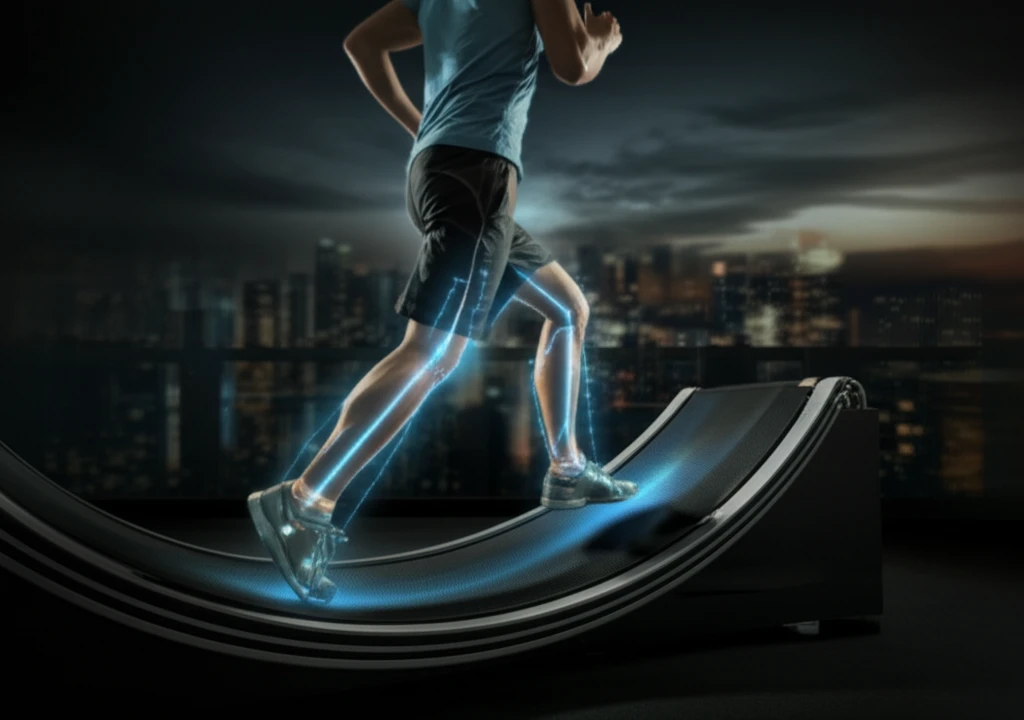
Runner on a curve treadmill with biomechanical lines.

Curve Treadmills: Do They Really Change How You Run?

"A new study explores how running on a curve-shaped, self-driven treadmill impacts your ground reaction force and lower limb movement, offering insights into injury prevention."


In recent years, the popularity of walking and running has surged as people seek ways to improve their health and prevent lifestyle-related diseases. With this increased interest, researchers have been diligently investigating the effects of these activities on the body. These studies aim to provide evidence-based insights, especially with advancements in wearable technology like smartphones and GPS sensors that now track our every step.

Treadmills have become a staple in fitness routines, offering controlled environments for measuring physical performance and designing workouts. They allow precise adjustments of speed and incline to standardize exercise conditions. Treadmills are frequently used to measure crucial fitness metrics such as maximum oxygen uptake and lactate threshold, which help tailor training programs.

However, a key question persists: Is running on a treadmill the same as running outdoors on solid ground? Researchers have explored this, with studies on walking showing similar kinematics and kinetics between treadmill and overground conditions, especially among adults. In running, though, differences emerge, especially concerning stride length and ground reaction forces. This leads us to investigate newer treadmill designs like the curve treadmill and how it affects running biomechanics.

How Curve Treadmills Change Your Stride and Impact

Runner on a curve treadmill with biomechanical lines.

A recent study published in the Journal of Physical Fitness and Sports Medicine delved into the unique characteristics of running on a self-driven treadmill with a curve-shaped running surface. Researchers compared the biomechanics of running on this type of treadmill (TM) to running overground (OG). Eight male subjects ran under both conditions at a constant speed of 3 m/s, while their movements and the forces exerted on the ground were carefully measured.

The study focused on several key factors:

  • Spatiotemporal Parameters: Stride length and stride frequency were analyzed to understand how the curved surface affects running rhythm.
  • Lower Limb Kinematics: Joint movements in the hip, knee, and ankle were tracked to assess changes in motion patterns.
  • Ground Reaction Force: The forces exerted upon impact with the treadmill or ground were measured to evaluate the load on the musculoskeletal system.
The results indicated some interesting differences. Runners on the curve treadmill exhibited a significantly higher stride frequency compared to overground running. While contact time remained similar between the two conditions, the vertical ground reaction force was notably different. Specifically, the initial impact force and average loading rate were lower on the curve treadmill.

The Takeaway: Is Curve Treadmill Running Right for You?

This study suggests that running on a curve treadmill reduces the intensity of impact on lower limb joints during the stance phase. This could be beneficial for injury prevention, particularly for runners prone to joint stress.

However, it's essential to consider that curve treadmills might also alter your running economy. The increased stride frequency and altered muscle activation patterns could lead to higher energy expenditure, as noted in other research.

Ultimately, the choice between a curve treadmill and traditional running depends on your individual needs and goals. If you're looking to reduce joint impact and potentially prevent injuries, a curve treadmill might be a valuable option to explore. If you have further questions, consult a physiotherapist.

About this Article -

This article was crafted using a human-AI hybrid and collaborative approach. AI assisted our team with initial drafting, research insights, identifying key questions, and image generation. Our human editors guided topic selection, defined the angle, structured the content, ensured factual accuracy and relevance, refined the tone, and conducted thorough editing to deliver helpful, high-quality information.See our About page for more information.

This article is based on research published under:

DOI-LINK: 10.7600/jspfsm.64.333, Alternate LINK

Title: Characteristics Of Ground Reaction Force And Lower Limb Kinematics During Running On Self-Driven Treadmill Equipped With Curve-Shaped Bed In Sagittal Plane

Subject: Physical Therapy, Sports Therapy and Rehabilitation

Journal: Japanese Journal of Physical Fitness and Sports Medicine

Publisher: The Japanese Society of Physical Fitness and Sports Medicine

Authors: Yu Kashiwagi, Tomoya Hirano, Michio Yamagishi, Noriko Hakamada, Ken-Ichi Kaneko, Kazuo Funato

Published: 2015-01-01

Everything You Need To Know

1

What is a curve treadmill?

A curve treadmill is a self-driven treadmill with a curved running surface. Unlike traditional treadmills that use a motor to move the belt, this type of treadmill is powered by the runner's own movements. The curved design encourages a more natural running form, which can influence how the body absorbs impact.

2

What were the main differences between running on a curve treadmill and overground?

The study compared running on a curve treadmill (TM) to running overground (OG). Key factors examined were Spatiotemporal Parameters, Lower Limb Kinematics, and Ground Reaction Force. The results showed differences in stride frequency, with runners on the curve treadmill having a higher stride frequency. Additionally, the initial impact force and average loading rate were lower on the curve treadmill compared to overground running.

3

What are Lower Limb Kinematics and why are they important in the context of the study?

Lower Limb Kinematics refers to the movements of joints in the hip, knee, and ankle during running. Researchers track these movements to understand changes in motion patterns. The study tracked Lower Limb Kinematics to assess the effects of the curve treadmill on running form. By analyzing these movements, researchers can gain insights into how the curve shape affects joint function and potential injury risks.

4

What is Ground Reaction Force and why is it significant when using a curve treadmill?

Ground Reaction Force (GRF) is the force exerted by the runner's body on the ground during the stance phase of running. The study found that the initial impact force and average loading rate were lower on the curve treadmill. This is significant because it suggests that the curve treadmill may reduce the impact on lower limb joints, potentially aiding in injury prevention. This understanding is crucial for runners to make informed decisions about their training methods.

5

What does the study suggest about curve treadmills and their potential benefits?

The study indicates that the curve treadmill may be beneficial for runners by reducing the intensity of impact on lower limb joints. This reduction in impact could potentially lower the risk of injuries, especially for those prone to joint stress. However, it is important to note that more research is needed to fully understand the long-term effects and benefits of using a curve treadmill. The findings suggest that the curve treadmill can be a useful tool for runners.

Newsletter Subscribe

Subscribe to get the latest articles and insights directly in your inbox.