
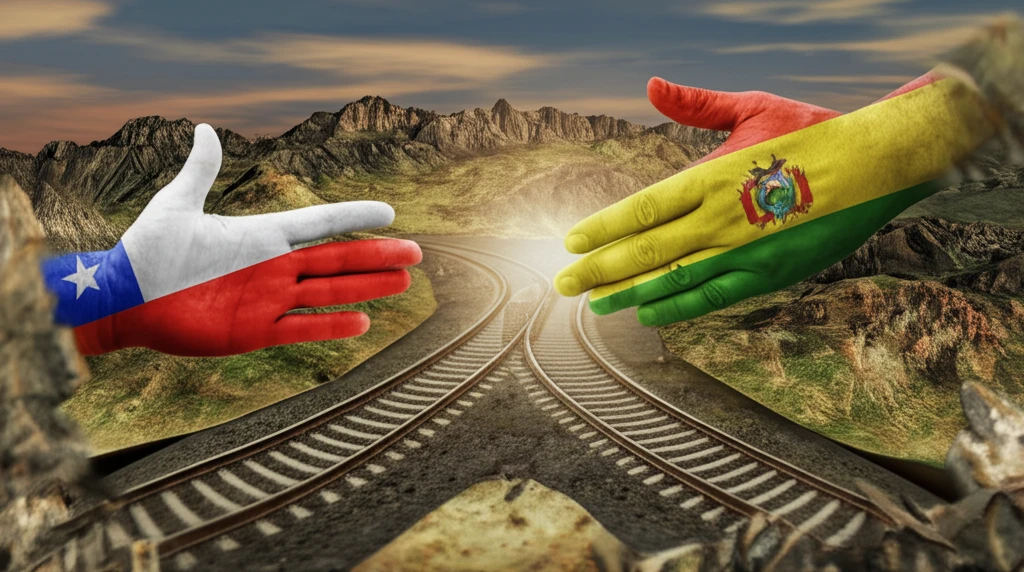
Bridging Divides: How Local Diplomacy Can Reshape International Relations

"Uncover the untold story of how regional collaborations between Chile and Bolivia offer a fresh perspective on overcoming historical tensions and fostering cross-border unity."
International relations are often perceived as grand negotiations between national governments, but the reality on the ground can be quite different. Tensions and opportunities bubble up from local communities, shaping the dynamics between countries in unexpected ways. A compelling example of this can be found in the historical relationship between Chile and Bolivia, particularly through the lens of regional interactions.
For decades, the official diplomatic narrative between Chile and Bolivia has been fraught with disputes, especially regarding Bolivia's access to the Pacific Ocean. However, beneath this formal discourse lies a rich history of regional collaboration, driven by the shared interests and cultural connections of communities along the border. These cross-border initiatives, often overlooked, provide valuable insights into how diplomacy can be reimagined from the ground up.
This article delves into the intricate dance between national diplomacy and regional initiatives, focusing on the Tarapacá and Oruro regions. It explores how local actors, driven by economic and social imperatives, have challenged and complemented the traditional diplomatic framework, offering a more nuanced understanding of international relations.
A Landlocked Legacy and an Enduring Dispute
Bolivia lost its Pacific coastline to Chile during the War of the Pacific and became a landlocked country, a status that continues to shape its foreign relations. The two neighbors have maintained only consular relations since 1978, when territorial negotiations failed and Bolivia severed diplomatic ties. Bolivia later demanded that Chile negotiate an outlet to the Pacific Ocean, taking its case to the International Court of Justice. The rift has also flared over shared water, with diplomatic relations severed from 1962 to 1975 in a dispute over the waters of the Lauca River. Bolivia, bordered by Brazil, Paraguay, Argentina, Chile, and Peru, remains the landlocked focal point of this enduring conflict.
Consultation, Litigation, and the Persistence of Mistrust
After decades of friction, Chile and Bolivia have at times restarted political consultations aimed at strengthening cooperation on trade, security, and migration through renewed diplomatic channels. Analysts describe the relationship as a complex mixture of hostility and cooperation that has persisted for over a century. The standard toolkit of diplomatic engagement has repeatedly run up against the foundational territorial question: a dispute centred on the Atacama border, with both countries claiming access to the sea. Such consultations signal goodwill but have rarely resolved the underlying maritime disagreement that keeps full relations out of reach.
From the War of the Pacific to the Hague
Diplomatic relations between Chile and Bolivia broke down between 1975 and 1978, and the two countries severed diplomatic ties in 1978 over Bolivia's desire to reacquire territory it lost in the 1879-83 War of the Pacific, maintaining only consular relations since then. Bolivia pursued its maritime claim before the International Court of Justice in proceedings running from 2013 to 2018. The case concluded without granting Bolivia the negotiating obligation it sought, and analysts point to the ensuing economic costs for Bolivia. More recently, a Chilean head of state attended a Bolivian presidential inauguration for the first time in 19 years, President Boric's visit following Ricardo Lagos's trip to meet president-elect Evo Morales in 2006.
The Push and Pull of National vs. Regional Interests
The relationship between Chile and Bolivia has been complex since 1904, the year of the Treaty of Peace, marked by periods of cooperation and conflict. One notable point of contention has been Bolivia's access to the sea, a landlocked situation resulting from the War of the Pacific in the late 19th century. While national-level negotiations have often stalled, regional actors in areas like Tarapacá (Chile) and Oruro (Bolivia) have sought to foster integration and collaboration, driven by shared economic and cultural ties.
- Economic Integration: Cross-border trade and investment have been key drivers of regional collaboration, with local businesses and communities seeking to overcome national barriers to facilitate commerce.
- Cultural Exchange: Shared cultural traditions and social connections have fostered a sense of unity and understanding between communities on both sides of the border, promoting people-to-people diplomacy.
- Infrastructure Development: Regional actors have advocated for infrastructure projects, such as railways and roads, to improve connectivity and facilitate trade and transportation.
- Paradiplomacy: Local governments and regional organizations have engaged in paradiplomacy, establishing direct relationships with their counterparts across the border to pursue shared interests.
Scientific Research Enters the Silala Dispute
The Santiago Times reports that Chile raised the profile of its dispute with Bolivia by submitting the case to the United Nations in July. International experts are currently analysing evidence and recently met in Bolivia to begin scientific research on the river and its source. The framing of the disagreement around a shared waterway highlights how hydrological and environmental questions have become central to the bilateral relationship. As independent analysis proceeds, the findings could shape how both governments present their positions.
One Exception in a Continent of Relations
Bolivia has traditionally maintained normal diplomatic relations with all hemispheric states except Chile. This isolation is the product of a specific failure: since 1978, when territorial negotiations failed and Bolivia decided to sever diplomatic relations, the two countries have managed only consular ties. The long-standing exception underscores that the rupture is not a general breakdown of Bolivian diplomacy but a targeted impasse with a single neighbor. No government has yet found a formula to translate routine consular cooperation into full bilateral relations.
Diversifying Away from Chilean Ports
Reporting from the Universidad de Navarra's Global Affairs service indicates that Bolivia is developing logistical alternatives that reduce its dependence on Chilean ports. The share of Bolivian cargo shipped through Chile has fallen in recent years, from 74.4% of exported tons in 2018 to 64.4% in 2020. These alternatives include routes through Peru and the Atlantic river corridor. The shift illustrates how economic pragmatism can soften the practical impact of a political rupture, even while full diplomatic relations remain absent.
Rethinking Diplomacy from the Ground Up
The historical relationship between Chile and Bolivia, viewed through the lens of regional dynamics, challenges traditional notions of diplomacy. It highlights the importance of recognizing the agency of local actors and the potential for cross-border collaboration to overcome national-level tensions. By understanding the interplay between national and regional interests, we can gain a more nuanced perspective on international relations and identify innovative solutions to foster peace, cooperation, and shared prosperity. As globalization continues to reshape the world, the lessons learned from the Chile-Bolivia case study can inform efforts to promote regional integration and cross-border collaboration in other parts of the world.
An Impasse Rooted in the Atacama
Expert commentary traces the modern Chile-Bolivia relationship back to a territorial dispute over the Atacama Corridor that dates to the 19th century. Bolivia lost its coastline to Chile in the late 1800s during the Pacific War and became a landlocked country as a result. That single historical event continues to define the tenor of the bilateral relationship more than a century later. The enduring nature of the impasse suggests that any breakthrough may require addressing the symbolic weight of Bolivia's maritime loss, not just concrete territorial arrangements.
Recurring Frictions and Fragile Openings
The Centre for International Governance Innovation notes that a flashpoint occurred just days after Bolivian President Evo Morales called on Chile to release three Bolivian soldiers who had been arrested in Chile in January; the soldiers were allowed to return home on March 1. The episode highlights how quickly localized security incidents can reshape the atmosphere between the two countries. Analysts continue to ask where Chile-Bolivia relations stand today, underscoring how much depends on day-to-day events rather than grand gestures. The path forward likely rests on both governments' willingness to manage such episodes without letting them derail the broader relationship.
Regional Politics and the Persistent Bilateral Strain
Bolivia's relations with Brazil and Argentina improved significantly during their shared democratic transitions, owing in part to a common bond among weak democratic governments emerging from military rule and facing the challenges of economic chaos. In contrast, the dispute with Chile has remained a persistent exception to that regional rapprochement. Tensions there intensified when Bolivia went to the International Court of Justice demanding that Chile negotiate an outlet to the Pacific Ocean. The contrast shows how regional solidarity can ease some relationships while deep historical grievances continue to block others.
A River Divided by History
An Earth.Org special report on the Silala River observes that historical friction and the lack of full diplomatic relations between Bolivia and Chile, stemming from Bolivia's loss of access to the Pacific Ocean in the War of the Pacific at the end of the nineteenth century, have strengthened the two countries' disagreement over the river. A single shared waterway thus carries the weight of more than a century of unresolved grievance. The dispute shows how water, livelihoods, and communities become entangled with questions of national pride and sovereignty. For both governments, the river is not merely a hydrological asset but a symbol of the wider divide.