
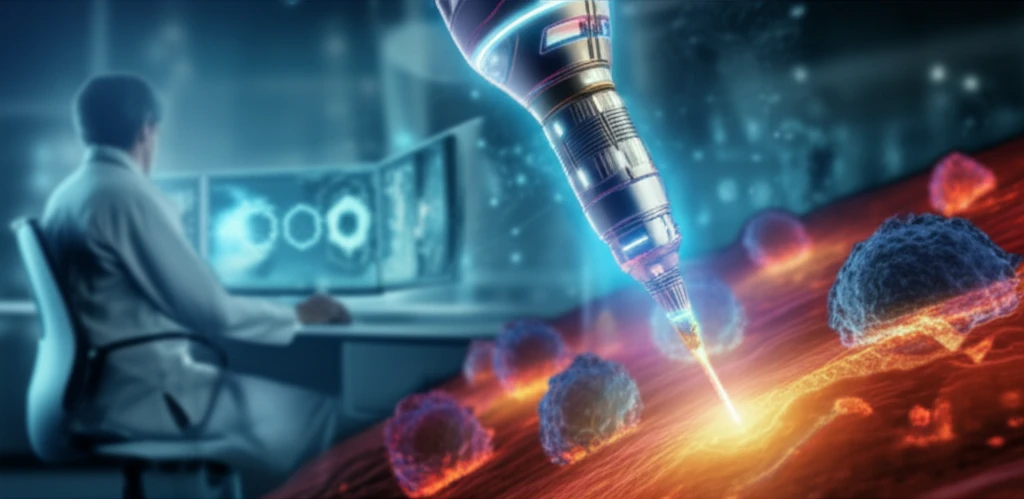
Unlocking Your Body's Secrets: How a Tiny 'Nanoprobe' Could Revolutionize Health

"From spotting early signs of disease to targeted treatments, discover how cutting-edge technology is changing the future of medicine."
In the relentless pursuit of better health, scientists are constantly innovating, pushing the boundaries of what's possible. One of the most promising frontiers is the realm of nanotechnology, where materials are engineered at the atomic and molecular level. This field has birthed incredible advancements, including the development of tiny, highly sensitive 'nanoprobes' that are poised to revolutionize how we detect and treat diseases.
These nanoprobes are not just theoretical concepts; they're tangible tools with the potential to transform medical diagnostics and therapies. Imagine a world where diseases are caught in their earliest stages, before they can inflict significant damage. Or picture treatments that are precisely targeted, minimizing side effects and maximizing effectiveness. This is the promise of nanoprobe technology.
This article delves into the exciting world of a specific nanoprobe—a GdPO4-based device—and its remarkable capabilities. Developed by a team of researchers, this technology is designed to recognize and interact with biological markers in unprecedented ways. We'll explore its potential impact on everything from cancer detection to precision medicine, and what it means for your health and well-being.
Nanoprobes Improve Early Detection Outcomes
Nanoparticle-based imaging probes are being combined with photoacoustic and fluorescence imaging to visualize disease sites with high spatial resolution and contrast, including metastatic lesions in lymph nodes. Major classes of nanoprobes—including quantum dots, plasmonic nanoparticles, and magnetic nanoparticles—leverage high surface-to-volume ratios and surface tailorability for biomarker discovery and diagnostics. Data from biomedical imaging studies indicates that early detection through advanced imaging can substantially improve survival: gastrointestinal cancer patients who benefited from early detection showed a two-year survival rate of 92.3% versus 33.3% for those without, and ten-year breast cancer mortality was reduced by 17–28% with early detection.
Conventional Imaging Has Resolution Limits
Traditional medical imaging modalities such as MRI, CT, and ultrasound remain the backbone of clinical diagnostics, but they operate at spatial resolutions that can miss early-stage cellular changes. Contrast agents used in these modalities often lack the specificity to distinguish between healthy and diseased tissue at the molecular level. These limitations have driven interest in nanoscale probes that can target biomarkers directly and provide subcellular-level information.
From Discovery to Clinical Translation
The concept of using nanoscale materials for biomedical purposes emerged from foundational discoveries in nanotechnology and materials science over the past few decades. Researchers have progressively developed diverse nanoprobe architectures—from simple quantum dots to multifunctional nanomaterials—each iteration improving biocompatibility and targeting precision. The field has moved steadily from laboratory proof-of-concept studies toward clinical applications, though full translation into routine patient care remains an ongoing process.
The Power of Nanoprobes: A New Era in Medical Science
Nanoprobes, in essence, are incredibly small sensors or delivery systems. They are designed to interact with the body at the cellular and molecular level, providing unparalleled access to biological processes. The particular nanoprobe we're focusing on is built around a core of GdPO4 (gadolinium orthophosphate), which has unique properties that make it suitable for imaging and sensing.
- Early Disease Detection: Nanoprobes can identify biomarkers, like specific proteins or molecules, that indicate the presence of diseases such as cancer, in their earliest stages.
- Targeted Therapies: They can be used to deliver drugs directly to diseased cells, minimizing harm to healthy tissues and reducing side effects.
- Real-time Monitoring: Nanoprobes enable doctors to monitor the effectiveness of treatments in real time, allowing for adjustments to be made as needed.
Multimodal Imaging Pushes Boundaries
Current research is focused on integrating nanoprobes with multiple imaging modalities—such as combining near-infrared fluorescence with photoacoustic tomography—to achieve comprehensive three-dimensional spatial information about disease sites. Three-dimensional multispectral photoacoustic tomography (3D MSOT) represents a particularly promising approach for visualizing metastatic lesions and other pathologies with depth and specificity. These multimodal strategies aim to overcome the limitations of any single imaging technique by providing complementary anatomical and molecular data simultaneously.
Translational Hurdles Persist
Despite promising laboratory results, nanoprobe technologies face significant hurdles before widespread clinical adoption, including concerns about long-term biocompatibility, potential toxicity, and scalability of manufacturing. Regulatory pathways for nanomedicine products remain complex and uncertain, as agencies grapple with how to evaluate the safety and efficacy of materials that behave differently at the nanoscale. Some early nanoprobe designs have shown limited stability in biological environments, prompting revisions to improve performance under physiological conditions.
Nanoprobes vs. Traditional Contrast Agents
Compared to conventional contrast agents, nanoprobe-based systems offer higher surface-to-volume ratios and the ability to be functionalized for specific molecular targets, potentially enabling earlier and more precise disease detection. However, traditional imaging methods benefit from decades of clinical validation, established reimbursement frameworks, and widespread availability that newer nanotechnology approaches have yet to match. The optimal approach may involve hybrid strategies that combine the specificity of nanoprobes with the proven infrastructure of existing imaging modalities.
A Brighter, Healthier Future: The Promise of Nanoprobe Technology
The development of nanoprobes represents a significant leap forward in medical science. While this technology is still in its early stages, the potential benefits are immense. From early disease detection to targeted therapies, nanoprobes are poised to transform the landscape of healthcare. As research continues and these tools become more sophisticated, we can look forward to a future where illnesses are easier to diagnose and treat, ultimately leading to longer, healthier lives.
Convergence of Nanotech and Medicine
Experts in the field broadly agree that nanoprobes represent a transformative frontier in diagnostic imaging, capable of detecting materials at the single-cell and subcellular levels that offer new hope for precision medicine. The integration of nanoprobes with advanced imaging techniques is seen as a critical step toward earlier disease detection and more personalized treatment strategies. However, researchers emphasize that rigorous clinical validation is essential before these technologies can be routinely deployed in patient care.
Toward Real-Time, Molecular-Level Diagnostics
Looking ahead, the field is moving toward nanoprobe systems capable of real-time, in vivo molecular imaging that could allow clinicians to monitor disease progression and treatment response at unprecedented resolution. Future developments may include probes that can simultaneously diagnose and deliver therapy, blurring the line between diagnostics and treatment. Continued interdisciplinary collaboration between materials scientists, biomedical engineers, and clinicians will be essential to realize this vision.
Scaling Innovation for Global Health
The promise of nanoprobe diagnostics must be considered within the broader context of global health equity, as advanced imaging technologies risk being accessible only in well-resourced healthcare settings. Manufacturing costs, cold-chain requirements, and the need for specialized equipment could limit deployment in low- and middle-income countries where early disease detection is often most needed. Addressing these systemic challenges will require deliberate investment in affordable, scalable nanoprobe technologies alongside traditional infrastructure development.
From Bench to Bedside
For patients, the ultimate impact of nanoprobe technology lies in its potential to detect diseases earlier, reduce the need for invasive biopsies, and enable less toxic, more targeted therapies. Early clinical applications are already emerging in cancer imaging, where nanoprobes may help identify metastatic lesions that conventional imaging misses. As these technologies mature, they could fundamentally shift the patient experience from reactive treatment of advanced disease toward proactive management of health at the molecular level.