
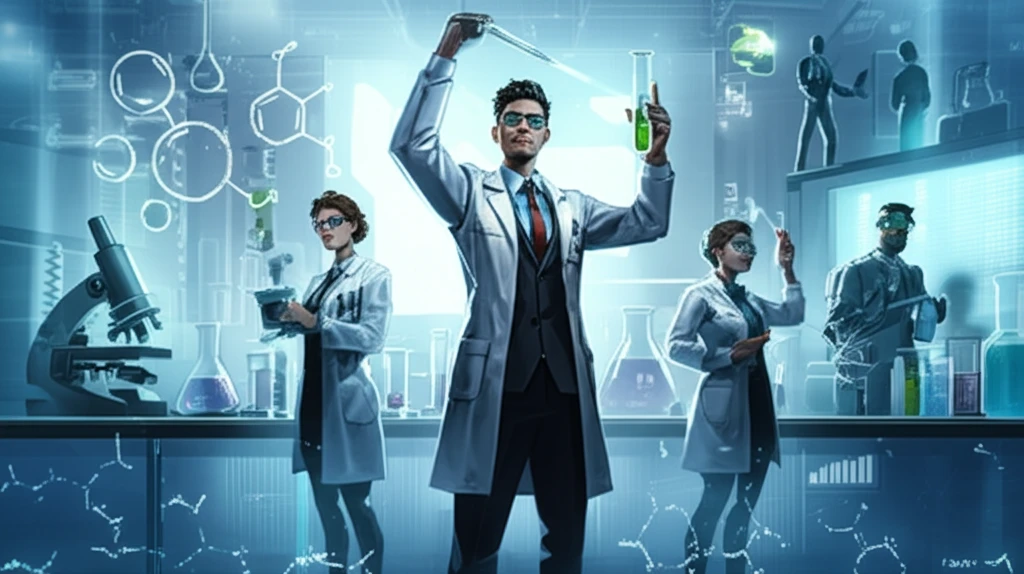
Chemical Innovation: Celebrating the Bright Minds Shaping Our Future

"Discover the groundbreaking achievements of Lu Wei, Jay Siegel, and other award-winning scientists who are revolutionizing chemistry and beyond."
The world of chemistry is constantly evolving, driven by brilliant minds dedicated to pushing the boundaries of scientific knowledge. This article celebrates the remarkable achievements of several award-winning scientists who are making significant contributions to their respective fields.
We will explore the groundbreaking work of Lu Wei, recipient of the prestigious Blavatnik Award, and Jay Siegel, recognized as one of the most influential foreign experts in China. Additionally, we will highlight various awards and nominations, showcasing the diverse talent and dedication within the chemistry community.
This article aims to not only recognize these exceptional individuals but also to inspire the next generation of scientists and innovators. By highlighting their accomplishments and contributions, we hope to foster a greater appreciation for the vital role chemistry plays in shaping our future.
Current Statistics & Impact
Lu Wei, an assistant professor of chemistry at Caltech, has been recognized for developing novel imaging techniques that enable simultaneous visualization of a larger number of distinctive biological species inside live cells. Her work has earned her the 2018 Blavatnik Regional Award for Young Scientists in chemistry and the 2022 Emerging Leader in Molecular Spectroscopy Award from the Federation of Analytical Chemistry and Spectroscopy Societies. Research.com profiles highlight her academic impact through citation metrics and publication records in both chemistry and materials science domains.
Standard Approach, Accepted Methods & Their Limitations
Research in the Wei group operates at the intersection of optical spectroscopy, chemical biology, and life science, developing cutting-edge optical spectroscopy and microscopy methods combined with advances in chemical biology. A key publication in Nature (2017) introduced a larger palette for biological imaging, enabling super-multicolor imaging through new dyes and vibrational microscopy methods. These approaches have been featured in Nature News & Views, Chemical & Engineering News, and Nature Methods as significant advances in bioimaging capabilities.
Historical Perspective, Milestones, Foundational Discoveries
The development of super-multiplexed imaging techniques represents a significant milestone in chemical biology, building on decades of advances in vibrational spectroscopy and fluorescence microscopy. Early work in nonlinear optical microscopy laid the groundwork for label-free imaging, while subsequent innovations in chemical probe design expanded the available color palette for simultaneous multi-species detection. These foundational discoveries have progressively overcome the spectral crowding limitations that historically constrained the number of biomolecules that could be visualized concurrently in living systems.
Lu Wei: Pioneering Bioimaging Techniques
Lu Wei, a distinguished assistant professor of chemistry at the California Institute of Technology, has been honored with the 2018 Blavatnik Regional Award for Young Scientists. This prestigious award recognizes her pioneering postdoctoral work at Columbia University, where she developed innovative bioimaging techniques to visualize biological species in living cells.
- Revolutionizing Bioimaging: Development of novel techniques for visualizing biological species in live cells.
- Blavatnik Award Recipient: Honored with the 2018 Blavatnik Regional Award for Young Scientists.
- Columbia University Research: Recognized for postdoctoral work conducted at Columbia University.
Latest Research and Reviews
Lu Wei has received a remarkable series of early-career honors including the 2020 NIH Director's New Innovator Award, 2022 Sloan Research Fellowship, 2022 Vallee Scholar Award, 2023 NSF CAREER Award, 2024 BPS Margaret Oakley Dayhoff Award, and 2025 Coblentz Award. Her work has potential applications in cancer, cardiovascular, and neurodegenerative disease research, with the JCP-DCP Future of Chemical Physics Lectureship recognizing the expanding scope of her contributions. A separate researcher named Lu Wei at Tongji University focuses on electromagnetic research and serves as Chief Scientist for a National Key Research and Development Program in China.
Counter Arguments and Failures
While super-multiplexed imaging has transformed biological visualization, challenges remain in achieving sufficient signal-to-noise ratios for low-abundance species, managing phototoxicity during extended live-cell imaging, and ensuring probe specificity across diverse cellular environments. Computational complexity in spectral unmixing and data analysis also presents practical barriers to widespread adoption. These limitations underscore the need for continued innovation in both probe chemistry and instrumentation to realize the full potential of highly multiplexed biological imaging.
Comparative Analysis
The Wei Lab's team includes researchers with diverse backgrounds such as post-bachelor's experience at Los Alamos National Laboratory in waveguide-based biosensing and synthetic lipoprotein design. This interdisciplinary composition reflects a broader trend in chemical innovation where physics, engineering, and biology converge. The landscape of chemistry awards—spanning organizations like the Royal Society of Chemistry, American Chemical Society, and Society of Chemical Industry—illustrates the multiple pathways through which chemical advances are recognized and validated across the field.
Celebrating Excellence in Chemistry
The awards and recognitions highlighted in this article demonstrate the vibrancy and dynamism of the chemistry field. From groundbreaking research to influential leadership, the individuals and organizations recognized are shaping the future of science and technology. By continuing to support and celebrate excellence in chemistry, we can foster further innovation and address the challenges facing our world.
Synthesis & Expert Commentary
The convergence of nonlinear spectroscopy, chemical biology, and advanced microscopy represents a transformative paradigm in how chemical innovation drives biological discovery. By expanding the observable parameter space within living systems, these technologies enable researchers to ask fundamentally new questions about cellular dynamics, molecular interactions, and disease mechanisms. The sustained recognition from diverse scientific institutions suggests broad consensus on the significance of this interdisciplinary approach.
Future Outlook & Next Frontiers
Next frontiers in chemical imaging likely include pushing toward true molecular-resolution dynamics in intact tissues, integrating artificial intelligence for real-time spectral analysis, and developing genetically encoded probes that expand the endogenous labeling toolkit. Advances in quantum light sources and detector technologies may further enhance sensitivity while reducing photodamage. The continued cross-pollination between physical chemistry, synthetic biology, and data science promises to accelerate discovery across biomedical research.
Broader Context & Systemic Challenges
Lu Wei's research at Caltech focuses on bio-imaging through novel nonlinear spectroscopy and microscopy development, situated within the broader ecosystem of chemical biology innovation. Her verified Google Scholar profile reflects active contribution to advancing the technical capabilities for visualizing dynamic biological processes. Systemic challenges include translating these sophisticated imaging modalities from specialized laboratories to wider research and clinical settings, ensuring reproducibility across platforms, and training the next generation of interdisciplinary scientists equipped to wield these tools.
The Human Element & Real-World Impact
Lu Wei's trajectory from PhD at Columbia University under Wei Min through postdoctoral training to her current professorship at Caltech exemplifies the mentorship and institutional support that nurture scientific innovation. Her selection for Scialog: Advancing BioImaging funding as one of 20 early-career scientists highlights community investment in developing new technologies for imaging living tissues. The Vallee Scholar Award further recognizes her potential to make transformative contributions, with her work poised to impact disease research through enhanced visualization capabilities.