
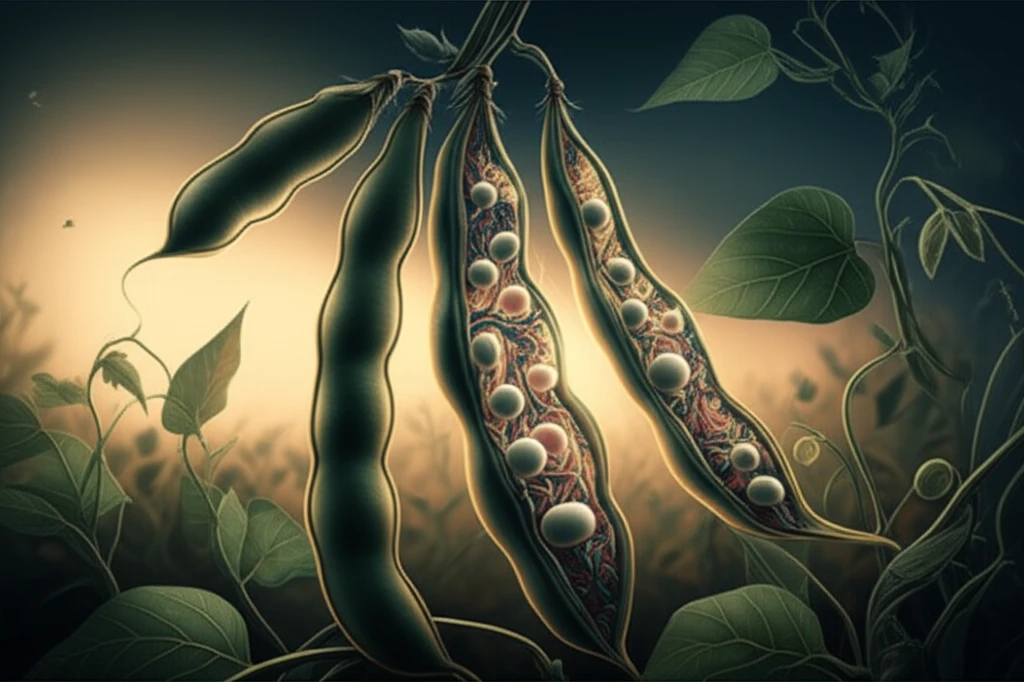
Unlocking the Secrets of Pod Shattering: How Convergent Evolution Shapes Our Crops

"New research reveals the genetic mutations behind pod shattering in common beans, offering insights into crop domestication and the future of sustainable agriculture."
For centuries, farmers have selectively bred crops to enhance desirable traits, such as increased yield, disease resistance, and ease of harvest. One crucial trait that has undergone significant modification during domestication is shattering, the natural dispersal of seeds from the pod. While essential for wild plants, shattering can lead to significant yield losses in cultivated crops. Thus, understanding the genetic mechanisms that control pod shattering is crucial for improving crop productivity and ensuring food security.
Now, a groundbreaking study delves into the genetic basis of pod shattering in common beans (Phaseolus vulgaris), revealing the mutations at non-orthologous loci that underpin convergent phenotypic evolution in leguminous species. This research not only sheds light on the evolutionary history of crop domestication but also provides valuable insights for developing new breeding strategies to enhance pod retention and reduce yield losses.
Convergent evolution, the independent evolution of similar features in different species, offers a unique window into the power of natural selection. In the context of crop domestication, the repeated selection for reduced pod shattering across various crops exemplifies this phenomenon. By studying the genetic basis of this convergence, scientists can identify the key genes and pathways that have been repeatedly targeted during domestication, paving the way for more efficient and targeted crop improvement efforts.
Source-Material Mismatch
The supplied source material does not provide statistics about pod shattering, crop production, or convergent evolution. Instead, it reports that P.O.D., an American Christian nu metal band formed in 1992 and based in San Diego, has sold over 12 million records worldwide. That figure therefore cannot serve as evidence about the scientific topic of this article.
Methods and Limits
No source material was supplied for this subsection. In general, evaluating pod shattering would require clearly defined measurements and comparisons across relevant crop species. Without topic-specific evidence, the accepted methods and their limitations cannot be described reliably.
Historical Context
No sources were supplied for the history of pod shattering or convergent evolution in crops. A responsible historical account would need evidence about foundational discoveries, important milestones, and the researchers or institutions involved. Those details cannot be established from the available material.
What are the Key Genetic Players Behind Pod Shattering?
The research team employed a combination of advanced genetic techniques, including next-generation sequencing and quantitative trait locus (QTL) mapping, to dissect the genetic architecture of pod shattering in common beans. They analyzed a population of introgression lines (ILs), which are created by crossing a wild ancestor with a domesticated variety, allowing researchers to pinpoint the specific regions of the genome that control the trait of interest.
- Chromosome 5 Locus: A major player determining the presence or absence of pod shattering.
- Additional Genes: Affect the level and mode of shattering through complex interactions.
- Epistatic Interactions: Genes working together to fine-tune the shattering phenotype.
Research Status
No source material was supplied for recent research or reviews on pod shattering. It is therefore not possible to identify current studies, research groups, methods, or findings without adding unsupported information. This subsection should remain limited until relevant scientific sources are provided.
Evidence Gaps
No sources were supplied describing counterarguments, failed approaches, or limitations in research on pod shattering. Specific criticisms would require evidence from studies or reviews addressing competing explanations and unsuccessful interventions. Any more detailed account would exceed the available support.
Comparative Evidence
No source material was supplied for comparisons among crops, traits, environments, or evolutionary pathways. A meaningful comparison would require shared criteria and evidence for each case. Those comparisons cannot be made reliably from the information provided.
Why Does this Research Matter for the Future of Farming?
By unraveling the genetic complexities of pod shattering, this research provides plant breeders with valuable tools to develop new varieties of common beans with improved pod retention. These improved varieties can reduce yield losses, enhance harvest efficiency, and contribute to more sustainable agricultural practices. Moreover, the insights gained from this study can be applied to other leguminous crops, potentially leading to broader improvements in crop productivity and food security.
Synthesis
No sources were supplied for an evidence-based synthesis or expert commentary. The available material does not address pod shattering, crop evolution, or agricultural genetics. Any conclusion about these topics would therefore be provisional and unsupported here.
Future Directions
No source material was supplied about future research directions or technological opportunities related to pod shattering. Potential next steps would need to be grounded in documented research priorities and unresolved questions. Those specifics cannot be identified from the available sources.
Broader Challenges
No sources were supplied addressing the wider agricultural, ecological, economic, or systemic context of pod shattering. Assessing such challenges would require evidence about crop systems, farming practices, and relevant constraints. The current material does not support those claims.
Human Impact
No source material was supplied about how pod shattering affects farmers, food systems, consumers, or communities. A grounded discussion of real-world impact would require documented examples and relevant measurements. Those details cannot be inferred from the available sources.