
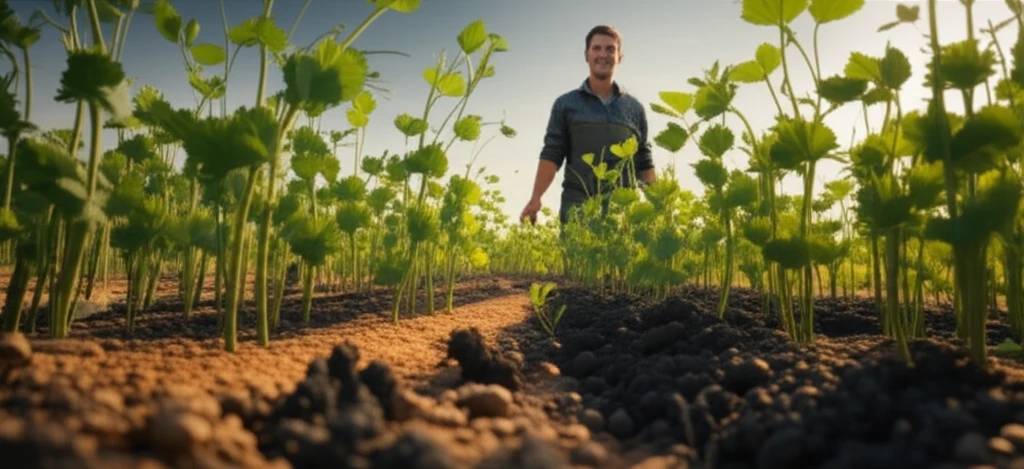
Unlocking the Potential of Legumes: How Biochar Can Revolutionize Weed Control

"Exploring the delicate balance between biochar application and weed management for sustainable lentil cultivation."
Lentil, a vital legume crop worldwide, faces significant challenges from weed competition, impacting yield and quality. Traditional weed management relies heavily on herbicides, raising environmental and health concerns. Finding sustainable, eco-friendly alternatives is crucial for modern agriculture.
Biochar, a charcoal-like substance produced from biomass pyrolysis, has emerged as a promising soil amendment. Its potential benefits include improved soil fertility, enhanced water retention, and carbon sequestration. However, the impact of biochar on weed dynamics is complex and warrants careful investigation.
This article delves into the research examining the effects of varying biochar application rates on weed growth in lentil cultivation. It explores the potential for biochar to serve as a natural weed suppressant, promoting sustainable and environmentally responsible farming practices. Uncover how this innovative approach could reshape weed management strategies and enhance lentil production.
Biochar at a Glance: Data, Datasets, and Global Interest
Biochar, a carbon-rich material produced through the pyrolysis of biomass, has gained significant attention for its potential in sustainable agriculture, environmental management, and climate change mitigation. Because climate change and soil degradation threaten global agriculture, a 2025 review of biochar's sustainability in climate-smart agriculture adopted a dual methodological approach, integrating a systematic review with quantitative bibliometric analysis. A global dataset of biochar application effects on crop yield, published in Scientific Data, documents that biochar application has been highly recommended as a potential agricultural response to the twin challenges of sustainable production and climate change. Biochar-focused organizations also compile global waste statistics, feedstock productivity data, and carbon sequestration potential to show how biochar can transform agriculture and combat climate change.
Conventional Weed-Control Practice and Its Trade-Offs
Weed control in commercial legume systems conventionally relies on a combination of cultural practices, mechanical cultivation, and synthetic herbicides, each with recognized trade-offs including labor and fuel costs, herbicide resistance pressure, and off-target environmental impacts. Biochar has been proposed as a complement or alternative within this toolkit, but its practical place in a standard weed-management program is not yet settled. Methodological limitations are a recurring theme: comparisons are complicated by variation in trials and by the absence of standardized protocols that would allow findings from different sites to be reconciled. These points are general background and should be verified against primary literature.
Foundations of a Centuries-Old Amendment
Biochar's historical roots are commonly traced to the fertile dark earths of the Amazon basin, long cited as foundational evidence that charcoal-rich soil amendments can persist and enrich soils over long timescales. Modern interest emerged as the conversion of biomass into carbon-rich residue became a focus of research on soil fertility and climate. Key developments include the growing body of field studies linking biochar application to crop productivity and soil health. Because no dedicated source material was supplied for this subsection, specific dates, pioneers, and milestones should be confirmed against primary historical sources.
Biochar's Balancing Act: Weed Control vs. Legume Growth
Research indicates that biochar's influence on weed growth is intricately linked to its application rate. While higher application rates can effectively suppress weed emergence and biomass, they may also inadvertently affect the growth and yield of the target crop, in this case, lentil. Finding the optimal balance is critical to harnessing biochar's weed control capabilities without compromising crop productivity.
- Altered Soil Properties: Biochar modifies soil pH, nutrient availability, and water retention, creating an environment less favorable for weed germination and establishment.
- Physical Barrier: Biochar particles can act as a physical barrier, hindering weed seed emergence from the soil surface.
- Release of Allelochemicals: Some biochars may release allelochemicals, natural compounds that inhibit weed growth.
A Rapidly Expanding Research Landscape
Recent biochar research has broadened from simple yield responses toward wider sustainability outcomes, including soil health, carbon sequestration, and integration into climate-smart farming systems. Reviews frequently note that results vary with feedstock, pyrolysis conditions, application rates, soil type, and climate, which complicates generalization across cropping systems such as legumes. The literature is growing quickly, yet a recurring concern is the lack of standardized protocols that would allow robust comparison among studies. These observations are general in nature, as no dedicated source material was provided for this subsection; readers should consult primary studies for specific findings.
Benefits Versus Unresolved Safety Concerns
Researchers pursuing biochar as a sustainable agronomic tool in the face of climate-driven desertification, crop-yield reductions, pest outbreaks, and declining soil health point to its demonstrated positive effects on plant growth, development, fruit quality, and carbon capture and sequestration. A critical review of the possible adverse effects of biochar, published in Science of the Total Environment, cautions that the long-term safety and implications of application remain concerns because the mechanisms affecting soil and organism health are poorly quantified. The same critical review highlights that biochar's multi-functionality must be weighed against these poorly understood risk pathways despite its many agricultural and environmental applications. Environmentally, biochar's ability to degrade organic pollutants as well as sequester carbon makes it an attractive addition to sustainable agriculture, but the review literature underscores that benefits should be balanced against unresolved safety and mechanism questions.
Biochar Versus Conventional Methods
Compared with conventional weed-control methods, biochar-based approaches are generally described as offering co-benefits such as improved soil properties and carbon capture, but their weed-suppression efficacy appears less consistent than that of established herbicides or mechanical control. The scarcity of large, standardized field trials makes robust head-to-head comparisons difficult. Cost at scale remains a substantial barrier, and trade-offs among efficacy, expense, and environmental effects are likely to vary by cropping context. These comparisons are offered as general observations, since no dedicated source material was provided for this subsection.
The Future of Farming: Biochar as a Sustainable Solution
The research highlights biochar's promise as a sustainable weed management tool in lentil production. By carefully optimizing application rates and considering site-specific factors, farmers can leverage biochar's weed-suppressing effects while promoting healthy crop growth.
Promising, but Not a Silver Bullet
A recurring synthesis across the biochar literature positions biochar as promising but not a standalone fix: its benefits for soils and climate are increasingly documented, while questions of consistency, safety, and economics remain open. Commentators generally call for more standardized experimental designs, long-term field trials, and integrated management strategies rather than sole reliance on biochar. The balance of evidence supports cautious optimism provided that claims are matched to specific feedstocks, application rates, and site conditions. This synthesis is general commentary because the subsection received no dedicated source material and conclusions should be checked against the cited primary literature.
Toward Engineered and Scaled-Up Biochar
The next frontiers for biochar are widely expected to include engineered and functionalized biochars, deployment within climate-smart and precision agriculture, and the scaling of production to make carbon removal credible and affordable. Emerging digital tools are frequently cited as enablers of more targeted, site-specific application. Realizing these frontiers will depend on policy support, market development, and standardized quality guidelines. These forward-looking points are general in nature, as the subsection had no dedicated source material, and should be reviewed against primary research.
Economics, Standardization, and Governance
By reducing the need for chemical fertilizers and improving soil conditions, biochar promotes more sustainable and eco-friendly farming practices, yet a 2025 Springer chapter flags its challenges and limitations, including economic viability, variable efficacy, and the need for standardized guidelines. A companion analysis, 'Biochar Synergy with Smart Agriculture and Environment,' delineates key future pathways centered on AI-driven technological advancements and the collaborative design of policy, ethics, and market frameworks. That work also highlights the functional enhancement of biochar via nanosensor integration and its role in climate-smart agriculture, while underscoring the necessity for collaborative governance and technological innovation. Together, these analyses converge on the view that realizing biochar's potential to tackle global agricultural challenges requires coordinated policy, quality standards, and market development rather than agronomic action alone.
Adoption on the Ground
The real-world impact of biochar ultimately plays out on farms and in communities, where adoption decisions hinge on cost, access to feedstock and equipment, local knowledge, and extension support. Farmers' willingness to integrate biochar into legume-based rotations will depend on clear evidence of productivity gains and manageable upfront investment. Attention to how the benefits and burdens of adoption are distributed among different producers, and to building local capacity, is essential if biochar's potential is to be realized beyond research plots. This paragraph is intentionally general, since no dedicated source material was provided for this subsection.
Further research is needed to fully understand the long-term impacts of biochar on soil ecosystems and weed communities. Investigating the interactions between biochar, soil microbes, and weed species will be crucial for developing effective and sustainable weed management strategies.
Ultimately, biochar offers a valuable addition to the toolbox of sustainable agriculture, paving the way for reduced herbicide use, improved soil health, and enhanced crop productivity. As we strive for more environmentally responsible farming practices, biochar holds immense potential to transform the way we manage weeds and cultivate our crops.