
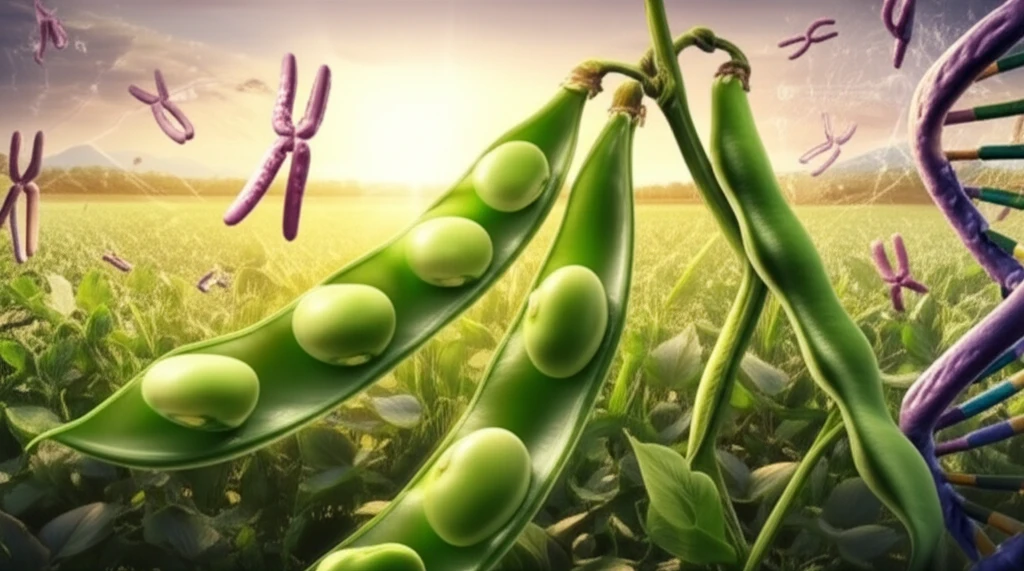
Unlocking Nature's Secrets: How Scientists Are Revolutionizing Crop Domestication

"From Ancient Beans to Modern Breakthroughs: A Deep Dive into the Genetics of Crop Evolution and Its Impact on Our Food Supply."
Throughout history, humans have cultivated crops, a journey that has reshaped ecosystems and fueled civilization. But what if we could truly understand the secrets of this age-old partnership? Scientists are now delving into the genetic mechanisms that drove the domestication of plants, like the humble bean, offering a revolutionary perspective on crop evolution.
This groundbreaking research, published in the journal The Plant Journal, unveils the intricate genetic architecture of 'pod shattering' in common beans. The study, led by a team of international researchers, has identified key genetic regions that control crucial traits in bean plants, like pod shattering, with potential implications for how we breed and improve crops.
This article explores the key findings of this study, the innovative methods used, and what they mean for the future of agriculture. We'll explore the convergence of genetic mutations, the roles of specific genes, and the potential for enhancing food production in a sustainable way. Prepare to be amazed by the intricate dance of nature and the power of scientific discovery.
Genomics Reveals Common Bean’s Domestication
Research on common bean (Phaseolus vulgaris) has combined its genome with genome-wide resequencing data from wild and domesticated accessions. Studies have used these data to investigate how the crop’s current distribution arose and how domestication and gene flow from close relatives shaped its genome. Researchers identify the molecular basis of the domestication syndrome as an important next step for understanding evolutionary processes and supporting crop improvement. This work also examines convergent phenotypic evolution in common bean.
From Phenotypes to Genomes
Crop domestication research commonly combines observations of domestication-related traits with genetic and genomic analysis. Such approaches can clarify how selection changed plants, but the underlying history may be difficult to reconstruct when populations exchanged genes or followed different evolutionary paths. Results should therefore be interpreted cautiously, especially when evidence comes from limited samples or when a trait has several genetic and environmental causes. Genome-based methods can strengthen the analysis, but they do not by themselves eliminate uncertainty.
Reconstructing Common Bean Origins
A foundational study of common bean domestication resequenced the genomes of 160 wild and cultivated accessions. The sampling represented both the Mesoamerican and Andean domestication centers, allowing researchers to investigate domestication across these major lineages. This genomic approach established a basis for reconstructing the crop’s complex domestication history. It also demonstrated the value of comparing wild and cultivated material rather than examining domesticated varieties alone.
Deciphering the Bean's Genetic Code: A Deep Dive into Pod Shattering
At the heart of this research is the study of 'pod shattering,' the natural process where seed pods split open to release seeds. While beneficial in the wild, this trait presents challenges for farmers, leading to harvest losses. Researchers focused on the genetic basis of this trait in the common bean (Phaseolus vulgaris), a staple crop worldwide.
- Chromosome 5 is a key player: The primary genetic region influencing pod shattering was located on chromosome 5.
- Multiple Genes at Work: Additional genetic regions on chromosomes 5, 4, 6, and 9 play roles in controlling the level and mode of shattering.
- Epistatic Interactions: The expression of pod shattering depends not only on the individual effects of genes, but also on their interactions.
- Lignin Patterns and Cell Wall Biosynthesis: The genes involved in pod shattering are linked to cell wall biosynthesis and lignin deposition.
Domestication Through Selection and Diversity
Recent soybean research continues to examine the roles of selection and introgression, while noting that earlier work had important limitations. A 2025 analysis of 8,105 soybean accessions reported that black soybeans function as a critical domestication intermediate and that domestication traits were selected stepwise. Reviews of mung bean, Vigna radiata, describe a crop whose ancient African and Asian history is still being unraveled through genome sequence information. Broader reviews emphasize domestication phenotypes and syndromes, genetic architecture, and the ecology of domestication as central research themes.
Limits of a Single Domestication Model
Domestication does not follow one universal genetic pathway across crops. A recent review highlights convergent domestication, in which conserved homologous loci and lineage-specific regulatory innovations can shape similar agronomic traits in different lineages. This complicates attempts to transfer conclusions from one crop directly to another. At the same time, advances in domestication genes and CRISPR-associated protein 9 genome editing have opened the possibility of domesticating crops de novo, although that opportunity does not remove the biological and practical challenges of crop improvement.
Wild Diversity and Breeding Resilience
The evolutionary history of common bean illustrates a recurring consequence of domestication: domesticated genotypes can experience a genetic bottleneck that reduces variation and produces substantial phenotypic change. Wild relatives therefore remain important resources for phylogenetic investigation and for recovering useful diversity. Research on grain legumes connects this molecular understanding to breeding goals, including stabilizing yield under pressure from evolving pathogens and changing climates. Together, these perspectives show both the costs of domestication and the potential value of wild germplasm.
A Future of Sustainable Agriculture
This research opens new avenues for improving crop breeding practices. By understanding the genetic basis of pod shattering, scientists can develop bean varieties that are more resilient to environmental challenges and enhance food production. This knowledge can be extended to other crops, contributing to a more sustainable future for agriculture and food security. The study on the common bean provides a valuable model for understanding the complexities of plant evolution, which opens the door to innovations for all plant-based foods.
A More Complete View of Domestication
The available evidence suggests that crop domestication is best understood as an interaction among selection, genetic architecture, ecology, and population history. Genomic tools can reveal patterns that are difficult to detect from visible traits alone, but interpretations remain dependent on sampling and evolutionary context. A cautious synthesis therefore treats domestication as a diverse set of processes rather than a single recipe. This perspective can help connect evolutionary research with practical breeding without overstating what current evidence can predict.
Climate-Ready Common Beans
A proposed future strategy for common bean is to exploit useful traits from wild relatives while applying modern breeding approaches. The cited work presents this as a way to enhance the crop’s genetic diversity and produce climate-resistant varieties. Its goal is to help common beans withstand future climate pressures. The approach places wild genetic resources at the center of forward-looking crop improvement.
Balancing Progress and Uncertainty
Crop domestication research must balance the promise of genomic intervention with the complexity of living agricultural systems. Genetic improvements may perform differently across environments, and domestication can reduce variation that later breeding needs. Progress is therefore likely to depend on combining modern tools with careful conservation and evaluation of diverse plant material. These challenges make long-term, context-sensitive research important.
From Discovery to Food Security
The practical importance of domestication research lies in its potential to support crops that remain productive under changing conditions. Breeding decisions must connect genomic discoveries with traits that matter in cultivation, including yield stability and resilience. Because outcomes depend on environments and farming needs, scientific advances are most useful when translated carefully into breeding programs. The human impact will therefore depend not only on new technologies but also on how effectively they serve agricultural communities.