
Decoding DNA: How Unnatural Bases Could Revolutionize Genetic Understanding

"Scientists discover that modified DNA bases mimic natural ones, paving the way for advanced DNA studies and technologies."
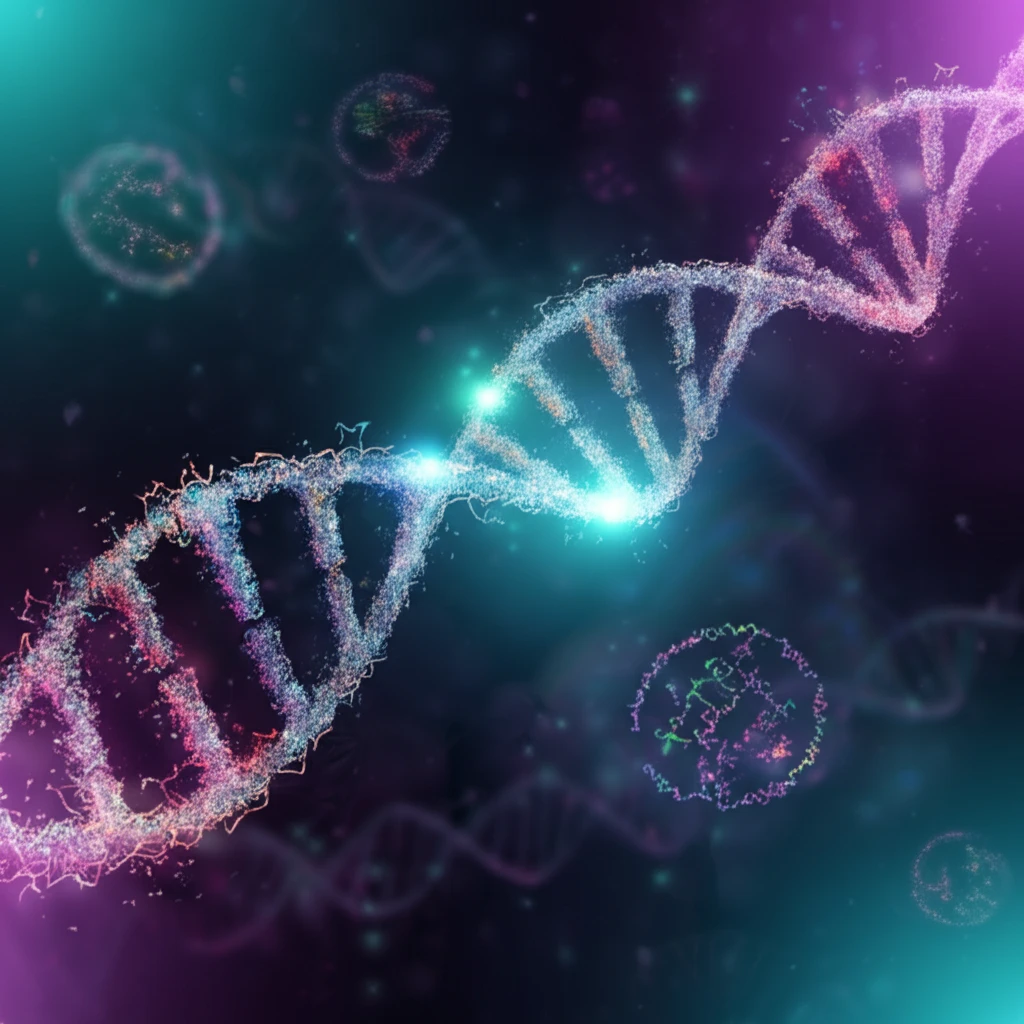
The world of DNA is constantly revealing new secrets, and recent breakthroughs are particularly exciting. Scientists are now exploring 'unnatural' DNA bases – modified versions of the building blocks that make up our genetic code. These aren't errors or mutations, but deliberately designed molecules that can help us understand how DNA works.
One fascinating area of study involves how DNA polymerases – the enzymes responsible for copying DNA – interact with these unnatural bases. A recent study has uncovered that certain modified cytosine bases (one of the four standard DNA bases) can be recognized as thymines by these polymerases. This happens because these modified bases cleverly mimic the shape and structure of natural base pairs.
This discovery is more than just a scientific curiosity. It has the potential to revolutionize our understanding of DNA replication, open doors to new DNA sequencing technologies, and even lead to the creation of advanced nanodevices.
Expanding the Genetic Alphabet
The conventional genetic alphabet has been expanded through the development of several synthetic unnatural base pairs that maintain the standard Watson-Crick structure of DNA. Deep sequencing data has revealed distinct percentages of different natural bases at positions of unnatural bases in oligonucleotides, indicating successful conversion of unnatural bases into combinations of natural ones. Recent research has identified nine unnatural codons that can produce unnatural proteins with nearly complete incorporation of encoded amino acids. These advances demonstrate that unnatural base pairs formed by recognition and interaction of synthetic bases can function within biological systems.
Current Methods and Constraints
Standard genetic engineering relies on the four natural nucleotide bases (A, T, G, C) which limit the information density and functional diversity of DNA-based systems. Current approaches to expanding the genetic alphabet face challenges in achieving high-fidelity replication, transcription, and translation of unnatural bases within living cells. The efficiency and specificity of polymerase recognition remains a key bottleneck for practical applications. These limitations have driven the search for more robust unnatural base pair systems.
From Natural Origins to Synthetic Expansion
Research into the origins of DNA is fundamentally constrained by the lack of direct physical evidence, as DNA survives in natural environments for less than one million years. The history of genetics spans from early work in the 1850s through the DNA era beginning in the 1940s to the genomics era starting in the 1970s. The development of unnatural base pairs represents a new paradigm, with researchers building on shape complementarity to create hydrophobic UBPs that rely on packing interactions for pairing specificity. Three representative types of unnatural base pairs have been developed that function as a third base pair in PCR, prompting reconsideration of the origin of natural nucleic acids.
What Makes These Unnatural Bases So Special?
The key lies in a concept called Watson-Crick geometry. James Watson and Francis Crick famously discovered that DNA consists of two strands held together by specific base pairs: adenine (A) with thymine (T), and cytosine (C) with guanine (G). These pairs fit together like puzzle pieces due to their unique shapes and hydrogen bonding patterns. DNA polymerases rely on this geometry to accurately copy DNA.
- Mimicking Nature: M-fC and I-fC bases successfully pair with adenine (A), just like thymine (T) does in normal DNA.
- Watson-Crick Geometry: This pairing occurs because the modified bases maintain a similar shape and structure to natural base pairs.
- Polymerase Confusion: DNA polymerases recognize these modified cytosines as thymines, leading to their incorporation during DNA replication.
Epigenetic Detection Breakthrough
Scientists have engineered an unnatural base pair system named MfC:D that enables direct identification of 5-formylcytosine (5fC) within DNA sequences, a pivotal epigenetic mark that has long eluded simple and reliable detection methods. This approach exploits hydrogen-bonding complementarity between a malononitrile adduct of 5-formylcytosine and protonated 3,7-dideazaadenine. Human DNA polymerase β (Pol β) has demonstrated efficient and specific synthesis and extension of representative UBPs including dNaM–dTPT3, dCNMO–dTPT3, and their functionalized derivatives. These advances represent significant progress in using unnatural base pairs for epigenetic sequencing applications.
Challenges and Limitations
Despite their potential, unnatural base pairs face structural and functional challenges in biological systems. The precise fit, complementarity, and versatility of natural nucleobases enable accurate base pairing and genetic stability that synthetic alternatives struggle to replicate. Expansion of the genetic alphabet with artificial extra base pairs, while promising, encounters difficulties in achieving the same level of fidelity and efficiency as natural base pairs. Computational and experimental studies highlight the complexity of characterizing UBP pairing behavior in free duplex DNA versus when bound to polymerase active sites.
Comparing Natural and Synthetic Systems
Natural base pairs benefit from billions of years of evolutionary optimization for replication fidelity, repair recognition, and functional integration within cellular machinery. Synthetic unnatural base pairs must achieve comparable performance across multiple biological processes simultaneously, including polymerase recognition, nucleotide transport, and avoidance of repair pathways. Current systems show varying degrees of success in different contexts, with some excelling in vitro but struggling in vivo. The trade-offs between structural similarity to natural bases and novel chemical functionality remain a central design challenge.
What Does This Mean for the Future?
This research has several exciting implications: New Sequencing Technologies: The ability to manipulate DNA base pairing could lead to the development of novel DNA sequencing methods. By using unnatural bases, scientists could potentially read and write DNA with greater precision. Understanding Epigenetics: This research provides new insights into how epigenetic modifications (chemical changes to DNA that affect gene expression) influence DNA replication and polymerase activity. DNA Nanotechnology: Unnatural bases could be used to create custom-designed DNA structures for use in nanotechnology. These structures could be used for drug delivery, biosensing, or other applications. In conclusion, while this research is still in its early stages, it opens up a world of possibilities for manipulating and understanding DNA. As we continue to explore the potential of unnatural bases, we can expect even more exciting discoveries in the years to come.
Integrating Perspectives
The field of unnatural base pairs represents a convergence of synthetic biology, chemical biology, and genetics that challenges fundamental assumptions about the universality of the genetic code. Expert consensus suggests that while technical hurdles remain, the demonstrated ability to expand the genetic alphabet opens transformative possibilities for information storage, protein engineering, and epigenetic analysis. The interdisciplinary nature of this research requires continued collaboration between chemists, biologists, and computational scientists. Long-term success will depend on achieving seamless integration with natural cellular processes.
Expanding Horizons
Scientists are exploring unnatural DNA bases as deliberately designed molecules that can help us understand how DNA works, not as errors or mutations. Introducing unnatural nucleobases can expand the genetic code, allowing for new amino acids to be encoded and leading to novel proteins with unique properties and functions. The unnatural base pair between 7-(2-thienyl)-imidazo[4,5-b]pyridine (Ds) and pyrrole-2-carbaldehyde (Pa) demonstrates specific hydrophobic shape complementation and works with natural pairs in vitro replication and transcription. These advances represent key steps toward creating fully synthetic genomes with expanded information storage capacity.
Systemic Implications
The invention of unnatural base pairs is considered one of the most significant achievements of synthetic biology, broadening entire biological systems in the central dogma. Artificial extra base pairs expand the genetic alphabet of DNA, enabling new coding possibilities and functional diversity. Incorporating unnatural bases represents a major technical achievement that expands the storage capacity of DNA. However, systemic challenges include ensuring compatibility with existing cellular machinery, avoiding unintended consequences, and developing scalable synthesis and sequencing methods.
Biological Integration and Discovery
Computational and experimental studies have characterized the pairing behavior of UBPs in free duplex DNA and when bound to the active site of KlenTaq DNA polymerase, highlighting the structural basis for their processing. Recent research has described a biochemical route for an unnatural DNA base to accidentally appear in vivo, demonstrating that exotic chemistries can be accommodated by natural systems. Human DNA polymerase β has shown efficient and specific synthesis and extension of representative UBPs, suggesting potential for therapeutic and diagnostic applications. These discoveries underscore how unnatural bases can both reveal and harness fundamental biological processes.