
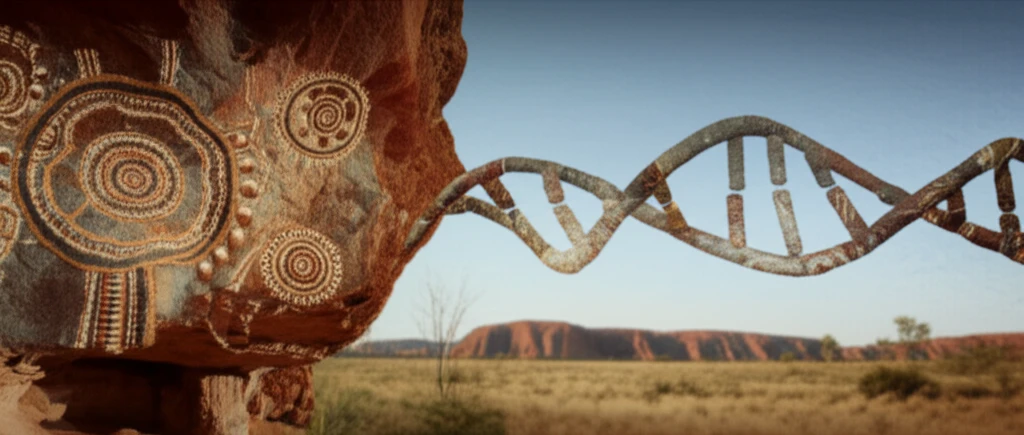
Unlocking the Past: How Ancient DNA is Rewriting Aboriginal Australian History and Enabling Repatriation

"Groundbreaking genomic research is helping to identify the origins of Indigenous remains, paving the way for their return to rightful communities."
For decades, museums and institutions around the world have held the ancestral remains of Indigenous people, often collected during colonial times under fraught circumstances. The repatriation of these remains is a deeply sensitive issue, carrying immense cultural and spiritual significance for Indigenous communities. Yet, in many cases, the exact origins of these remains have been lost, making their return to the correct communities a heartbreakingly difficult – sometimes impossible – task.
Now, a groundbreaking study published in Science Advances offers a beacon of hope. Researchers have successfully used ancient DNA analysis to trace the genetic lineages of pre-European Aboriginal Australians, opening up the possibility of identifying the origins of even unprovenanced remains. This has the potential to rewrite aspects of Aboriginal Australian history and, most importantly, facilitate the return of ancestors to their 'Place and Country'.
This article delves into the details of this landmark research, explaining the methods used, the key findings, and the profound implications for repatriation efforts and our understanding of Aboriginal Australian heritage. We'll explore how this scientific breakthrough addresses a complex ethical challenge, honoring the deep connection between Aboriginal Australians and their ancestors.
Repatriation's Provenance Problem
Indigenous people worldwide continue to struggle to repatriate the remains of their ancestors held by national and international organisations, and after European settlement of Australia in 1788, Aboriginal Australian remains were deposited in museums worldwide. Many of these remains have no known provenance, which makes returning them to Indigenous custodians difficult. In the Return to Country project, researchers sequenced ten nuclear genomes and 27 mitogenomes from ancient pre-European Aboriginal Australians (up to 1,540 years before the present) of known provenance and compared them to 100 high-coverage contemporary Aboriginal Australian genomes, also of known provenance, drawn from 12 geographic locations. The research, undertaken in collaboration with Aboriginal Australian Traditional Owners and communities across Australia, tests whether DNA-based methods can determine the origins of ancient individuals from their remains.
The Limits of Archival Repatriation
Historically, repatriation has relied on documentary records, museum catalogue entries and oral histories to establish where ancestral remains originated. These methods are only as reliable as the archival trail left behind, and for many museum collections that trail is sparse or nonexistent. When provenance is unknown, returns can stall for years because custodianship cannot be confidently assigned. DNA-based methods are being explored precisely because genetic evidence of ancestry may persist even where paperwork does not, though such methods remain complementary to rather than a replacement for established procedures.
From Archaeology to Ancient DNA
Understanding of Aboriginal Australian history has long rested on archaeology, linguistics and the ethnographic record rather than on genetics. Over recent decades, advances in ancient DNA sequencing made it possible to recover genetic material from remains thousands of years old, opening a new window onto deep population history. The field has had to develop careful methods to prevent contamination and to ensure that sampling is conducted with community consent. These still-developing foundations are what enable the more recent, repatriation-focused research described above.
Deciphering Ancient Genomes: A New Path to Repatriation
The core challenge lies in the fact that many ancestral remains lack detailed records of their geographic origin, tribal affiliation, or language group. Museums and institutions are often reluctant to repatriate remains without clear evidence of their provenance, fearing they might return them to the wrong community. This is where ancient DNA analysis steps in, offering a potentially definitive way to link remains to specific regions and people.
- DNA in-solution capture methods: Targeted enrichment of DNA fragments for sequencing.
- Second-generation sequencing: High-throughput sequencing technology for analyzing DNA.
- Mitochondrial and Y-chromosome sequencing: Analysis of specific genetic markers to determine maternal and paternal lineages.
- Phylogenetic analysis: Reconstructing evolutionary relationships between individuals and populations based on genetic data.
A Fast-Evolving Field
Research on ancient DNA and Aboriginal Australian ancestry is moving quickly, with new genomic techniques and ethical frameworks emerging on short timescales. Much of the recent work is less about any single headline result and more about proving whether DNA-based methods can reliably connect ancient remains to living descendant communities. Results, however, are often preliminary and may shift as larger reference datasets are built. Readers should treat any specific findings in the field as early-stage rather than settled.
Testing DNA Against Known Provenance
Work in this area has deliberately positioned DNA analysis as a hypothesis to be tested rather than a settled solution, with research undertaken in collaboration with Aboriginal Australian traditional owners and communities across Australia asking whether it is possible to determine the origins of ancient individuals using DNA-based methods. A key obstacle is that validating a method requires ancient remains of known provenance, yet many museum-held remains lack any record of origin. The Lake Mungo World Heritage Site, which has a long history of Aboriginal occupation, provides a context where archaeological knowledge and genetic results can be weighed against one another. Where such reference materials do not exist, DNA-based repatriation remains constrained.
Genomics in Context
Compared with other repatriation tools, genomic analysis offers the advantage of working from material evidence that survives independently of written records. Country-by-country comparisons suggest that the practical impact of ancient DNA depends heavily on whether reference genomes from living descendants are available and on the willingness of institutions to alter longstanding collection practices. In settings where archives are absent, genetics can out-perform documentary approaches, while in well-documented collections it rarely adds much. How these trade-offs play out remains an active area of discussion rather than established consensus.
A Future of Reconciliation: Returning Ancestors to Their Roots
The study's findings revealed substantial ancient population structure in Australia, demonstrating strong genetic affinities between ancient and contemporary Aboriginal Australians from the same geographic locations. This confirms that DNA-based methods can successfully identify the origins of unprovenanced ancestral remains.
A Cultural and Ethical Turning Point
Commentary on this research describes cutting-edge ancient DNA analysis as revolutionizing our understanding of Aboriginal Australian history while simultaneously offering a powerful tool for the repatriation of ancestral remains. The technology is framed as addressing a long-standing issue of cultural sensitivity and ethical responsibility rather than as a purely technical advance. Its significance lies in reuniting ancestral remains with Indigenous communities where documentary provenance has failed. Ethical collaboration with Aboriginal communities is presented as the foundation that makes the genetic science meaningful.
Scaling from Pilot to Practice
The near-term frontier is likely to be scaling genome-based provenance work from proof-of-concept studies to routine practice across the many collections holding unprovenanced Aboriginal remains. Larger reference datasets of contemporary Aboriginal genomes could improve the reliability of origin assignments, though building them will depend on sustained community consent and participation. Continued refinement of contamination control and ethical protocols will be needed as the methods broaden. Whether this translates into faster repatriation will depend on institutional willingness to act on genetic evidence when archives offer no answers.
Institutions, Ethics and Ownership
Genomics alone cannot solve repatriation, which ultimately depends on the policies of national and international organisations that still hold ancestral remains. Systemic challenges include inconsistent museum practices, disputes over custodianship, and the legacy of colonial-era collection. Ethical frameworks for the use of ancient DNA in Indigenous contexts are still being negotiated and are not uniform across institutions. Progress therefore requires institutional change, funding and community governance as much as it requires better science.
Person to Person, Community to Community
At its core, repatriation is about people and families seeking to lay their ancestors to rest in country. For Aboriginal Australian communities, the return of remains carries deep cultural and spiritual meaning that a laboratory finding alone does not capture. Genomic evidence matters most when it is placed in the hands of Traditional Owners and used on their terms to settle claims that archives could not resolve. The ultimate measure of success is not a published dataset but whether ancestors can finally come home with the consent and involvement of those who remember them.
While mitochondrial DNA analysis proved useful to some extent, the researchers found that nuclear genome analysis provided the most accurate and reliable results for repatriation purposes. The study emphasizes the importance of collaboration with Aboriginal Australian Traditional Owners and communities throughout the process.
This research marks a significant step forward in addressing the ethical imperative of returning Indigenous remains to their rightful communities. As DNA sequencing technologies continue to advance and become more accessible, this approach has the potential to transform repatriation efforts worldwide, fostering reconciliation and honoring the deep connections between people, their ancestors, and their land. This is not just about returning bones; it's about restoring cultural identity, spiritual connection, and historical justice.