
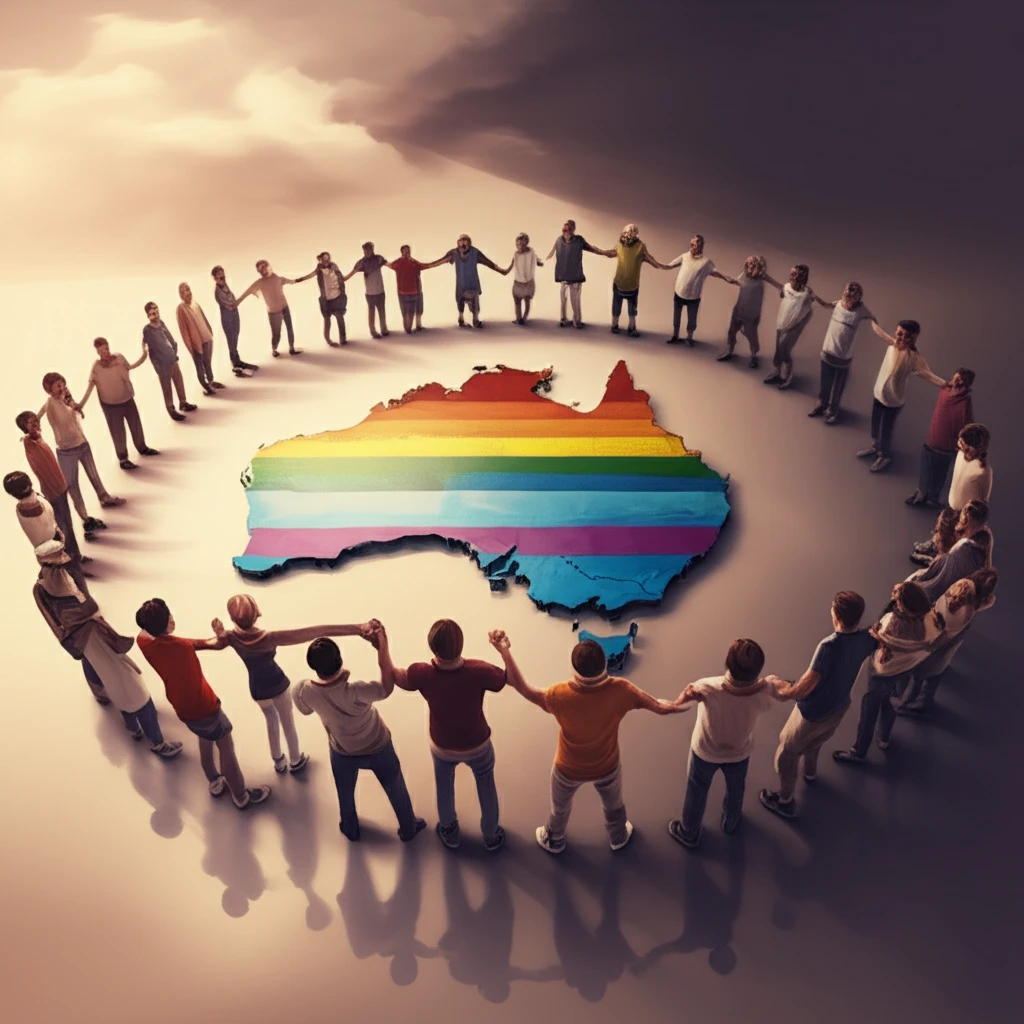
Beyond Binaries: How Queer Migrant Stories Redefine Identity and Belonging

"Exploring the voices of LGBTQ+ migrants in Australia reveals a complex tapestry of heritage, sexuality, and resilience."
The experiences of queer migrants often exist at the crossroads of multiple identities, navigating both their sexual orientation and cultural heritage. Traditional assumptions suggest that these individuals face constant tension, shifting between different worlds without fully belonging to either. However, a closer look at the narratives of LGBTQ+ migrants reveals a more nuanced and hopeful reality.
In Australia, the Queering the Air collective on 3CR Community Radio sought to explore these complex experiences through a series of radio documentaries titled 'We Weren't Born Yesterday.' This project delved into the lives of gay, lesbian, bisexual, trans, intersex, and queer individuals from diverse diasporic backgrounds, examining their heritage, vocabulary, and intergenerational connections within migrant communities.
This article draws insights from the 'We Weren't Born Yesterday' series, showcasing how queer migrants in Australia are redefining identity and belonging. By amplifying their voices, it challenges conventional understandings and highlights the resilience and community-building efforts of these individuals.
LGBTIQA+ Population Data and Discrimination Context
The Australian Human Rights Commission captures statistics on refugees, asylum seekers, and migrants from non-Western countries who cannot safely live in their country of origin due to LGBTIQA+ status and subsequent discrimination, persecution, and violence. In December 2024, the Australian Bureau of Statistics compiled its first experimental estimates of LGBTI+ populations in Australia, covering people who are lesbian, gay, bisexual, transgender and gender diverse, and people born with variations of sex characteristics. The term LGBTIQA+ refers to lesbian, gay, bisexual, transgender, intersex, queer, asexual people, or people otherwise diverse in gender, sexual orientation, and/or innate variations of sex characteristics. These populations face documented vulnerability within both Australian society and international contexts.
Research Methodologies and Service Delivery Gaps
An Australian Research Council Linkage Project investigating LGBTQ+ memory, migration, and collecting institution practices has examined the ethics of welcome for migrants relocating within Australia. Research drawing on 26 LGBTQ+ participants conceptualizes settlement as a process of interdependency rather than individual adaptation, mobilizing queer, feminist, and decolonial theories of care. Queer asylum seekers and refugees are more likely to have poor mental health compared to non-queer counterparts, and key priority areas for refugee services have been identified through a modified Delphi method comprising a scoping review and multiple rounds of expert consultation. The Queer Migrant Project Manual provides key considerations and recommendations for workers and organizations supporting LGBTQ+ immigrants, refugees, and asylum seekers in the context of domestic and family violence in Queensland.
Historical Context of Queer Migration
Sexuality has been an underexplored element of migration history, both within Australia and transnationally. For lesbian and gay migrants, leaving one country for another has historically brought both challenges and rewards, though these experiences have often remained invisible in mainstream migration narratives. As understanding of LGBTQ+ identities has evolved, scholars and communities have increasingly sought to document and honor the contributions of queer migrants to Australian society. This growing recognition represents a significant shift from earlier periods when such stories were largely absent from public discourse.
Navigating Multiple Identities: Challenging the Either/Or Narrative
For many years, the prevailing narrative surrounding queer migrants centered on the idea of forced choice. Individuals were often portrayed as having to choose between their sexual identity and their cultural or ethnic identity. This created a sense of constant negotiation and potential conflict, as expressed in Peter Jackson and Gerard Sullivan's 'Multicultural Queer Australian Narratives.'
- Breaking Down Silos: Participants shared stories of finding common ground and support within both LGBTQ+ and cultural communities.
- Redefining Family: Many individuals spoke about creating chosen families that embraced their sexual orientation and cultural heritage.
- Challenging Cultural Norms: The series highlighted instances of increased acceptance and understanding of diverse sexualities within migrant families.
Emerging Scholarship and Knowledge Gaps
Research on queer migration remains an evolving field with significant knowledge gaps yet to be addressed. While foundational studies have established frameworks for understanding LGBTQ+ migrant experiences, newer research continues to refine methodologies and expand the scope of inquiry. Interdisciplinary approaches combining sociology, public health, and migration studies are increasingly being applied to this area. The complexity of intersecting identities—including race, culture, and legal status—demands ongoing scholarly attention and methodological innovation.
Settlement Barriers and Service System Shortcomings
Research on settlement experiences of LGBTQI+ refugee and asylum seeker young adults aged 18-30 reveals additional barriers due to sexual orientation and gender identity, including discrimination, lack of social support, and difficulties in accessing services. Young LGBTQI+ migrants face compounded challenges navigating identity while attempting to access support and integrate into Australian society. Settlement services across Australia work with LGBTIQA+ migrants and refugees, recognizing the barriers they face, though the sector is still on a journey to become more inclusive, responsive, and client-centered. The settlement sector acknowledges it has not yet fully addressed the needs of this community, with specialist and expert voices calling for systemic improvements.
Cross-Contextual Perspectives
Comparative analysis of queer migration experiences across different cultural and national contexts reveals both common patterns and distinct challenges. While Australian research provides a relatively robust evidence base, direct comparisons with other receiving countries remain limited in the existing literature. The diversity of migration pathways—including refugee resettlement, skilled migration, and family reunification—creates varied experiences that resist simple generalization. Future comparative research could illuminate how different policy environments and social attitudes shape LGBTQ+ migrant outcomes.
Empowering Voices, Building Bridges: The Future of Queer Migrant Narratives
'We Weren't Born Yesterday' serves as a powerful example of how amplifying the voices of marginalized communities can foster understanding and create more inclusive societies. By providing a platform for queer migrants to share their stories, the series challenged stereotypes, celebrated resilience, and promoted community building. As William Yang noted in the Chinese episode, it is crucial to ensure visibility and representation for LGBTQ+ individuals within all communities. The series underscores that there are many people like us, there have always been people like us, translated from Mandarin, all over the world and will be in the future. Through sharing experiences and building bridges, the queer diaspora propels us to build relationships with each other that are deeply rooted in our dynamic heritage.
Professional Insights and Scholarly Perspectives
Interpreters mediating communication for queer migrants in English-dominant service environments report specific challenges that highlight gaps in current service provision. Research examining migrant and multicultural contributions to Sydney's queer history emphasizes that racial difference must be made explicit to understand how migration has shaped LGBTQ+ narratives and community contributions. Public acceptance of LGBTQ+ people in Australia remains high among younger Australians, with openly queer federal MPs now serving across major parties—a development that would have been almost unthinkable a generation ago. These converging perspectives suggest both progress and persistent challenges in creating genuinely inclusive spaces.
Directions for Research and Practice
The field of queer migration studies stands at a pivotal moment, with growing recognition of the need for more comprehensive and intersectional research approaches. Methodological innovations, including oral history and narrative-based research, offer promising avenues for capturing the complexity of LGBTQ+ migrant experiences. Service providers and policymakers increasingly acknowledge that current frameworks may not adequately address the nuanced needs of queer migrants. Continued investment in research infrastructure and community partnerships will be essential for advancing understanding and improving outcomes in the years ahead.
Intersectional Vulnerabilities and Structural Barriers
Queer Chinese migrants navigating HIV, visas, and belonging in Australia face compounded vulnerabilities that intersect across health status, immigration precariousness, and cultural marginalization. Even within broader LGBTQ+ spaces in Australia, migrants from non-English-speaking backgrounds can feel culturally peripheral—welcomed in theory but not always understood in practice. When HIV enters this already fragile landscape, the emotional burden can become unbearable for affected individuals. Research on infrastructures of interdependency in queer mobility highlights how leisure, sports, arts, and domestic contexts can serve as sites of care and community building for LGBTQ+ migrants.
Personal Narratives and Community Transformation
Oral history provides a unique means of interrogating the challenges and rewards that lesbian and gay migrants experience when leaving one country for another. Case studies of Japanese LGBTQ+ migration to Australia illustrate the primary factors prompting migration and the diverse encounters individuals have within their new environments. The 'Beyond Binaries' series has provided a platform for queer migrants to share stories, challenge stereotypes, celebrate resilience, and promote community building. As William Yang noted in the Chinese episode, ensuring visibility and representation for LGBTQ+ individuals within all communities remains crucial for advancing equality and belonging.