
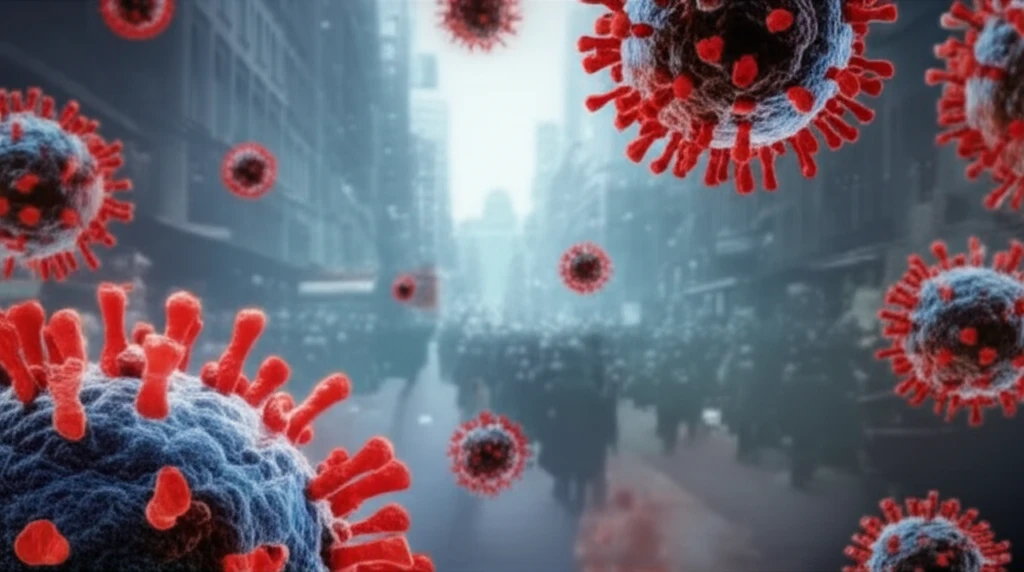
T cells attacking influenza virus particles with a historical cityscape in the background

Unlocking Immunity's Secrets: How the 1918 Flu Pandemic Shaped Our Understanding of T Cells

"A century after the deadly 1918 influenza pandemic, explore how this devastating event became a cornerstone in unraveling the complexities of the human immune response, particularly the role of T cells."


The influenza virus, notorious for its ability to cause widespread epidemics and pandemics, has inadvertently served as a powerful tool for unraveling the intricate workings of the human immune system. The catastrophic 1918 pandemic, in particular, spurred intense scientific inquiry into how our bodies combat this ever-evolving threat.

While the pandemic's impact was devastating, it fueled crucial research that illuminated the critical role of T lymphocytes, now known as T cells. These specialized immune cells are central to adaptive immunity, orchestrating targeted attacks against specific pathogens. Early studies of influenza infection revealed how T cells recognize and eliminate infected cells, providing essential insights into their function.

This article delves into the fascinating history of influenza research, tracing how investigations into the 1918 pandemic led to fundamental discoveries about T cells and their critical role in defending us against viral infections. It will cover key milestones such as the discovery of MHC restriction, the identification of viral peptides as T cell targets, and the ongoing quest for universal influenza vaccines.

The Discovery of CD8 T Cells: A Turning Point in Immunology

T cells attacking influenza virus particles with a historical cityscape in the background

In the early 1970s, pioneering work by researchers like R.V. Blanden laid the foundation for understanding cytotoxic T lymphocytes (CTLs), now known as CD8 T cells. These cells are critical for eliminating virus-infected cells. The introduction of the chromium release assay allowed scientists to measure CTL activity against cells infected with intracellular bacteria and viruses in mice.

A major breakthrough came in 1974 when Zinkernagel and Doherty, building on Blanden's work, demonstrated major histocompatibility complex (MHC) restriction. They discovered that CTLs could only recognize and kill virus-infected target cells that shared specific MHC molecules. This revolutionized our understanding of how T cells distinguish infected cells from healthy ones.

  • MHC Restriction: CTLs recognize viral peptides presented by MHC class I molecules on infected cells.
  • Fine Specificity: T cells exhibit remarkable specificity for self-MHC molecules.
  • Cross-Reactivity: The same T cells can react with different influenza A virus subtypes.
These early findings sparked a debate about T cell receptor specificity. Some scientists proposed that T cells might possess two receptors: one for self-MHC and another for the foreign viral glycoprotein. This puzzle would eventually be solved through further research that revealed the true nature of antigen recognition by T cells.

The Quest for a Universal Influenza Vaccine: A Continuing Legacy

The knowledge gained from studying influenza and T cell responses has fueled the pursuit of a universal influenza vaccine. Such a vaccine would target conserved internal proteins of the virus, inducing broad T cell immunity that protects against all subtypes. This remains a significant challenge, requiring further research into optimizing vaccine delivery, boosting T cell responses, and ensuring safety.

About this Article -

This article was crafted using a human-AI hybrid and collaborative approach. AI assisted our team with initial drafting, research insights, identifying key questions, and image generation. Our human editors guided topic selection, defined the angle, structured the content, ensured factual accuracy and relevance, refined the tone, and conducted thorough editing to deliver helpful, high-quality information.See our About page for more information.

Everything You Need To Know

1

How did the 1918 influenza pandemic contribute to our understanding of the immune system?

The 1918 influenza pandemic, while devastating, spurred intense scientific inquiry into how our bodies combat viral threats. This led to crucial research that illuminated the critical role of T lymphocytes, now known as T cells, in adaptive immunity. Early studies of influenza infection revealed how T cells recognize and eliminate infected cells, providing essential insights into their function. This kickstarted decades of research into cellular immunity and vaccine development.

2

What are T cells, and why are they important in fighting influenza?

T cells are specialized immune cells central to adaptive immunity. They orchestrate targeted attacks against specific pathogens, including the influenza virus. Specifically, CD8 T cells, or cytotoxic T lymphocytes (CTLs), are critical for eliminating virus-infected cells. They recognize viral peptides presented by MHC class I molecules on infected cells, allowing them to distinguish infected cells from healthy ones. This targeted elimination helps to control and clear the influenza infection.

3

What is MHC restriction, and how did its discovery change our understanding of T cell function?

MHC restriction refers to the discovery that cytotoxic T lymphocytes (CTLs) can only recognize and kill virus-infected target cells that share specific MHC molecules. This breakthrough, demonstrated by Zinkernagel and Doherty, revolutionized our understanding of how T cells distinguish infected cells from healthy ones. Prior to this, the precise mechanisms by which T cells identified and targeted infected cells were largely unknown. The discovery of MHC restriction explained how T cells exhibit remarkable specificity and fine-tune their responses to viral infections.

4

What is a universal influenza vaccine, and why is it important?

A universal influenza vaccine is a vaccine designed to protect against all subtypes of the influenza virus, rather than just specific strains that are predicted to be prevalent in a given season. This type of vaccine would target conserved internal proteins of the virus, inducing broad T cell immunity that protects against diverse influenza strains. It is important because it would eliminate the need for annual seasonal influenza vaccines and provide more comprehensive and long-lasting protection against influenza pandemics.

5

How did the chromium release assay contribute to understanding CD8 T cells, and what impact did it have on immunology research?

The chromium release assay was instrumental in advancing the understanding of cytotoxic T lymphocytes (CTLs), now known as CD8 T cells. This assay allowed scientists to measure CTL activity against cells infected with intracellular bacteria and viruses in mice. By quantifying the release of chromium from infected cells targeted by CD8 T cells, researchers could directly assess the cytotoxic potential of these immune cells. This provided a crucial tool for studying the mechanisms of cellular immunity and paved the way for further discoveries, such as MHC restriction, which significantly impacted immunology research.

Newsletter Subscribe

Subscribe to get the latest articles and insights directly in your inbox.