
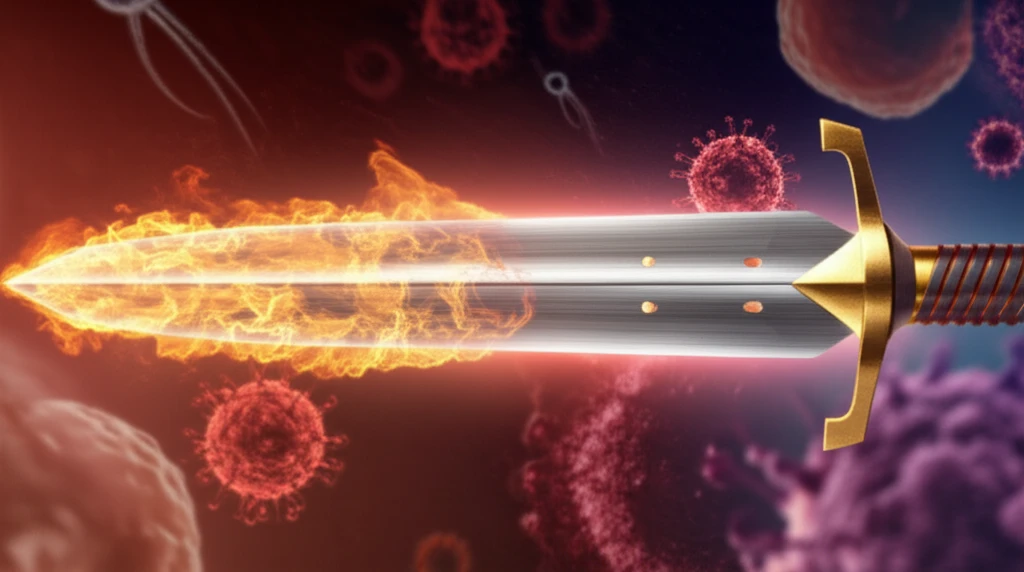
IL-15: The Double-Edged Sword in Cancer

"How this powerful immune cytokine can both fuel and fight tumors, and what that means for future therapies."
Interleukin-15 (IL-15) is a cytokine, a type of signaling molecule that plays a crucial role in the immune system. It belongs to the IL-2 family, a group of cytokines known for their ability to stimulate the growth, survival, and activity of immune cells like NK cells, T cells, and B cells. These cells are essential for fighting off infections and diseases, including cancer.
However, the story of IL-15 is more complex than it seems. While it can boost the immune system's ability to attack tumors, IL-15 has also been shown to support the growth and survival of certain types of cancer cells. This duality makes IL-15 a fascinating and challenging target for cancer research and therapy.
This article dives into the conflicting roles of IL-15 in cancer, exploring how it can act as both a friend and foe. We'll examine the mechanisms behind its actions, the potential benefits and risks of targeting IL-15 in cancer treatment, and the exciting new strategies being developed to harness its power for good.
Immunotherapy's Growing Role in Cancer Treatment
Over the past decade, immunotherapy has joined surgery, radiation therapy, and chemotherapy as a pivotal element in cancer treatment. IL-15, a cytokine belonging to the interleukin-2 (IL-2) family, is essential for the development, proliferation, and activation of natural killer (NK) cells, T cells, and B cells, making it a key focus of recent immunotherapy research. The Cancer Research Institute's 2025 Insights and Impact report highlights how the immunotherapy field is evolving toward more personalized, accessible, and durable treatment strategies.
IL-15's Immune Mechanisms and Therapeutic Promise
IL-15 binds to and signals through a complex composed of the IL-2/IL-15 receptor beta chain (CD122) and the common gamma chain (CD132), sharing structural similarity with interleukin-2. Its role in promoting immune cell development and activation has positioned it as a promising target for cancer immunotherapy. However, translating IL-15's immune-enhancing properties into durable clinical benefit remains an ongoing challenge.
A Century of Immunotherapy Research
The Cancer Research Institute's report charts the remarkable 100-plus-year journey of cancer immunotherapy, from early theories and experiments to today's most advanced treatments. This history includes decades of pioneering research, Nobel Prize-winning discoveries, and transformative breakthroughs that enabled the immune system to become one of the most powerful tools in cancer care. IL-15 was identified as a protein encoded by the IL15 gene in humans, with structural similarity to IL-2.
IL-15: Fueling the Fire or Lighting the Way?
IL-15 exerts its effects by binding to a receptor complex on the surface of immune cells. This complex includes the IL-15 receptor alpha chain (IL-15Ra), IL-2/IL-15Rβ (CD122), and the common gamma chain (γc or CD132). The binding of IL-15 to this receptor triggers a cascade of events inside the cell, activating signaling pathways like JAK/STAT, which promote cell survival, proliferation, and function.
- Pro-Tumor Effects: In certain lymphoid malignancies, such as large granular lymphocyte leukemia (LGLL), B-chronic lymphocytic leukemia (B-CLL), and adult T-cell leukemia (ATL), IL-15 can act as a growth factor, supporting the survival and proliferation of cancer cells. This can happen through autocrine signaling (where the cancer cell produces its own IL-15) or paracrine signaling (where IL-15 is produced by other cells in the tumor microenvironment).
- Anti-Tumor Activities: Conversely, IL-15 is a potent activator of NK cells and T cells, which are key players in the immune system's fight against cancer. IL-15 can enhance the cytotoxic activity of these cells, enabling them to directly kill tumor cells. It also promotes the production of other cytokines, such as IFN-γ and TNF-α, which further stimulate the immune response.
- IL-15 Trans-presentation: IL-15 action is also regulated by "trans-presentation", in which IL-15 bound to IL-15Ra on one cell (typically a dendritic cell) is presented to another cell expressing the IL-2/IL-15Rβ/γc complex. This mechanism is crucial for NK cell development and activation.
N-803: The First Cytokine FDA Approval in Over 30 Years
In April 2024, the FDA approved the IL-15 superagonist N-803 (Anktiva, nogapendekin alfa inbakicept-pmln) for the treatment of bladder cancer—the first cytokine in over 30 years to receive FDA approval for cancer treatment. This approval represents the culmination of years of preclinical and clinical studies involving both academic- and industry-driven research. A 2026 Frontiers review integrates emerging insights into IL-2Rβγ-driven CD8+ T-cell fate decisions and discusses key opportunities and challenges for translating IL-15-mediated immune enhancement into durable clinical benefit.
Limitations of IL-15 as a Monotherapy
Despite IL-15's potential, its effectiveness as a monotherapy is hindered by counter-regulatory immune mechanisms that limit its therapeutic impact. Research highlights that while IL-15 signaling regulates NK cell functions and antitumor properties, making it a key factor in NK cell immunity, these counter-regulatory pathways present significant obstacles. These findings suggest that combination approaches may be necessary to fully realize IL-15's promise in cancer immunotherapy.
Evaluating IL-15 in the Immunotherapy Landscape
IL-15 belongs to the interleukin-2 (IL-2) family and shares structural similarity with IL-2, but its distinct signaling properties—binding to and signaling through the IL-2/IL-15 receptor beta chain (CD122) and common gamma chain (CD132)—offer potential advantages for cancer treatment. Compared to IL-2, IL-15 promotes immune cell development without the same degree of toxicity, positioning it as a more favorable therapeutic option. However, the effectiveness of systemic IL-15 administration as a monotherapy has not been fully realized in clinical trials.
The Promise and Complexity of IL-15 Therapy
IL-15's journey from discovery to FDA approval demonstrates both the potential and complexity of cytokine-based cancer immunotherapy. The approval of N-803 in April 2024 marked a significant milestone, representing over 30 years of development since the last cytokine approval for cancer. Experts continue to explore how IL-15's immune-enhancing properties can be best leveraged, with ongoing research focused on optimizing delivery methods and overcoming counter-regulatory mechanisms.
Next-Generation IL-15 Delivery Approaches
Emerging research is exploring innovative delivery mechanisms for IL-15 superagonists, including targeted lipid nanoparticles (LNPs) that deliver mRNA encoding these molecules directly to tumors. This approach, recognized by the National Cancer Institute's immunotherapy workshop in 2007 as having potential to revolutionize cancer treatment, represents a promising avenue for improving precision and reducing systemic side effects. The evolution toward personalized, accessible, and durable treatment strategies suggests continued innovation in IL-15-based therapies.
Systemic Challenges in IL-15 Clinical Development
Interleukin 15 has been evaluated as a potential treatment for solid tumors in clinical trials, but the effectiveness of systemic IL-15 administration as a monotherapy has not been realized. IL-15 receptor alpha (IL-15Rα) can stabilize IL-15, suggesting that heterodimeric complexes may offer improved therapeutic outcomes. These systemic challenges highlight the need for innovative approaches to optimize IL-15 delivery and enhance its clinical efficacy.
IL-15's Potential to Transform Cancer Care
The development and approval of IL-15-based therapies like N-803 (Anktiva) represent years of collaborative research between academic institutions and industry partners. These efforts reflect the broader commitment to making immunotherapy more accessible and effective for patients with cancer. As the field continues to evolve, the integration of IL-15 into treatment regimens may help address unmet needs in cancer care.
The Future of IL-15 in Cancer Therapy: A Balancing Act
Given the dual nature of IL-15, researchers are exploring various strategies to harness its anti-tumor potential while minimizing its pro-tumor effects. One approach is to use IL-15 superagonists, which are modified forms of IL-15 that exhibit enhanced activity and selectivity for immune cells. These superagonists can boost the immune response against cancer without directly stimulating tumor cell growth.
Another strategy is to combine IL-15 with other immunotherapeutic agents, such as checkpoint inhibitors or adoptive cell therapies. Checkpoint inhibitors block the signals that cancer cells use to suppress the immune system, while adoptive cell therapies involve transferring immune cells into a patient to enhance their anti-tumor activity. Combining these approaches with IL-15 may result in synergistic effects, leading to more effective cancer control.
Ultimately, the key to unlocking the full potential of IL-15 in cancer therapy lies in a deeper understanding of its complex interactions with tumor cells and the immune system. By carefully manipulating the IL-15 pathway, scientists hope to tip the balance in favor of anti-tumor immunity and develop new, life-saving treatments for cancer.