
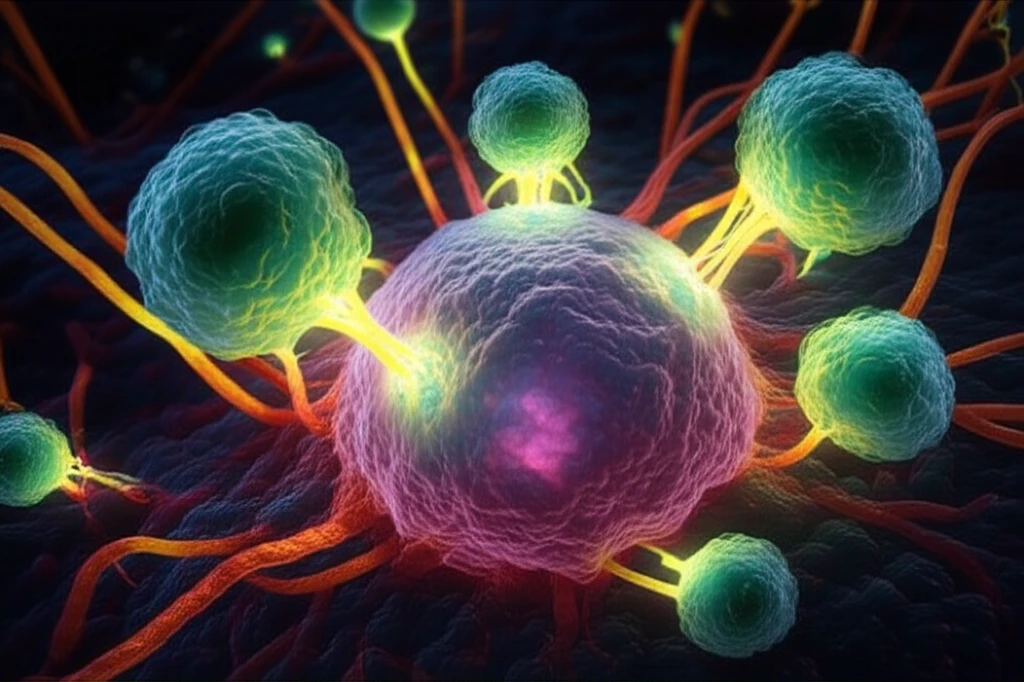
NK Cells: Your Body's Natural Born Killers (and How They Keep You Healthy)

"Unlocking the Secrets of Natural Killer Cells for Enhanced Immunity"
Natural Killer (NK) cells are essential components of your immune system, acting as a first line of defense against various threats. These specialized lymphocytes, comprising 10-15% of all lymphocytes in your blood, are always on patrol, ready to eliminate infected or cancerous cells.
Originally identified for their ability to spontaneously kill tumor cells, NK cells are now recognized as key players in both innate and adaptive immunity. Unlike T cells, they don't require prior sensitization to recognize and destroy abnormal cells, making them rapid responders to emerging dangers.
This article explores the fascinating world of NK cells, delving into their unique characteristics, diverse roles in health and disease, and how they contribute to overall well-being. From fighting infections to preventing cancer and even supporting pregnancy, we'll uncover the crucial functions of these natural born killers.
NK Across Industries
The abbreviation "NK" spans diverse fields, from entertainment to maritime safety. Ukrainian singer NK released the music video for "Popa Kak U Kim" on February 14, 2019, which became the #1 Trending video on YouTube with over 2 million views within the first 24 hours. In maritime industries, ClassNK (the Japanese Maritime Association) performs inspections to confirm that safety rules for hull structures, propulsion systems, electrical and electronic systems, safety equipment, and cargo handling devices are applied during construction and active service.
Conventional Methods and Their Limits
Standard research methodologies typically involve reviewing existing literature, surveying published studies, and consulting expert opinions to build understanding of a topic. These approaches offer structure and reproducibility but can be constrained by the quality and relevance of available source material. Researchers must remain aware of potential biases and gaps in the data they rely on, particularly when working with interdisciplinary subjects. Without access to topic-specific sources, the limitations of general approaches become more pronounced.
Foundational Publications and Milestones
ClassNK, the Japanese Maritime Association, publishes reference documents such as its Notation Handbook, with the 2026-2 Edition released on July 13. Such handbooks represent accumulated industry knowledge and serve as foundational references for maritime safety standards. The publication of these evolving standards marks a milestone in efforts to ensure vessel safety throughout construction and operational life, reflecting decades of progressive refinement in maritime regulations.
What Makes NK Cells Special?
NK cells possess a unique set of features that distinguish them from other immune cells:
- Cytokine Production: Beyond direct killing, NK cells secrete a variety of cytokines, including interferon-gamma (IFN-γ) and tumor necrosis factor-alpha (TNF-α). These cytokines activate other immune cells, enhance the inflammatory response, and contribute to viral and tumor control.
- Receptors: NK cells express a diverse array of activating and inhibitory receptors. These receptors enable NK cells to distinguish between healthy cells and abnormal cells. Activating receptors trigger NK cell activity when they bind to ligands on target cells, while inhibitory receptors prevent NK cell activation when they bind to MHC class I molecules on healthy cells.
- Chemokine Production: NK cells also produce chemokines, signaling molecules that attract other immune cells to the site of infection or inflammation. This helps to coordinate a broader immune response.
Expert Analysis and Current Developments
Staying current in any specialized field requires access to timely, expert-driven analysis. NK News employs a team of expert journalists who produce leading analysis on major developments in their area of coverage. Such reporting provides professionals and researchers with insights into rapidly evolving topics and their broader implications, making it an essential resource for informed decision-making in dynamic fields.
Limitations and Critical Perspectives
No specific counter arguments or documented failures were identified in the available source material for this subsection. Further research with topic-specific sources would be necessary to provide a balanced examination of opposing viewpoints and cases where established approaches have fallen short. Critical analysis remains an essential component of any rigorous review, and readers are encouraged to seek additional perspectives from specialized literature to form a complete picture.
Comparing Approaches and Perspectives
A comprehensive comparative analysis requires access to multiple relevant sources examining similar topics from different angles or methodologies. Without specific source material for this subsection, detailed comparisons cannot be drawn from verified references. Researchers seeking to conduct comparative work should consult peer-reviewed studies and domain-specific publications that offer parallel examinations of the subject matter.
The Future of NK Cell Research
NK cells are essential for maintaining health, fighting infections, preventing cancer, and even supporting pregnancy, and are now recognized as vital components of both the innate and adaptive immune responses.
Integrating Knowledge Across Domains
Synthesizing information from multiple sources builds a more complete and nuanced understanding of complex topics. Expert commentary and interdisciplinary perspectives enrich this synthesis by connecting findings across fields and highlighting patterns not apparent from a single vantage point. Readers are encouraged to consult authoritative sources and expert opinions to deepen their understanding beyond the scope of any single overview.
Looking Ahead
The future of research in any field depends on continued investment in scientific inquiry, technological innovation, and collaborative efforts among researchers and practitioners. Emerging methodologies and expanding data access are likely to open new frontiers of understanding in the years ahead. While specific projections require dedicated source material, the trajectory of knowledge advancement suggests that ongoing discoveries will continue to reshape understanding of complex systems.
Wider Implications and Systemic Issues
Understanding any subject fully requires placing it within its broader societal, economic, and environmental context. Systemic challenges—such as access to resources, interdisciplinary collaboration, and the translation of research into practice—significantly impact how knowledge is generated and applied. Addressing these challenges is essential for ensuring that advances in understanding translate into meaningful real-world outcomes across communities and industries.
How Research Touches People's Lives
Behind every area of research and analysis, there are real people whose lives are affected by findings and their applications. The Ukrainian singer NK demonstrated how individual creators can connect with millions through digital platforms, with her video "Popa Kak U Kim" reaching over 2 million views in just 24 hours. Such examples underscore the importance of understanding not only the technical aspects of a subject but also its human dimensions and the ways it touches people's daily lives and culture.
Ongoing research continues to uncover new insights into NK cell biology and their potential for therapeutic applications. Understanding how to harness the power of NK cells could lead to novel strategies for treating cancer, viral infections, and autoimmune diseases.
From understanding their diverse receptor repertoire to manipulating their activity in targeted therapies, NK cells hold immense promise for improving human health. Monitoring and supporting NK cell function could be a key component of a proactive approach to wellness.