
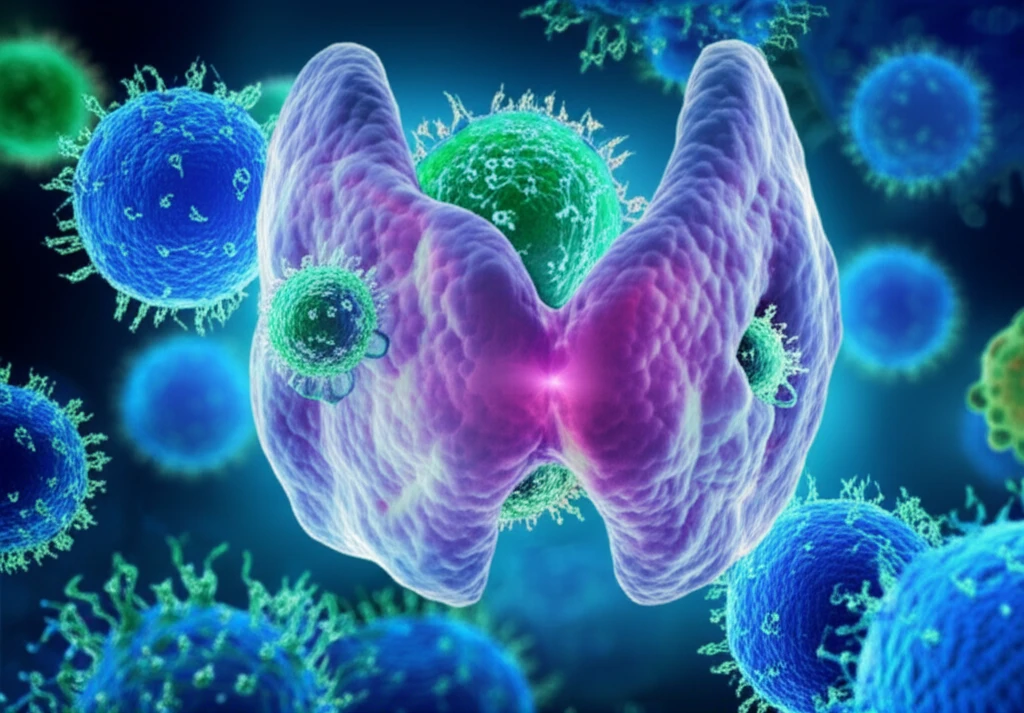
Thyroid Cancer and Your Body: Unlocking the Secrets of Tumor Microenvironments

"New research sheds light on how tumor-associated macrophages (TAMs) influence papillary thyroid carcinoma, offering hope for better treatments and understanding."
Papillary thyroid carcinoma (PTC) is the most frequently diagnosed endocrine malignancy, and its incidence has been steadily increasing over the past two decades. This rise is attributed to advances in diagnostic procedures, which allow for earlier detection. Due to the typically slow progression of PTC, managing these tumors has become a critical area of focus in endocrinological oncology.
The tumor microenvironment—the area surrounding the tumor that includes blood vessels, immune cells, signaling molecules, and the extracellular matrix—plays a crucial role in cancer development and progression. This complex environment influences how tumors grow, spread, and respond to treatment. Researchers are intensely studying the properties of the tumor microenvironment and the prognostic features of primary tumors to improve patient outcomes.
One key element within the tumor microenvironment is tumor-associated macrophages (TAMs). Macrophages are immune cells that can either promote or suppress tumor growth depending on their activation state. This article delves into a recent study that examined the relationships between specific types of TAMs and various clinical and pathological features of papillary thyroid carcinoma. By understanding these interactions, we can potentially develop more effective treatment strategies.
Why the Microenvironment Matters
The tumor microenvironment is an important research focus because its components may provide targets for therapeutic intervention across cancers. In thyroid cancer, however, mechanisms governing tumor-cell responses to the microenvironment remain more limited than in other cancers. A July 2026 report describes thyroid cancer as the most common malignant tumor of the endocrine system, with incidence increasing annually and the disease ranking as the ninth most common cancer worldwide.
Methods and Their Limits
One reported approach to studying tumor-associated macrophages in papillary thyroid carcinoma investigated macrophage density in benign thyroid lesions and PTC tumors using CD68 immunostaining. Research on the thyroid tumor microenvironment is complicated by its complexity, limitations in current research tools, and the difficulty of translating laboratory findings into real-world treatment. Reviews of cell-based tumor-microenvironment models likewise emphasize that existing methods have advantages and limitations, while newer technologies may help address open questions.
What Are Tumor-Associated Macrophages (TAMs) and Why Do They Matter?
Tumor-associated macrophages (TAMs) are a significant component of the tumor microenvironment. These immune cells originate from monocytes, which differentiate into two main subtypes: M1 and M2-like macrophages. M1 macrophages are classically activated and typically exhibit anti-tumor activity. M2-like macrophages, on the other hand, are alternatively activated and can promote tumorigenesis.
- Neovascularization: TAMs stimulate the growth of new blood vessels, providing the tumor with nutrients and oxygen.
- Invasion and Metastasis: They promote the spread of cancer cells to other parts of the body.
- Immune Suppression: TAMs can suppress the body’s natural anti-tumor immune responses, allowing the tumor to evade detection and destruction.
Immune Links in PTC
One study examined whether Hashimoto thyroiditis affects papillary thyroid carcinoma through STAT6 activation and M2 macrophage polarization, measuring STAT6 expression in tumor and stromal cells. Another report found that PTC occurring with Hashimoto thyroiditis was associated with a higher number of CD8+ cells, with P < 0.001. The authors linked this finding to immune-system recruitment of cytotoxic T cells into the tumor area and proposed it as an explanation for a protective effect of Hashimoto thyroiditis on PTC progression.
Why Outcomes Differ
Most thyroid cancer cases have a favorable prognosis, but some patients are resistant to treatment or develop aggressive disease. Tumor-associated macrophages can have differing effects because their products and behavior may be directed by tumor cells or neighboring immune cells. This complexity supports the need to identify patients at greatest risk of persistent disease or progression to poorly differentiated or anaplastic disease, while also developing treatments with less morbidity for survivors.
The TME as a Network
A 2026 review describes the thyroid-cancer tumor microenvironment as a network composed of stromal cells, immune cells, vascular cells, and cancer cells. This network has become a key factor in thyroid-cancer development. The source emphasizes that the microenvironment affects the disease, although the provided material does not specify a direct comparison between particular thyroid-cancer subtypes or treatments.
Implications and Future Directions
This research underscores the multifaceted nature of TAMs in papillary thyroid carcinoma and highlights their potential as therapeutic targets. Further molecular studies are needed to fully elucidate the roles of these cells in tumor progression and dissemination. By gaining a deeper understanding of TAMs, we can pave the way for novel therapies that improve outcomes for patients with thyroid cancer.
Heterogeneity at the Cellular Level
Thyroid cancer is described as the most common endocrine malignancy and as having a unique, complex tumor microenvironment. A comprehensive single-cell RNA analysis was presented as a way to investigate high tumor heterogeneity and the molecular mechanisms associated with it. These findings position single-cell analysis as a tool for examining differences among tumor microenvironments.
Mapping the Immune Ecosystem
The tumor immune microenvironment is described as a dynamic and highly heterogeneous ecosystem. In thyroid cancer and colorectal cancer, it critically shapes tumor progression, immune escape, and therapeutic response. This framework points toward future research focused on understanding how changing immune environments influence treatment outcomes.
From Favorable to Aggressive Disease
Thyroid cancer is identified as the most common malignant tumor of the endocrine system. Although most cases have a favorable prognosis, some patients experience treatment resistance or aggressive behavior. The tumor microenvironment includes stromal, immune, and vascular cells alongside cancer cells, making it a broad biological network relevant to these differing outcomes.
Connecting Research to Care
The listed case-study resource connects thyroid-cancer care with oncology updates on immunotherapy, biomarkers, cancer pathways, and targeted precision-medicine strategies. Its expert-perspective format is oriented toward oncology professionals. The provided material does not include an individual patient case or a specific treatment outcome, so no further patient-level conclusion can be drawn from this source.