
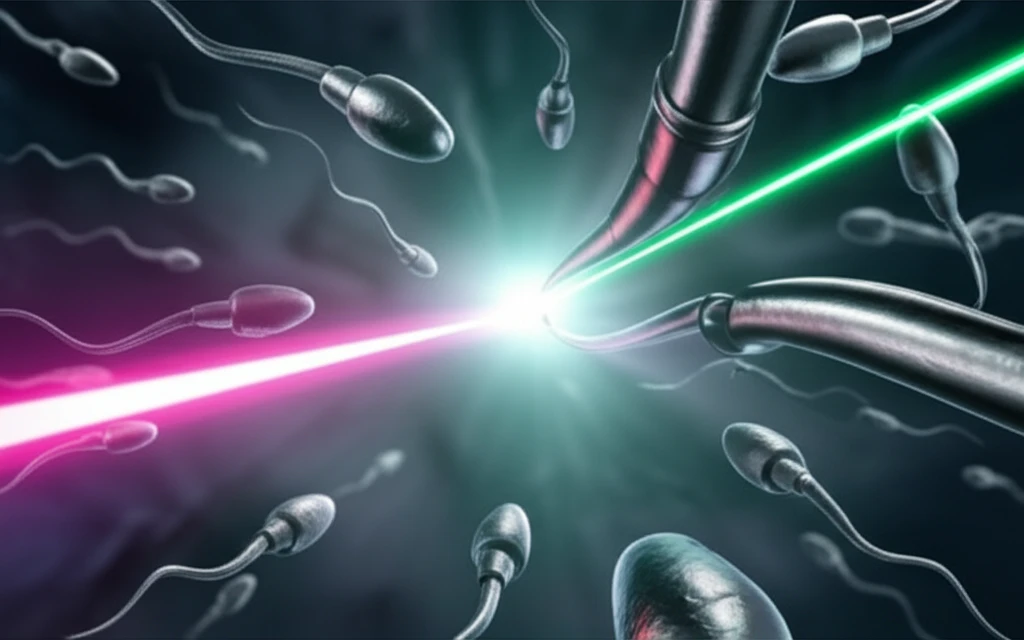
Illustration of laser precision in clearing ejaculatory duct obstruction for fertility treatment.

Unlocking Fertility: The Hybrid Approach to Clearing Ejaculatory Duct Obstructions

"A new technique combines laser precision with traditional methods to overcome blockages and improve sperm quality."


Infertility affects a significant number of couples, with male factors contributing substantially to these challenges. Among these factors, ejaculatory duct obstruction (EDO) is a condition where blockages in the ducts prevent sperm from being released during ejaculation. This can lead to low semen volume or even azoospermia, the complete absence of sperm, impacting a man's ability to conceive naturally.

Traditional treatments for EDO include transurethral resection of the ejaculatory ducts (TUREJD), a surgical procedure to remove the obstruction. However, navigating the narrow spaces of the prostatic urethra can be challenging, sometimes limiting the effectiveness of the procedure. Advances in technology have paved the way for innovative approaches that enhance the precision and success of EDO treatment.

A recent study introduces a hybrid technique combining the precision of holmium:yttriumaluminium garnet (Ho:YAG) laser with monopolar transurethral resection. This novel approach aims to overcome the limitations of traditional TUREJD, offering a more effective solution for men with complete ejaculatory duct obstruction and improving their chances of fathering a child.

What is Ejaculatory Duct Obstruction (EDO) and How Does It Impact Fertility?

Illustration of laser precision in clearing ejaculatory duct obstruction for fertility treatment.

Ejaculatory Duct Obstruction (EDO) occurs when one or both ejaculatory ducts become blocked, preventing sperm from mixing with seminal fluid and being released during ejaculation. This blockage can result in a variety of issues, including:

The causes of EDO can be congenital (present at birth) or acquired later in life. Common causes include:

  • Congenital atresia (abnormal development of the ducts)
  • Duct cysts
  • Trauma to the pelvic area
  • Infections
  • Inflammation
  • Calculus formation (stones)
Diagnosing EDO typically involves a combination of physical examinations, imaging techniques, and semen analysis. Advances in diagnostic methods, such as high-resolution transrectal ultrasonography (TRUS) and magnetic resonance imaging (MRI), have greatly improved the accuracy of EDO diagnosis, allowing for targeted and effective treatment strategies.

The Future of EDO Treatment: A Promising Outlook

The hybrid technique combining Ho:YAG laser and monopolar TUR represents a significant advancement in the treatment of EDO. By providing a more precise and less invasive approach, this method offers new hope for men struggling with infertility due to ejaculatory duct obstruction. As research continues and techniques refine, the future of EDO treatment looks promising, with the potential to improve fertility outcomes and quality of life for countless individuals and couples.

About this Article -

This article was crafted using a human-AI hybrid and collaborative approach. AI assisted our team with initial drafting, research insights, identifying key questions, and image generation. Our human editors guided topic selection, defined the angle, structured the content, ensured factual accuracy and relevance, refined the tone, and conducted thorough editing to deliver helpful, high-quality information.See our About page for more information.

This article is based on research published under:

DOI-LINK: 10.3349/ymj.2013.54.4.1062, Alternate LINK

Title: Hybrid Method Of Transurethral Resection Of Ejaculatory Ducts Using Holmium:Yttriumaluminium Garnet Laser On Complete Ejaculatory Duct Obstruction

Subject: General Medicine

Journal: Yonsei Medical Journal

Publisher: Yonsei University College of Medicine

Authors: Joo Yong Lee, Richilda Red Diaz, Young Deuk Choi, Kang Su Cho

Published: 2013-01-01

Everything You Need To Know

1

What is Ejaculatory Duct Obstruction (EDO), and how does it affect a man's ability to have children?

Ejaculatory Duct Obstruction (EDO) occurs when one or both of the ejaculatory ducts are blocked. This blockage prevents sperm from mixing with seminal fluid and being released during ejaculation. This can result in low semen volume or azoospermia, severely impacting the ability to conceive naturally. The implications of EDO are significant because it directly interferes with the process of sperm transport and delivery, a critical step in male fertility. Without treatment, EDO will continue to be a significant barrier to conception.

2

What are the traditional methods for treating Ejaculatory Duct Obstruction, and what are their limitations?

Traditional treatment for EDO involves transurethral resection of the ejaculatory ducts (TUREJD). This is a surgical procedure aimed at removing the obstruction. However, navigating the narrow spaces of the prostatic urethra during TUREJD can be challenging. The limitations of traditional methods include the potential for incomplete removal of the blockage and a higher risk of complications due to the invasive nature of the procedure. The evolution of treatments for EDO involves incorporating advanced technologies to improve precision and effectiveness.

3

How does the hybrid technique work to treat Ejaculatory Duct Obstruction?

The hybrid technique combines the holmium:yttrium-aluminum garnet (Ho:YAG) laser with monopolar transurethral resection. The Ho:YAG laser is used for its precision in ablating the obstruction, while the monopolar transurethral resection provides a method for clearing the blockage. This hybrid approach aims to overcome the limitations of traditional TUREJD. By enhancing precision and reducing invasiveness, it can lead to improved outcomes for men with complete EDO and increase their chances of conceiving naturally. This combination offers a more effective solution compared to either method alone.

4

What are the common causes of Ejaculatory Duct Obstruction (EDO)?

Causes of Ejaculatory Duct Obstruction (EDO) can be either congenital (present at birth) or acquired later in life. Congenital atresia, which is the abnormal development of the ducts, can cause EDO. Also, duct cysts, trauma to the pelvic area, infections, inflammation, and calculus formation (stones) are potential causes. Understanding the underlying cause is essential for accurate diagnosis and effective treatment. The diversity of causes underscores the complexity of EDO.

5

How is Ejaculatory Duct Obstruction diagnosed?

Diagnosing Ejaculatory Duct Obstruction (EDO) involves a combination of physical examinations, imaging techniques, and semen analysis. High-resolution transrectal ultrasonography (TRUS) and magnetic resonance imaging (MRI) have greatly improved the accuracy of diagnosis. Semen analysis helps to evaluate the presence and quality of sperm, while imaging techniques help visualize the obstruction. Accurate diagnosis is crucial for determining the appropriate treatment strategy. The use of advanced diagnostic methods allows for targeted and effective treatment of EDO, which can significantly improve fertility outcomes.

Newsletter Subscribe

Subscribe to get the latest articles and insights directly in your inbox.