
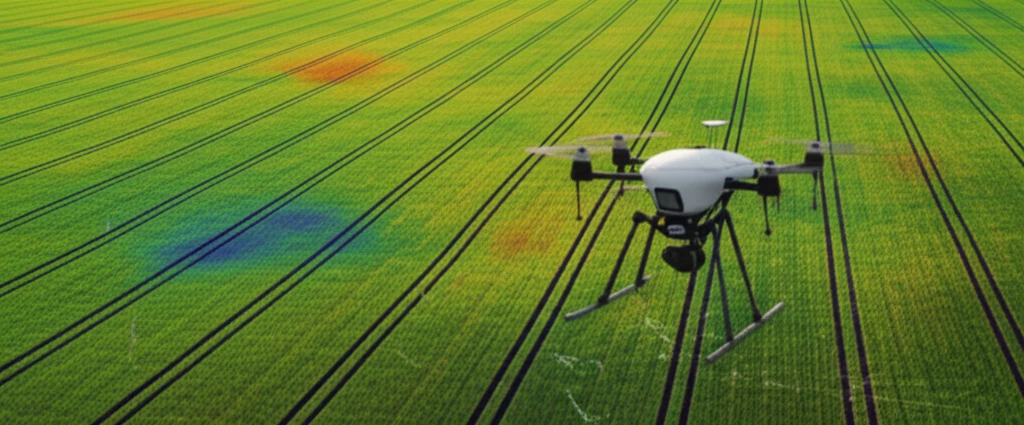
Aerial view of pasture with heat map visualization of nitrogen levels.

Unlock Your Farm's Potential: How Aerial Tech Can Boost Pasture Health

"Discover how drone-based remote sensing revolutionizes nitrogen management in Brachiaria decumbens pastures, improving yield and sustainability."


In the world of modern agriculture, staying competitive means embracing innovative techniques that optimize resource use and maximize yields. For cattle farmers, pasture health is paramount, directly impacting the quality and quantity of bovine meat production. Traditional methods of assessing pasture conditions can be time-consuming and often lack the precision needed for effective management. Enter the era of remote sensing, offering a bird's-eye view of pasture health and nutritional status.

A recent study published in Engenharia Agrícola explores the use of an aerial remote sensing system to detect variations in the nutritional status of Brachiaria decumbens, a common pasture grass. This research highlights how digital images, captured from cameras mounted on a helium balloon, can be used to assess the impact of different nitrogen levels on pasture growth. Nitrogen, a crucial nutrient for plant development, plays a significant role in forage productivity. Efficient nitrogen management is not only essential for maximizing yields but also for minimizing environmental impact.

This article delves into the findings of this study, explaining how aerial remote sensing can revolutionize pasture management. We'll break down the methods used, the key results obtained, and the practical implications for farmers looking to enhance pasture health, optimize fertilizer use, and promote sustainable farming practices. Whether you're a seasoned agricultural professional or new to the field, understanding these advancements can unlock your farm's full potential.

Nitrogen's Impact: Seeing the Unseen with Aerial Imaging

Aerial view of pasture with heat map visualization of nitrogen levels.

The study's core objective was to determine if digital images acquired via balloon-mounted cameras could effectively detect variations in the nutritional status of Brachiaria decumbens pastures. Researchers applied five different doses of nitrogen fertilizer (0, 50, 100, 150, and 200 kg ha⁻¹) to the pastures and then used a remote sensing system to capture images at varying heights (15, 20, 25, and 30 meters). The system consisted of digital cameras, microcomputers, and a helium balloon used to lift the cameras, and a chlorophyll meter to measure the nitrogen content.

To validate the accuracy of the aerial system, researchers compared the image data with traditional methods, measuring chlorophyll content using a portable meter and conducting laboratory analyses of leaf nitrogen content. Data was collected in two phases, accounting for different climatic conditions. At the end of each phase, dry matter production was measured to assess the overall impact of the nitrogen treatments.

To evaluate the effectiveness of the aerial system, the researchers used three key vegetation indices:
  • NDVI (Normalized Difference Vegetation Index): Measures the difference between near-infrared and red light reflected by vegetation.
  • GNDVI (Green Normalized Difference Vegetation Index): Similar to NDVI but uses green light instead of red light.
  • SAVI (Soil Adjusted Vegetation Index): Modifies NDVI to minimize the impact of soil brightness.
The study found that all three vegetation indices were capable of detecting the effects of different nitrogen doses. Notably, the indices constructed using the green spectral band (GNDVI) proved to be more efficient than those using the red spectral band (NDVI) in detecting nutritional variations.

Sky-High Insights for Down-to-Earth Results

This study demonstrates the potential of aerial remote sensing as a valuable tool for assessing pasture health and optimizing nitrogen management. By using balloon-mounted cameras and analyzing vegetation indices, farmers can gain a more precise understanding of the nutritional status of their pastures.

The findings suggest that GNDVI, which utilizes the green spectral band, is particularly effective in detecting nutritional variations in Brachiaria decumbens. This information can help farmers tailor their fertilizer applications, ensuring that pastures receive the right amount of nitrogen to maximize yields without over-fertilizing.

Embracing aerial remote sensing technology can lead to more sustainable farming practices, reduced environmental impact, and healthier, more productive pastures. As technology continues to advance, expect even more sophisticated tools to emerge, further empowering farmers to make informed decisions and optimize their operations.

About this Article -

This article was crafted using a human-AI hybrid and collaborative approach. AI assisted our team with initial drafting, research insights, identifying key questions, and image generation. Our human editors guided topic selection, defined the angle, structured the content, ensured factual accuracy and relevance, refined the tone, and conducted thorough editing to deliver helpful, high-quality information.See our About page for more information.

This article is based on research published under:

DOI-LINK: 10.1590/s0100-69162013000500016, Alternate LINK

Title: Using An Aerial System Of Remote Sensing To Detect Different Nutritional Status In Brachiaria Decumbens

Subject: Agricultural and Biological Sciences (miscellaneous)

Journal: Engenharia Agrícola

Publisher: FapUNIFESP (SciELO)

Authors: Mário C. Da Silva Júnior, Francisco De A. De C. Pinto, Daniel M. De Queiroz, Luciano B. Vieira, Ricardo C. De Resende

Published: 2013-10-01

Everything You Need To Know

1

How does aerial remote sensing help in determining pasture health?

Aerial remote sensing is used to determine the nutritional status of Brachiaria decumbens pastures by analyzing digital images captured from cameras mounted on a helium balloon. These images are processed to assess the impact of different nitrogen levels on pasture growth. The system involves using digital cameras, microcomputers, and a chlorophyll meter to measure the nitrogen content. This method provides a bird's-eye view, offering a more precise and less time-consuming assessment compared to traditional methods.

2

What are the key vegetation indices used to evaluate pasture health, and what does each one measure?

The three key vegetation indices used in the study are NDVI (Normalized Difference Vegetation Index), which measures the difference between near-infrared and red light reflected by vegetation; GNDVI (Green Normalized Difference Vegetation Index), which is similar to NDVI but uses green light instead of red light; and SAVI (Soil Adjusted Vegetation Index), which modifies NDVI to minimize the impact of soil brightness. These indices help in quantifying the health and nutritional status of the pasture.

3

Why is efficient nitrogen management so critical for pasture health, and what are its implications?

Nitrogen management is important because nitrogen is a crucial nutrient for plant development, directly impacting forage productivity in Brachiaria decumbens pastures. Efficient nitrogen management maximizes yields and minimizes environmental impact. By precisely detecting variations in nitrogen levels, farmers can optimize fertilizer use, leading to healthier, more productive land and sustainable farming practices. Insufficient management can lead to reduced yields and environmental damage, while over-application can result in nutrient runoff and pollution.

4

Which vegetation index proved more effective in detecting nutritional variations, and why?

The study found that the Green Normalized Difference Vegetation Index (GNDVI) was more efficient than the Normalized Difference Vegetation Index (NDVI) in detecting nutritional variations in Brachiaria decumbens pastures. This is because GNDVI uses green light, which is more sensitive to changes in chlorophyll content, an indicator of plant health and nitrogen levels. This finding suggests that focusing on green spectral bands can provide more accurate assessments of pasture health.

5

What aspects of aerial remote sensing for pasture health weren't covered, and what further research could be done?

While the study focuses on aerial remote sensing using balloon-mounted cameras and specific vegetation indices like NDVI, GNDVI, and SAVI for Brachiaria decumbens pastures, it doesn't delve into the specifics of data processing techniques, such as machine learning algorithms or advanced image analysis. Additionally, the economic feasibility of implementing such systems on a large scale is not discussed. Future research could explore these areas to further refine and optimize the use of aerial remote sensing in pasture management, potentially integrating other technologies like drone-based sensors and AI-driven analysis for even more precise and efficient results. The long-term environmental impacts of optimized nitrogen use, such as changes in soil health and biodiversity, could also be investigated.

Newsletter Subscribe

Subscribe to get the latest articles and insights directly in your inbox.