
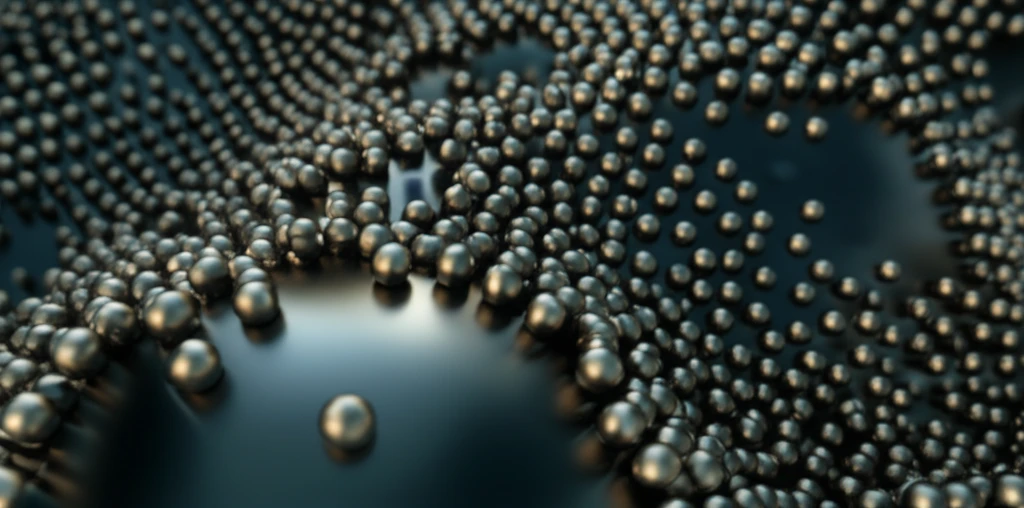
Dot-like metal nanocrystals forming on a nanosheet surface.

Tiny Dots, Big Potential: How New Metal Nanocrystals Could Revolutionize Material Science

"Scientists discover a novel method for creating 2D metal nanocrystals with unique properties, paving the way for advanced materials and technologies."


Metal nanomaterials, those tiny particles, rods, and wires measured in nanometers, have captured the attention of scientists worldwide. Their unique physical and chemical properties, stemming from their size and shape, make them incredibly promising for diverse applications. From creating faster electronics and more efficient solar cells to developing advanced sensors and catalysts, the possibilities seem endless.

A particularly exciting area of research involves creating these nanomaterials in two-dimensional (2D) forms. Imagine atomically thin sheets with precisely controlled properties. One cutting-edge technique involves 'exfoliation,' stripping down layered compounds like clays, oxides, and graphite into single-layer nanosheets. These nanosheets, just a few nanometers thick but potentially micrometers wide, can then be manipulated and transformed into new materials.

This article dives into the innovative work of researchers who have successfully created novel 2D metal nanocrystals using exfoliated ruthenate nanosheets. By carefully controlling the heating process of these nanosheets, they've achieved a dot-like formation of ruthenium (Ru) metal nanocrystals with unique dimensions and properties. This breakthrough could lead to a new generation of advanced materials with tailored functionalities.

From Nanosheets to Nanodots: The Metallization Process

Dot-like metal nanocrystals forming on a nanosheet surface.

The journey from layered ruthenate to metal nanocrystals begins with a carefully prepared precursor material: K0.2RuO2.1. This layered compound undergoes a process called exfoliation, resulting in individual Ru0.95O2.2- nanosheets. Think of it like peeling apart the layers of a flaky pastry to obtain extremely thin sheets.

The magic happens when these nanosheets are heated in a controlled environment. Here's a breakdown of the key steps:

  • Initial Material: Starting with layered potassium ruthenate (K0.2RuO2.1).
  • Exfoliation: Separating the layers into individual Ru0.95O2.2- nanosheets.
  • Heating: Applying heat in a mixture of nitrogen and hydrogen gas.
  • Transformation: The nanosheets convert into ruthenium (Ru) metal.
  • Dot Formation: Under specific conditions, dot-like nanocrystals form.
The researchers discovered that heating multilayers of these nanosheets at around 200°C in a mixture of nitrogen and hydrogen transforms them into hexagonal close-packed (hcp) Ru metal. What's particularly fascinating is the unique morphology of the resulting metal, reflecting the original layered structure of the precursor nanosheets. Moreover, when a monolayer of the Ru0.95O2.2- nanosheets is used, it triggers the formation of dot-like Ru metal nanocrystals, approximately 0.6 nm thick and tens of nanometers wide – a new class of 2D anisotropic metal nanomaterials.

Opening Doors to Future Tech

This research highlights the incredible potential of using exfoliated nanosheets to create novel nanomaterials with precisely controlled properties. By manipulating the initial structure and reaction conditions, scientists can tailor the size, shape, and composition of these materials, opening up a world of possibilities for advanced applications.

Imagine more efficient catalysts for chemical reactions, ultra-sensitive sensors for detecting diseases, or even new types of electronic devices with enhanced performance. The dot-like Ru metal nanocrystals created in this study represent a significant step towards these goals.

Further research into the properties and applications of these unique nanocrystals will undoubtedly pave the way for exciting technological advancements in the years to come. This innovative approach could revolutionize various fields, impacting everything from electronics and energy to medicine and environmental science.

About this Article -

This article was crafted using a human-AI hybrid and collaborative approach. AI assisted our team with initial drafting, research insights, identifying key questions, and image generation. Our human editors guided topic selection, defined the angle, structured the content, ensured factual accuracy and relevance, refined the tone, and conducted thorough editing to deliver helpful, high-quality information.See our About page for more information.

This article is based on research published under:

DOI-LINK: 10.1380/ejssnt.2014.97, Alternate LINK

Title: Dot-Like Formation Of Metal Nanocrystals From Exfoliated Ruthenate Nanosheets

Subject: Surfaces, Coatings and Films

Journal: e-Journal of Surface Science and Nanotechnology

Publisher: Surface Science Society Japan

Authors: Katsutoshi Fukuda, Kazuhiro Kumagai

Published: 2014-01-01

Everything You Need To Know

1

How are these dot-like metal nanocrystals actually made from ruthenate?

The process starts with potassium ruthenate (K0.2RuO2.1), which is exfoliated into individual Ru0.95O2.2- nanosheets. These nanosheets are then heated in a mixture of nitrogen and hydrogen gas, transforming them into ruthenium (Ru) metal. By controlling the conditions, specifically using a monolayer of Ru0.95O2.2- nanosheets, dot-like Ru metal nanocrystals are formed. These nanocrystals are approximately 0.6 nm thick and tens of nanometers wide, representing a novel class of 2D anisotropic metal nanomaterials. The original layered structure of the precursor nanosheets influences the morphology of the resulting metal.

2

What makes these tiny 2D metal nanocrystals so special and what are they good for?

Metal nanomaterials, including these 2D metal nanocrystals, possess unique physical and chemical properties due to their size and shape. These properties make them suitable for a wide array of applications, such as faster electronics, more efficient solar cells, advanced sensors, and catalysts. The ability to precisely control their size, shape, and composition opens doors to tailoring functionalities for specific technological advancements. While the text highlights electronics, optics, and catalysis, future applications might extend to medicine, environmental science, and energy storage.

3

What does 'exfoliation' mean in the process of making these nanocrystals?

Exfoliation is a technique used to strip down layered compounds, such as clays, oxides, and graphite, into single-layer nanosheets. In the context of creating the dot-like metal nanocrystals, exfoliation is used to separate layered potassium ruthenate (K0.2RuO2.1) into individual Ru0.95O2.2- nanosheets. These nanosheets then serve as the starting material for the subsequent heating and transformation process.

4

Why use ruthenate to create these nanocrystals? Could other metals work?

The research specifically uses exfoliated ruthenate nanosheets, derived from the compound K0.2RuO2.1. These nanosheets are composed of Ru0.95O2.2-. When a monolayer of these nanosheets is heated under controlled conditions, dot-like nanocrystals of ruthenium (Ru) metal are formed. This is different from using other metals because Ruthenium allows the creation of unique 2D anisotropic metal nanomaterials that are approximately 0.6 nm thick and tens of nanometers wide. The process leverages the structure of ruthenate to achieve this specific dot-like formation, something not necessarily achievable with all metals.

5

Why is using exfoliated nanosheets important for controlling the properties of the new materials?

The use of exfoliated nanosheets allows for precise control over the size, shape, and composition of the resulting nanomaterials. By manipulating the initial structure of the nanosheets and the reaction conditions (such as temperature and gas composition), scientists can tailor the properties of the 2D metal nanocrystals. This level of control is essential for optimizing their performance in specific applications, allowing for a new generation of advanced materials with tailored functionalities. Without this control, it would be difficult to achieve the desired properties for specific applications.

Newsletter Subscribe

Subscribe to get the latest articles and insights directly in your inbox.