
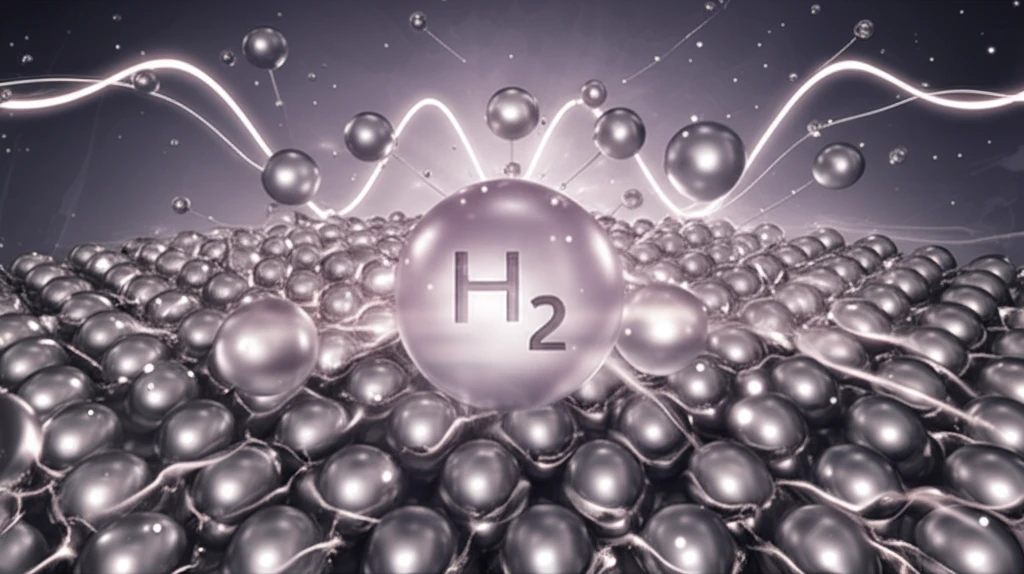
The Hidden Danger in Fusion Energy: Understanding Hydrogen's Impact on Tungsten

"New research sheds light on how hydrogen behaves near tungsten surfaces, a critical factor for the future of fusion reactors and their plasma facing materials. Uncover the science behind surface blistering and material degradation."
Tungsten is a promising material for fusion reactors, which are designed to harness the power of the stars to generate clean energy. One major hurdle? The intense conditions inside a reactor, where high-energy hydrogen isotopes bombard the reactor walls. This bombardment can cause hydrogen to accumulate within the tungsten, leading to blistering and ultimately compromising the material's integrity.
For years, scientists have been grappling with the complexities of this issue, striving to understand exactly how hydrogen interacts with tungsten at the atomic level. This knowledge gap has hindered the development of effective strategies to mitigate the damage and ensure the long-term reliability of fusion reactors. Understanding the way that hydrogen accumulates is essential to creating the technology of tomorrow.
Recent research published in Materials Today Communications has shed new light on this critical interaction. Using advanced computational methods, scientists have simulated the behavior of hydrogen atoms on and within tungsten surfaces, providing valuable insights into the mechanisms driving surface blistering. By understanding the forces at play, we can pave the way for more resilient materials and, ultimately, the realization of sustainable fusion energy.
Fusion's Promised Timelines and the Statistics That Aren't There Yet
Companies such as Tokamak Energy are targeting fusion power plants in the 2040s, touting technologies like high-temperature superconducting magnets and power delivery on the order of one megawatt per server rack. Helion Energy describes its approach as one in which magnets accelerate particles toward each other so that they merge, fusion occurs, and the released energy is converted into usable electricity. As a Citi I/O report on MIT research notes, fusion harnesses the reaction that powers the stars — the fusion of light nuclei — often called "plasma fusion," since the reactions take place in a plasma confined by magnets or ignited by powerful lasers. Meanwhile, official statistics such as the U.S. Energy Information Administration's Weekly Petroleum Status Report continue to track conventional fuels, underscoring how far fusion remains from commercial energy accounting.
Confinement Approaches and the Limits of Standard Methods
The dominant approaches to fusion are inertial confinement fusion and magnetic confinement fusion, with ITER representing the magnetic confinement path; in both cases, it takes energy to bring about the release of nuclear fusion energy. Standard materials testing has traditionally relied on a "cook and look" method, though researchers recently blasted a thin copper film with laser heat to rapidly escalate its temperature, finding that copper endured 2,595°F and defied earlier models. Some researchers, such as Rostoker and Binderbauer, deliberately rejected the mainstream approach altogether, beginning their quest by searching for a fusion reaction that could replace deuterium-tritium. That search reflects a recognized limitation of the standard approach: dependence on deuterium-tritium and the difficulty of engineering materials that survive extreme conditions.
From Proof-of-Principle to Record Plasma Pressures
Fusion's foundational discoveries date to the realization that the process can produce energy, and the field has continued to log milestones, including what Science reported as a historic explosion marking a long-sought fusion breakthrough. On the technology side, companies like Helion Energy, founded in Everett, Washington, are pursuing magneto-inertial fusion that combines deuterium with helium-3 via aneutronic fusion. More recently, in August 2026, a practical nuclear fusion milestone was recorded when a machine achieved its highest plasma pressure yet while overcoming control problems, a feat reported by Interesting Engineering and associated with the UKAEA. Together these milestones trace the arc from early proof-of-principle to ever-higher plasma performance.
The First-Principles Study: A Closer Look
The study employed first-principles calculations, a powerful simulation technique rooted in quantum mechanics. These calculations allow researchers to model the behavior of atoms and molecules with remarkable accuracy, predicting their interactions and properties without relying on experimental data alone. This approach is particularly valuable when studying complex phenomena, such as hydrogen-tungsten interactions, where experimental observations can be challenging.
- Adsorption energies: How strongly hydrogen atoms bind to different sites on the tungsten surface.
- Migration pathways: The routes hydrogen atoms take as they move across and into the tungsten material.
- Binding energies: The forces between hydrogen atoms within the tungsten lattice, influencing their tendency to cluster or repel each other.
Plasma-Edge Disruptions and a Maturing Industry
European fusion studies are shedding light on disruptive phenomena at the plasma edge, and new research reported by the UKAEA complements German studies on better controlling bursts of energy that destabilize plasma in fusion machines; these include experiments on MAST, the Mega Amp Spherical Tokamak. Industry coverage is also maturing: The Fusion Report, a newsletter covering breakthroughs and analysis, interviewed Cosylab CEO Mark Pleško about the 250-person Slovenian company's two decades of building control systems for ITER, UKAEA, and major research labs. The broader history remains relevant to current research, as Inverse notes that investigations into fusion energy date to the 1920s, when astronomers realized fusion could explain how stars keep burning, and that the field was shaped by Cold War secrecy.
Setbacks, Instabilities, and the Fuel Question
Fusion has faced a long list of setbacks. At the National Ignition Facility, the first demonstrations of net fusion energy gain were a world first, but Physics World notes that instabilities in the plasma and asymmetries in the capsule implosions limited the facility's fusion output — the result of a ten-year slog of step-by-step problem solving. NIF's high energy density and inertial confinement fusion experiments have also drawn criticism, with Science.org reporting concerns that fusion power may run out of fuel before it even gets started. Proponents counter that ITER and similar projects remain a promising long-term option for sustainable, non-carbon-emitting energy, though the scale of the engineering challenges remains a persistent counterweight.
Two Very Different Things Called 'Fusion Energy'
In the scientific frame, fusion power is described by The Cool Down as "maybe the ultimate clean energy goal": it is safe, produces little waste, and does not pollute the environment, and industrial-scale reactors could help solve the problems presented by dirty energy, which emits gases that rapidly heat the Earth. Notably, a competing "fusion energy" comparison exists in the consumer market: TikTok reviews of the Fusion Energy Drink focus on its unique flavors and ingredients rather than any power-generation claims. The contrast underscores how sharply the term "fusion energy" is used depending on audience — a scientific energy source versus a branded beverage.
Implications and Future Directions
This research provides valuable insights into the complex interplay between hydrogen and tungsten, paving the way for the development of more durable and reliable plasma-facing materials. Understanding how hydrogen interacts with tungsten at the atomic level is crucial for mitigating surface blistering and ensuring the long-term viability of fusion reactors. By tailoring the composition and microstructure of tungsten-based materials, scientists can potentially minimize hydrogen retention and extend the lifespan of reactor components, bringing us closer to a future powered by clean, sustainable fusion energy.
The Physics Is Simple; the Economics Are Not
Experts agree the physics principle is straightforward: when a lightweight atomic nucleus is merged at high temperatures, more energy is produced than went in, and that extra energy can then be used to generate electricity, as the Institute for Climate explains. Yet expert commentary tempers enthusiasm — GeekWire notes that the Sun, while a fusion reactor, has an energy density comparable to a compost heap, working only because it is gigantic. Meanwhile, an MIT-led analysis concludes that fusion's biggest challenge may no longer be the physics: now that fusion has proved it can produce net energy, commercial plants must also generate more economic value than they cost. Institutions are responding by strengthening leadership, with the UKAEA appointing fusion expert Dennis Whyte as its next CEO, whose agenda emphasizes modelling, engineering design, materials analysis, and data processing.
The Holy Grail's New Hurdle: Profitability
Fusion energy, long seen as the "holy grail" of clean power, is moving closer to commercial reality as climate change pressures mount and nations strive for carbon neutrality, positioning the fusion energy market as a potential game-changer in the global energy mix. The next frontier, however, may be economic rather than scientific: an MIT study introduces an economic Q model defining fusion's new challenge of making profits, not just energy. Public perception has been shaped by recent milestones, such as when Lawrence Livermore National Laboratory produced more fusion energy than the energy in the incoming laser beams for a tiny moment in 2022. In physical terms, the fuel for this future is hydrogen reaching temperatures in excess of 100 million degrees Celsius.
A 70-Year Bottleneck and the Call for All Hands on Deck
A 70-year-old problem in fusion containment — a long-standing bottleneck for engineers — was recently reported as solved; traditionally, fixing magnetic flaws required complex simulations based on Newton's laws, which are accurate but painfully slow, meaning reactor designs could take years to iterate and test. The broader quest, as The New York Times frames it, began as an answer to a question humans have asked since first raising our heads toward the sky. Responding to that challenge, leaders like ORNL Fusion Energy Division Director Troy Carter call for "all hands on deck," drawing on more than two decades of experience in national and international fusion research advisory committees. Companies such as Helical Fusion are also framing the effort in terms of broader societal impact, with its CEO set to discuss the transformative changes commercialization could bring to global energy systems at the Black Swan Summit in Australia.
ITER: A Partnership of Unprecedented Scale
ITER, described as the world's biggest experiment on the path to fusion energy, is currently under construction in Cadarache, in the south of France, and is hosted by Europe. The project represents a global scientific partnership of unprecedented scale, bringing together nations representing half of the world's population, including China and Europe. This human dimension — countries collaborating across political divides on a shared energy goal — is arguably the real-world impact that makes ITER more than a physics experiment.