
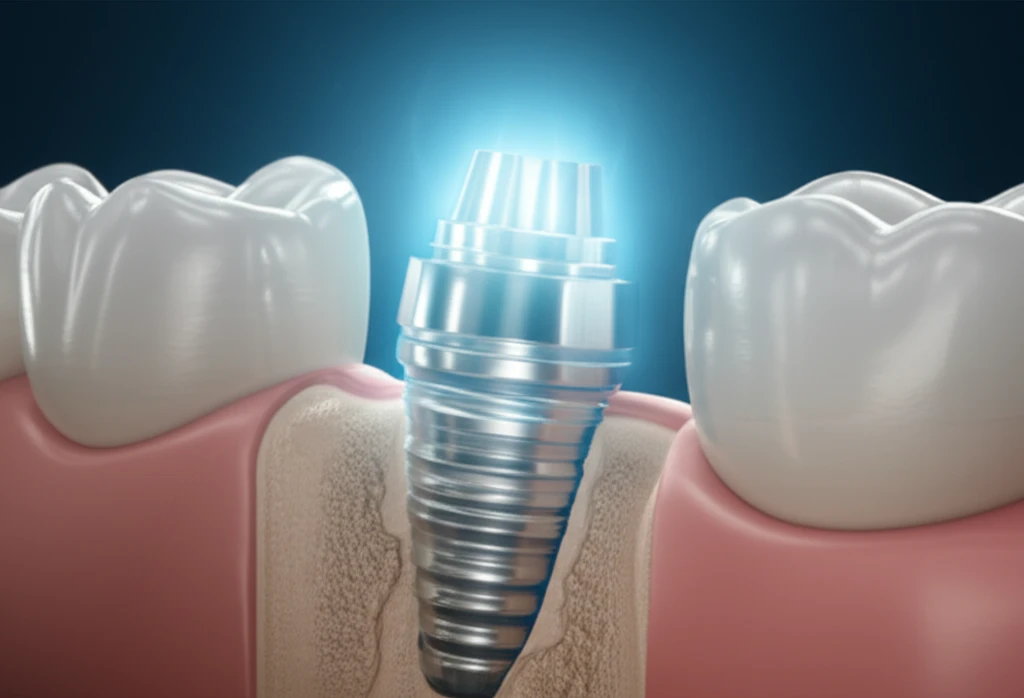
The Future of Dental Implants: How Abutment Design Impacts Bone Health

"Discover how innovative abutment designs and connections are revolutionizing dental implant procedures, leading to better marginal bone stability and long-term success."
Stable peri-implant bone is essential for successful implant-supported prosthetic rehabilitation. Preserving the integrity of peri-implant soft tissues is a prerequisite, and platform switching has emerged as a technique to maintain marginal bone around implants. Studies show that implants with integrated platform switching experience minimal crestal bone loss—around 0.37 mm—and a 30-50% reduction compared to non-platform switching implants.
Recently, modified titanium abutments with vertical preparation have been designed to modulate soft tissue integration around implant-supported crowns. While these advancements are promising, many supporting studies rely on empirical data without rigorous controls.
A randomized controlled clinical trial aimed to evaluate the efficacy of platform switching (PS) versus platform matching (PM), and vertical modified abutments (MA) versus conventional abutments (CA) on peri-implant Marginal Bone Level (MBL) and Probing Depth (PD). This research provides valuable insights into optimizing dental implant procedures for better patient outcomes.
Understanding Abutment Design and Marginal Bone Level
The clinical trial involved 80 implants inserted in 42 patients after obtaining IRB approval. Participants were randomly assigned to one of four groups (n = 20 per group):
- Group 1: Platform Matching with Conventional Abutments (PM+CA)
- Group 2: Platform Matching with Modified Abutments (PM+MA)
- Group 3: Platform Switching with Conventional Abutments (PS+CA)
- Group 4: Platform Switching with Modified Abutments (PS+MA)
Key Takeaways for Dental Professionals
At the 1-year follow-up, Marginal Bone Level (MBL) was more stable in groups using Platform Switching (PS) compared to Platform Matching (PM). The implant-abutment connection (PS versus PM) appears to be more critical than the abutment preparation type (Modified Abutments [MA] versus Conventional Abutments [CA]). At 1-year, Probing Depth (PD) increased in group 1. These findings suggest that using Platform Switching (with both Modified and Conventional Abutments) and Modified Abutments (with both Platform Switching and Platform Matching) can positively influence Marginal Bone Level stability and Probing Depth.