
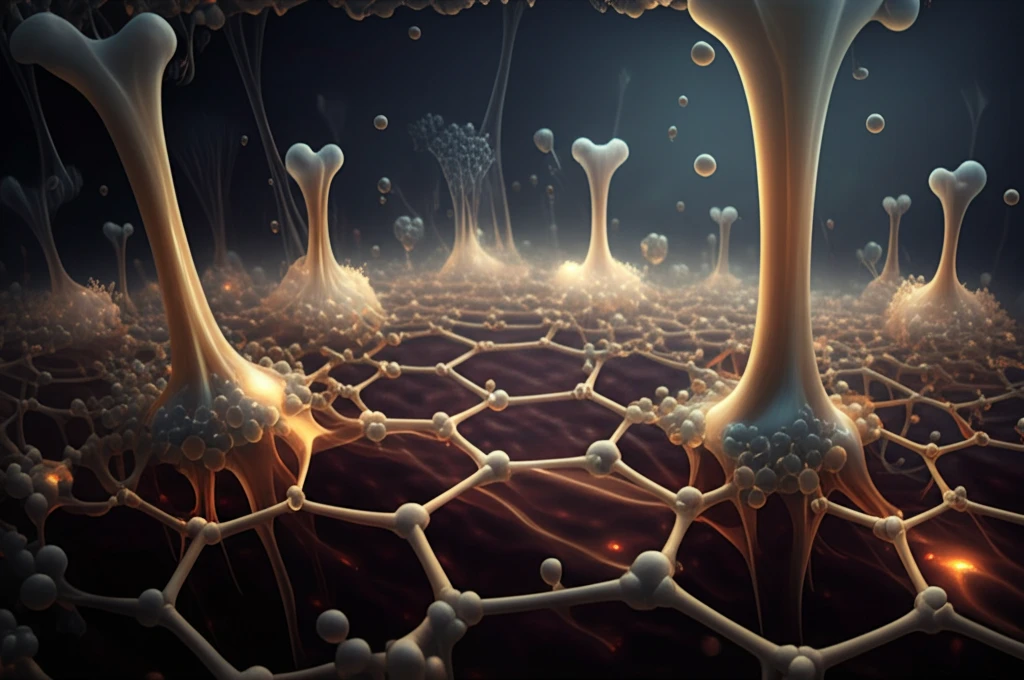
The Future of Bone Healing: How Nanotechnology is Revolutionizing Bone Regeneration

"Discover how crosslinked chitosan nanocomposites are paving the way for more effective and biomimetic bone mineralization."
For centuries, the treatment of bone defects and fractures has relied on traditional methods like autografts and allografts. While these approaches have their merits, they also come with significant drawbacks, including donor scarcity, immune rejection, and the risk of pathogen transmission. This has spurred researchers to seek innovative solutions that can overcome these limitations and promote more effective bone regeneration.
Enter nanotechnology, a field that holds immense promise for revolutionizing medicine, including bone tissue engineering. By manipulating materials at the nanoscale, scientists can create biocompatible materials that mimic the structure and properties of natural bone, facilitating the body's own healing processes. One such material is chitosan, a unique polysaccharide derived from chitin, found in the exoskeletons of insects and crustaceans. Chitosan possesses several desirable properties, including biocompatibility, biodegradability, and non-toxicity, making it an attractive candidate for bone regeneration applications.
However, chitosan alone has limitations. To enhance its properties and create a more effective bone regeneration material, researchers are turning to nanocomposites – materials that combine chitosan with other nanoscale components. This article will delve into the exciting world of chitosan nanocomposites, focusing on a recent study that explores the potential of crosslinked chitosan/nitrogen-doped graphene quantum dot nanocomposites for hydroxyapatite biomimetic mineralization.
Chitosan Nanocomposites: A Growing Class of Advanced Biomaterials
Chitosan-based nanocomposites have emerged as a versatile class of materials with tunable mechanical, antibacterial, and barrier properties. Research has shown that incorporating small amounts of nanofillers such as montmorillonite-CuO into chitosan films can enhance mechanical strength and antibacterial activity while reducing water solubility and UV transmission with minimal impact on transparency. Separately, Fe3O4 chitosan nanocomposites have been developed using coprecipitation methods and cross-linked via glutaraldehyde, demonstrating pH-responsive delivery capabilities. Green-synthesized AgNP-chitosan nanocomposites using plant extracts such as Cymbopogon citratus have also been characterized through SEM, FTIR, and tensile testing, expanding the repertoire of sustainable fabrication routes.
Fabrication Methods for Chitosan Nanocomposites
Several established fabrication approaches are used to produce chitosan nanocomposites for biomedical and materials applications. The ionotropic gelation method has been employed to synthesize chitosan/ZnO nanocomposites for targeted delivery of antibacterial peptides such as LL37. Atomic layer deposition (ALD) with minimal cycles has been used as a novel approach to enrich titania nanotubes with thin hydroxyapatite coatings, enhancing biocompatibility of titania-chitosan composites. In situ compositing methods involving precursor solutions and chitosan membranes have been used to prepare magnetite/hydroxyapatite/chitosan nanocomposites, while xathate-modified magnetic chitosan nanocomposites have been developed for adsorption applications such as mercury removal from aqueous solutions.
Early Developments in Chitosan Nanocomposite Research
Foundational work on chitosan nanocomposites has established key processing-structure-property relationships that continue to guide current research. Studies on polyamide/chitosan nanocomposites fabricated via electrospinning have revealed nanofiber adhesion and orientation within the matrix, with thermal degradation temperatures in the range of 300 to 500 degrees Celsius as measured by XRD and FTIR. Early preparation of silver-chitosan nanocomposite particles demonstrated antimicrobial activity, laying groundwork for metal nanoparticle incorporation into chitosan matrices. Research into the processing-properties-applications relationship of nanocomposites based on polymer matrices has provided a conceptual framework that underpins modern nanocomposite design for biomedical and industrial uses.
The Science Behind Chitosan Nanocomposites
The recent study, led by Shadpour Mallakpour and Elham Khadem, investigates the creation and properties of a novel nanocomposite material designed to mimic the natural mineralization process of bone. This process involves the formation of hydroxyapatite, a calcium phosphate mineral that is the main component of bone. By creating a material that promotes hydroxyapatite formation, researchers hope to accelerate bone regeneration and improve the success of bone implants.
- Chitosan: Provides a biocompatible and biodegradable matrix for cell growth and attachment.
- Nitrogen-Doped Graphene Quantum Dots (NGQD): Enhance the mechanical properties of the composite, promote hydroxyapatite formation, and improve cell adhesion.
- Glutaraldehyde: Acts as a crosslinker, strengthening the composite and controlling its swelling properties.
Recent Advances in Chitosan Nanocomposite Applications
Current research on chitosan nanocomposites spans pulmonary drug delivery, antimicrobial coatings, and multifunctional bioactive materials. Spray-dried chitosan nanocomposite microparticles have been investigated for pulmonary drug delivery applications, representing a promising avenue for targeted therapeutic administration. Chitosan nanocomposite films incorporating metal nanoparticles have emerged as a rapidly advancing field in active and sustainable food packaging, with synthesis and characterization methods continuously being refined. A silymarin-functionalized nanohydroxyapatite-chitosan nanocomposite synthesized using green methods demonstrated high crystallinity, improved wettability, excellent biocompatibility, and multifunctional bioactivity including antioxidant, antibacterial, and anti-inflammatory effects. Additionally, in vivo antimycobacterial studies of toussaintine A-chitosan nanocomposites have expanded the understanding of chitosan derivatives with various nanofillers in drug delivery contexts.
Challenges in Chitosan Nanocomposite Development
Despite their promise, chitosan nanocomposites face several challenges related to environmental impact, scalability, and performance optimization. Studies on magnetized Fe3O4-decorated chitosan nanocomposites have highlighted the complexity of synthesizing materials that maintain magnetic separability while achieving effective adsorption of target compounds such as malachite green and methylene blue dyes. Green synthesis approaches using plant extracts like peppermint for NiFe2O4-chitosan composites, while eco-friendly, introduce variability in nanoparticle characteristics that can affect reproducibility. Research on microalgae-based bio-fabrication of zinc oxide-chitosan nanocomposites has demonstrated photocatalytic degradation efficiency, though translating laboratory results to large-scale applications remains a persistent challenge. Furthermore, studies on nanocomposite materials for food packaging reveal that oxygen plasma pretreatment is needed to improve adhesion of chitosan coatings to polyethylene films, adding processing complexity.
Comparing Preparation Methods and Antimicrobial Efficacy
Comparative studies have revealed significant differences in chitosan nanocomposite properties depending on preparation methods and nanofiller types. Chitosan-carbon nanotube composites prepared using either dilute acid with 20 kHz ultrasound or gamma-irradiation in air showed differing mechanical and dielectric properties, indicating that surface treatment methods critically influence final material performance. Antifungal studies comparing thymol-loaded chitosan nanocomposite with nystatin against Candida albicans have demonstrated the potential of chitosan-based formulations as alternatives to conventional antifungal drugs. Chitosan nanocomposite coatings loaded with Melaleuca alternifolia essential oil showed enhanced antifungal properties against Alternaria alternata and improved storage quality of tomato fruits. Research on percolation phenomena in polymer nanocomposites has further shown that filler type and dispersion within the matrix significantly affect electrical conductivity thresholds, with carbon nanoplate fillers exhibiting higher percolation thresholds than carbon black in polyurethane matrices.
A Promising Future for Bone Regeneration
The CCS/NGQD NC nanocomposite developed in this study shows promising potential for bone tissue engineering applications. Its ability to promote hydroxyapatite formation, combined with its biocompatibility and mechanical strength, makes it an attractive candidate for bone scaffolds and implants. While further research is needed to fully evaluate its long-term performance and safety, this nanocomposite represents a significant step forward in the quest for more effective and biomimetic bone regeneration strategies.
Functionalized Nanocomposites for Environmental Applications
Recent synthesis work on APTES-functionalized biogenic silver nanoparticle-chitosan nanocomposites derived from banana pseudostem has demonstrated the potential of waste-derived biomass as a feedstock for advanced nanomaterials. TEM analysis of these nanocomposites revealed spherical AgNPs with a particle size distribution of 10 to 30 nanometers dispersed within the chitosan matrix. This approach combines green synthesis principles with surface functionalization to create materials suitable for ciprofloxacin adsorption from wastewater, illustrating how chitosan nanocomposites can address both environmental remediation and pharmaceutical contaminant removal challenges.
Emerging Directions in Nanocomposite Technology
Nanocomposite materials are increasingly being developed for affinity biosensors aimed at diagnosing multiple infections and diseases, pointing toward personalized healthcare applications. Magnetic graphene/chitosan nanocomposites have shown promise as nano-adsorbents for removing organic contaminants such as 2-naphthol from aqueous solutions, with kinetic studies supporting their practical viability. Bio-nanocomposites incorporating chitosan with and without acetic acid residue have been studied for their morphology and properties, representing potentially high-value materials for future applications. The fabrication of polyamide/chitosan nanocomposites via electrospinning using a novel single solvent method continues to advance, suggesting that novel processing techniques will play a central role in expanding the functional capabilities of chitosan-based nanocomposites.
Environmental and Toxicological Considerations
As chitosan nanocomposites advance toward broader application, their environmental footprint and potential toxicity require careful evaluation. Bentonite-chitosan nanocomposites have been investigated for the adsorptive removal of chromium ions from wastewater, demonstrating practical utility in water treatment but also raising questions about the lifecycle impacts of nanomaterial deployment. Studies on the toxic effects of silver chitosan nanocomposites on aquatic species have highlighted the need for comprehensive ecotoxicological assessment before large-scale release of nanocomposite materials into the environment. Understanding the natural organic matter character in drinking water distribution systems and its interaction with nanomaterials is essential for evaluating real-world impacts of chitosan-based water treatment technologies.
Practical Applications in Food Safety and Biomedical Systems
Chitosan nanocomposites are being applied to real-world challenges in food safety and biomedical material development. Studies evaluating the antioxidative and antimicrobial effects of chitosan nanocomposites combined with rosemary extract as a coating for fish fillets inoculated with Listeria monocytogenes have demonstrated protective benefits during refrigerated storage. Graphene oxide-chitosan-copper-platinum nanocomposite thin films fabricated via cast solution methods represent an emerging approach to creating multifunctional coatings. Ultrasound-assisted synthesis of Fe3O4/chitosan nanocomposites has been characterized by XRD, FTIR, FESEM, and BET methods, with adsorption kinetics for Cr(VI) removal studied through Langmuir isotherm models, bridging the gap between laboratory synthesis and practical water purification applications.