
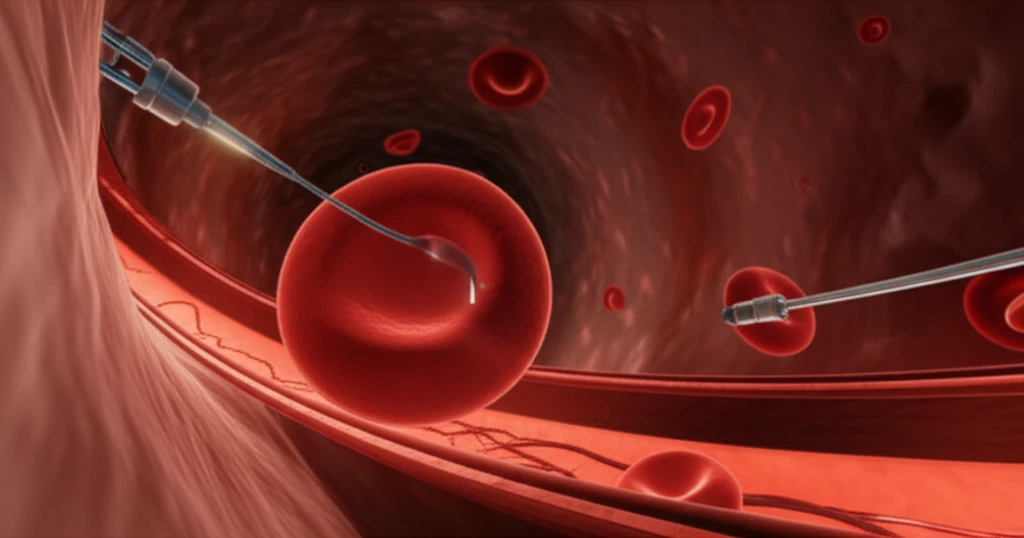
Medical device removing a clot from a brain artery.

Stroke Treatment Revolution: Can Mechanical Thrombectomy Deliver for You?

"A groundbreaking registry confirms the real-world effectiveness of neurothrombectomy for acute ischemic stroke, but time is of the essence. Discover how this life-saving procedure can dramatically improve outcomes and what you need to know to act fast."


Stroke is a leading cause of long-term disability, and every minute counts when it comes to treatment. Acute ischemic stroke, caused by a blockage in a brain blood vessel, can be devastating. For years, doctors have been working to refine and improve treatments to minimize the damage caused by these blockages.

One of the most promising advancements has been the development and refinement of mechanical thrombectomy, a procedure that uses specialized devices to physically remove blood clots from the brain. The STRATIS registry, a large-scale study evaluating the real-world use of neurothrombectomy devices, has provided compelling evidence that this approach can significantly improve outcomes for stroke patients.

This article breaks down the key findings from the STRATIS registry, explains what mechanical thrombectomy is, and why rapid action is critical. Whether you're a healthcare professional, a patient, or someone who wants to be informed about stroke care, this information could be life-changing.

The STRATIS Registry: Proof That Mechanical Thrombectomy Works

Medical device removing a clot from a brain artery.

The STRATIS (Systematic Evaluation of Patients Treated With Neurothrombectomy Devices for Acute Ischemic Stroke) registry was designed to see if the positive results from controlled clinical trials could be replicated in everyday clinical practice. The study enrolled 984 patients at 55 hospitals across the United States, all of whom were treated with either the Solitaire Revascularization Device or the Mindframe Capture Low Profile Revascularization Device within eight hours of stroke symptom onset.

Here’s what the researchers found:

  • High Success Rate: Core lab-adjudicated modified Thrombolysis in Cerebral Infarction (mTICI) ≥2b, indicating successful reperfusion, was achieved in an impressive 87.9% of patients.
  • Improved Functional Outcomes: At 90 days post-procedure, 56.5% of patients achieved a modified Rankin Scale (mRS) score of 0 to 2, signifying minimal or no disability.
  • Low Mortality and Complication Rates: The all-cause mortality rate was 14.4%, and only 1.4% of patients experienced a symptomatic intracranial hemorrhage (sICH).
  • Time Matters: Every hour of delay from emergency medical services (EMS) arrival to arterial puncture was associated with a 5.5% absolute decline in the likelihood of achieving a modified Rankin Scale score of 0 to 2.
These results confirm that mechanical thrombectomy, when performed in a timely manner, can significantly improve outcomes for patients experiencing acute ischemic stroke due to large vessel occlusion. The STRATIS registry provides strong evidence that the benefits seen in controlled trials can be translated to a broader range of clinical settings.

Optimize Stroke Systems

The STRATIS registry underscores that the benefits observed in randomized trials can be realized in the wider community. The lesson of STRATIS is not just that thrombectomy works, but it works best when systems are optimized. Further studies are needed to address the specific challenges and how those can be overcome, so that every patient, regardless of age or location, has the best possible chance of recovery after a stroke.

About this Article -

This article was crafted using a human-AI hybrid and collaborative approach. AI assisted our team with initial drafting, research insights, identifying key questions, and image generation. Our human editors guided topic selection, defined the angle, structured the content, ensured factual accuracy and relevance, refined the tone, and conducted thorough editing to deliver helpful, high-quality information.See our About page for more information.

This article is based on research published under:

DOI-LINK: 10.1161/strokeaha.117.016456, Alternate LINK

Title: Systematic Evaluation Of Patients Treated With Neurothrombectomy Devices For Acute Ischemic Stroke

Subject: Advanced and Specialized Nursing

Journal: Stroke

Publisher: Ovid Technologies (Wolters Kluwer Health)

Authors: Nils H. Mueller-Kronast, Osama O. Zaidat, Michael T. Froehler, Reza Jahan, Mohammad Ali Aziz-Sultan, Richard P. Klucznik, Jeffrey L. Saver, Frank R. Hellinger, Dileep R. Yavagal, Tom L. Yao, David S. Liebeskind, Ashutosh P. Jadhav, Rishi Gupta, Ameer E. Hassan, Coleman O. Martin, Hormozd Bozorgchami, Ritesh Kaushal, Raul G. Nogueira, Ravi H. Gandhi, Eric C. Peterson, Shervin R. Dashti, Curtis A. Given, Brijesh P. Mehta, Vivek Deshmukh, Sidney Starkman, Italo Linfante, Scott H. Mcpherson, Peter Kvamme, Thomas J. Grobelny, Muhammad S. Hussain, Ike Thacker, Nirav Vora, Peng Roc Chen, Stephen J. Monteith, Robert D. Ecker, Clemens M. Schirmer, Eric Sauvageau, Alex Abou-Chebl, Colin P. Derdeyn, Lucian Maidan, Aamir Badruddin, Adnan H. Siddiqui, Travis M. Dumont, Abdulnasser Alhajeri, M. Asif Taqi, Khaled Asi, Jeffrey Carpenter, Alan Boulos, Gaurav Jindal, Ajit S. Puri, Rohan Chitale, Eric M. Deshaies, David H. Robinson, David F. Kallmes, Blaise W. Baxter, Mouhammad A. Jumaa, Peter Sunenshine, Aniel Majjhoo, Joey D. English, Shuichi Suzuki, Richard D. Fessler, Josser E. Delgado Almandoz, Jerry C. Martin, Diogo C. Haussen

Published: 2017-10-01

Everything You Need To Know

1

What is mechanical thrombectomy?

Mechanical thrombectomy is a procedure that uses specialized devices to physically remove blood clots from the brain. It's a treatment for acute ischemic stroke, which happens when a blockage occurs in a brain blood vessel. The process involves using devices like the Solitaire Revascularization Device or the Mindframe Capture Low Profile Revascularization Device. The STRATIS registry showed that this approach can significantly improve outcomes for stroke patients, highlighting its importance in transforming stroke care.

2

What is the STRATIS registry?

The STRATIS registry is a large-scale study that examined the real-world effectiveness of neurothrombectomy devices. It enrolled 984 patients at 55 hospitals across the United States. The study's design aimed to see if the positive results from controlled clinical trials of mechanical thrombectomy could be replicated in everyday clinical practice. Key findings from the STRATIS registry include a high success rate of successful reperfusion, improved functional outcomes where patients had minimal or no disability, and low mortality and complication rates. These findings provide compelling evidence supporting the use of mechanical thrombectomy.

3

Why is rapid intervention important?

Rapid intervention is critical because time is of the essence when treating acute ischemic stroke. The STRATIS registry data showed that every hour of delay from emergency medical services arrival to arterial puncture was associated with a decline in the likelihood of achieving a good outcome, measured by the modified Rankin Scale score. The sooner a patient undergoes mechanical thrombectomy, the better their chances of a successful recovery. This underscores the importance of optimizing stroke systems and acting fast when stroke symptoms arise.

4

What does the modified Rankin Scale (mRS) score tell us?

The modified Rankin Scale (mRS) score is used to assess the level of disability after a stroke. It measures the patient's functional outcome, with scores ranging from 0 to 6. A score of 0 indicates no symptoms, while a score of 6 indicates death. The STRATIS registry used the mRS to measure the effectiveness of mechanical thrombectomy; 56.5% of patients achieved an mRS score of 0 to 2, signifying minimal or no disability at 90 days post-procedure. This demonstrates the potential of mechanical thrombectomy to improve patients' quality of life after stroke.

5

What is the significance of the STRATIS registry findings?

The results of the STRATIS registry underscore that the benefits observed in randomized trials can be realized in a wider community. It showed that mechanical thrombectomy works best when systems are optimized. Further studies are needed to address the specific challenges and how those can be overcome, so that every patient, regardless of age or location, has the best possible chance of recovery after a stroke. It is a revolution in stroke care, providing hope and significantly improving outcomes for individuals suffering from acute ischemic stroke.

Newsletter Subscribe

Subscribe to get the latest articles and insights directly in your inbox.