
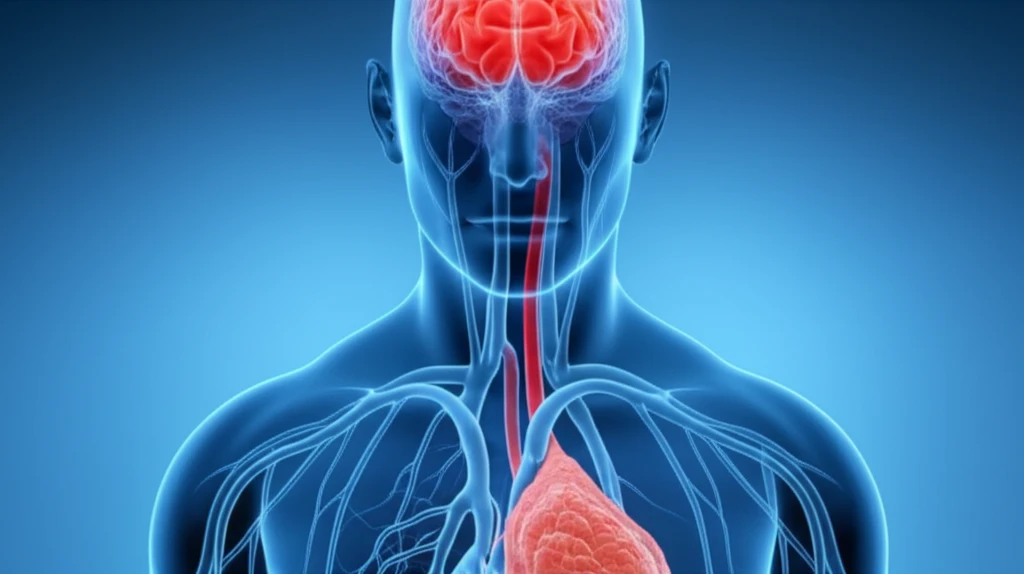
Illustration of the gut-brain connection, showing congested lymphatic vessels leading to brain inflammation.

Gut Feeling Gone Wrong: How Lymphatic Traffic Jams Can Harm Your Brain

"New research reveals the surprising link between blocked lymph flow in your gut and increased brain inflammation after a stroke-like event."


When a stroke occurs due to a blocked artery in the brain, it sets off a chain reaction. The initial blockage deprives the brain of oxygen and nutrients, leading to immediate damage. However, the problems don't stop there. What follows, known as ischemia-reperfusion injury, can sometimes cause even more harm than the initial event.

Scientists are increasingly focused on the gut's role in overall health, and it turns out that problems in the gut can make brain injuries worse. A key player in this connection is the mesenteric lymphatic system, a network of vessels that drains fluid and waste from the intestines. If this drainage system gets blocked, it can lead to serious consequences for the brain after a stroke-like event.

This article explores groundbreaking research that uncovers how a backup of lymphatic fluid in the gut can intensify brain inflammation and damage following a stroke. We'll break down the science in a way that's easy to understand, revealing the hidden dangers of a poorly functioning gut lymphatic system and what it could mean for future treatments.

AI Search Multiple angles on this topic

The gut–brain axis in stroke research

The gut–brain axis is described as a bidirectional communication network linking the central nervous system and the gut. A 2023 article, “Connecting the Dots: The Interplay Between Stroke and the Gut,” discusses this relationship in the context of stroke. A later review, published August 3, 2026, frames the gut–brain axis as a way to explore mechanisms and therapeutic targets for ischemic stroke, noting that poor functional recovery and recurrence remain concerns despite advances in acute reperfusion therapy.

The Gut-Brain Link: Why a Blocked Lymph System Spells Trouble

Illustration of the gut-brain connection, showing congested lymphatic vessels leading to brain inflammation.

The study, conducted on rats, investigated what happens when the mesenteric lymph duct (MLD) is blocked during a stroke-like event called superior mesenteric artery occlusion (SMAO). Researchers created four groups: one with a blocked MLD, one with SMAO, one with both, and a control group. They then measured levels of endotoxins (harmful substances released by bacteria) and inflammatory markers in the brain.

The results were alarming. Rats that experienced both SMAO and a blocked MLD showed significantly higher levels of endotoxins and inflammation in their brains compared to those with SMAO alone. This suggests that when the lymphatic system can't properly drain the gut, it worsens the brain's inflammatory response to injury.

Here's a breakdown of what the researchers found:
  • Endotoxin Levels: Significantly increased in the brains of rats with both SMAO and blocked MLD.
  • Inflammatory Markers (CD14, LBP, ICAM-1, TNF-α): These markers, which indicate inflammation, were also much higher in the combined SMAO and blocked MLD group.
  • The Culprit: Blocking the MLD appears to exacerbate the translocation of endotoxins from the gut to the brain, triggering a stronger inflammatory response.
AI Search Multiple angles on this topic

A review of shock and trauma models

A review of experimental models of shock and trauma reports that research over the preceding five years had generated valuable information about endothelial stability and mesenteric lymph. It also covers vascular reactivity, traumatic injuries, burns, and sepsis. The source describes these areas as topics of developed research, but does not provide findings specific to a lymphatic traffic jam affecting the brain.

The gut–brain–vascular axis and its limits

A 2026 review presents the gut–brain–vascular axis as an emerging model linking gut microbiota dysfunction with neurovascular and atherosclerotic disease. It suggests that preventing dysbiosis may reduce stroke risk and that post-stroke microbiota modulation could support recovery; these are emerging possibilities, not established outcomes. A 2022 review reports that stroke can lead to intestinal dysmotility and intestinal-barrier leakiness, which are associated with changes in gut microbiota composition and its interaction with the host.

Glucose handling in human studies

The two glucose-metabolism studies examine different aspects of glucose handling and do not directly compare lymphatic function or brain effects. In nondiabetic humans and people with type 2 diabetes, one study progressively raised insulin to approximately 150, 350, and 700 pmol/L and measured endogenous glucose production, splanchnic glucose uptake, and leg glucose uptake using catheterization and a [3-3H]glucose infusion. A separate study of NIDDM concluded that increased systemic glucose delivery—mainly from reduced suppression of endogenous hepatic glucose output, and to a lesser extent reduced splanchnic glucose sequestration—predominantly explained postprandial hyperglycemia. A 2026 review discusses the gut–brain axis in ischemic stroke, but the supplied material does not establish a direct comparison between these glucose studies and stroke-related gut–brain mechanisms.

Think of it like this: Imagine a city's drainage system is clogged during a flood. The water (endotoxins) can't drain away properly, leading to a buildup of harmful substances and increased damage (inflammation) in the surrounding areas (the brain).

What Does This Mean for You? The Future of Stroke Recovery

This research highlights the critical connection between gut health and brain health, particularly in the context of stroke recovery. While more research is needed, these findings suggest that maintaining a healthy gut lymphatic system could be a crucial factor in minimizing brain damage after a stroke.

What can you do? Focus on lifestyle choices that promote a healthy gut, such as eating a balanced diet rich in fiber, staying hydrated, and managing stress. If you're at risk for stroke or have a history of stroke, talk to your doctor about strategies to support your gut health.

In the future, treatments that target the gut lymphatic system could become a promising avenue for improving stroke outcomes. By addressing the root cause of inflammation and preventing the translocation of harmful substances to the brain, we may be able to unlock new possibilities for recovery and rehabilitation.

Rat study of mesenteric lymph reperfusion after artery occlusion

Study designAnimal study[1]
Populationrats[1]
ComparisonMLR, SMAO, MLR+SMAO, and sham groups[1]
Main outcomeEndotoxin translocation in brain[1]
Times cited2[1]

What a controlled rat experiment can establish

Animal study (level 5 of 8)

The study used an animal design, so it can show how the measured brain outcomes changed in rats under the experimental conditions, but it cannot establish that the same effects occur in people.[1]

The occlusion and reperfusion sequence

  • 1In the MLR group, the mesenteric lymph duct was clamped for 1 h, then reperfused for 2 h. In the SMAO group, the superior mesenteric artery underwent the same timing; the combined group had both vessels occluded for 1 h before 2 h of reperfusion.[1]

What a follow-up would need to clarify

  • Would the reported brain response differ between lymph reperfusion alone, artery occlusion alone, their combination, and sham conditions?[1]
  • How do the observed endotoxin and inflammatory-marker changes relate to the extent of brain injury in this model?[1]

About this Article -

Written with AI assistance from published research, and reviewed by the Mystum team. See our About page for more information.

This article is based on research published under:

DOI-LINK: 10.1590/s0102-86502014000600002, Alternate LINK

Title: Mesenteric Lymph Reperfusion After Superior Mesenteric Artery Occlusion Shock Exacerbates Endotoxin Translocation In Brain

Subject: Surgery

Journal: Acta Cirurgica Brasileira

Publisher: FapUNIFESP (SciELO)

Authors: Zi-Gang Zhao, Li-Na Yang, Yong-Quan Zhao, Chun-Yu Niu

Published: 2014-06-01

Everything You Need To Know

1

What is the mesenteric lymphatic system, and why is it important?

The mesenteric lymphatic system is a network of vessels in the gut responsible for draining fluid and waste from the intestines. This is vital because a blockage in this system can lead to a buildup of harmful substances, like endotoxins, which can then travel to the brain and cause inflammation. In this context, the system's proper function is crucial for minimizing brain damage after a stroke-like event, as its dysfunction exacerbates the brain's inflammatory response.

2

What is ischemia-reperfusion injury, and how does it relate to the research?

Ischemia-reperfusion injury is a cascade of events that occurs after a blocked artery in the brain (leading to a stroke-like event). Initially, the blockage deprives the brain of oxygen and nutrients, causing immediate damage. However, the restoration of blood flow can sometimes cause additional harm. The research presented suggests that problems in the gut, particularly a blocked mesenteric lymphatic system, can worsen this injury by increasing brain inflammation and the translocation of endotoxins.

3

What are endotoxins, and what role do they play in this study?

Endotoxins are harmful substances released by bacteria, and in the context of this research, they play a significant role in brain inflammation. When the mesenteric lymphatic system is blocked, these endotoxins can accumulate in the gut. This buildup can then be transported to the brain, triggering a stronger inflammatory response that intensifies brain damage after a stroke-like event. The study found significantly increased endotoxin levels in the brains of rats with both a stroke-like event (SMAO) and a blocked mesenteric lymph duct (MLD).

4

What is the gut-brain connection, and why is it relevant?

The gut-brain connection refers to the bidirectional communication pathway between the gut and the brain. This research highlights how problems in the gut, such as a blocked mesenteric lymphatic system, can negatively impact brain health. When the lymphatic system is blocked, the gut becomes a source of increased inflammation and the translocation of endotoxins that can travel to the brain and worsen the damage from a stroke-like event. This underscores the importance of gut health in overall brain health and recovery from neurological events.

5

What is superior mesenteric artery occlusion (SMAO), and what did the study find when combined with a blocked mesenteric lymph duct (MLD)?

The superior mesenteric artery occlusion (SMAO) is a stroke-like event used in this study to simulate a stroke. Researchers observed that when the mesenteric lymph duct (MLD) was also blocked, the resulting brain inflammation and damage were significantly worse. The research created four groups: one with a blocked MLD, one with SMAO, one with both, and a control group. The group that experienced both SMAO and a blocked MLD showed significantly higher levels of endotoxins and inflammation in their brains. This indicates the interplay between the gut's lymphatic system and the brain's response to injury and suggests potential future treatment avenues focused on maintaining a healthy gut lymphatic system.

Newsletter Subscribe

Subscribe to get the latest articles and insights directly in your inbox.