
Space Tethers: The Next Giant Leap for Asymmetrical Payload Delivery?

"Discover how motorized momentum exchange space tethers can revolutionize spacecraft propulsion, even when faced with payload imbalances."
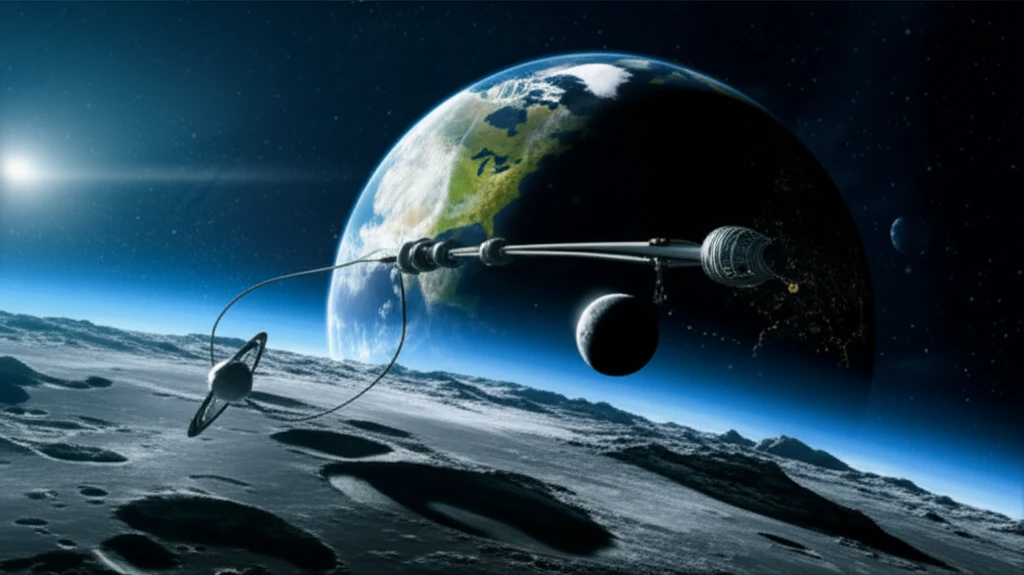
Momentum exchange tethers have captured global attention as a promising technology for eco-friendly and cost-effective propulsion of payloads from Low Earth Orbit (LEO). Imagine a space elevator, but instead of a fixed cable, it's a rotating tether system that 'throws' payloads into different orbits. This concept, known as a motorized momentum exchange tether, offers a revolutionary approach to space travel.
A typical motorized momentum exchange tether (MET) operating in a circular LEO could achieve orbit velocities of approximately 7.6 km/s. Furthermore, it can generate an increment of around 3.1 km/s. This increment has the potential to accelerate an outer payload, at its optimal release position, to about 10.7 km/s, which is sufficient for Earth escape. However, the operational design requires a counter-inertia system to satisfy Newton's third law of motion, ensuring stability and balance during rotation.
While symmetrical payload distribution is ideal for stable tether dynamics, unexpected events like payload loss or retrieval failure can lead to asymmetry. This paper explores the dynamics of asymmetrical tethers and presents conceptual designs for tethered payload release from LEO and lunar tether delivery and retrieval, offering solutions for future development.
The Challenge of Asymmetrical Payload Mass
The core issue with asymmetrical payload mass distribution is that the tether's center of mass shifts, resulting in dynamic disturbances that can de-orbit the tether. Payload mass symmetry is essential to maintain orbit and harness orbital harmonics, facilitating a smooth flow of payloads between the host planet and the destination.
- Catastrophic Failure: A small mass asymmetry can lead to catastrophic failure, causing the propulsion side to collide with the outrigger counter-inertia system.
- De-Stabilization: In an asymmetrical configuration, the tether will be de-stabilized and pushed out of the spin-and-orbit plane, generating moments that could reach up to 300 kNm.
- Translation: There will also be the problem of whole-body translation of the tether to consider, due to subsequent re-positioning of the CoM.
Looking Ahead: The Future of Space Tethers
Despite the challenges, motorized tethers offer a promising path to sustainable and reusable space propulsion. Continued research and development in GNC, compensation propulsion, and innovative designs like lunar lunavators are essential for realizing the full potential of this technology. As we continue to push the boundaries of space exploration, space tethers could become an indispensable part of future mission architectures.