
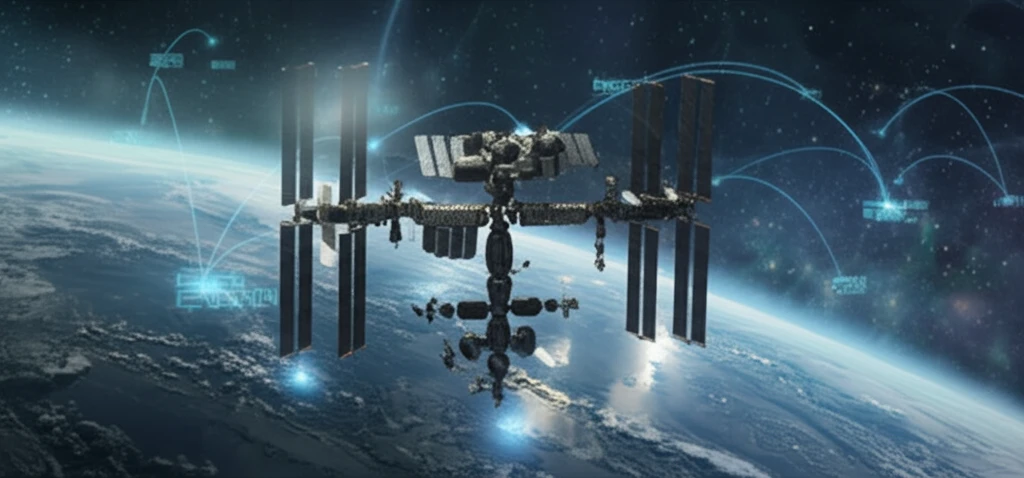
China's Space Station: A Leap in Payload Operation and Application Systems

"Explore how China's Space Station is revolutionizing space science with its advanced payload operation and application systems, designed for seamless upgrades and groundbreaking research."
China's Space Station, launched in 2018, represents a significant milestone as the nation's largest space science experiment and application platform. Designed for over a decade of operation, the station is set to undertake complex scientific endeavors. This ambitious project has presented unique challenges, especially in developing a robust payload operation and application ground system.
These challenges include managing intricate mission planning, processing high-speed mass data, ensuring payload health, and providing remote support via telescience. The ground system must dynamically adapt to evolving scientific mission requirements. This article explores the composition, system architecture, hardware framework, and innovative technologies employed to construct the payload operation and application ground system for China's Space Station.
A key focus is on how these systems facilitate cutting-edge research and international cooperation, marking a new era in space exploration.
Tiangong Station Overview and Metrics
Tiangong is a three-module space station consisting of the Tianhe core module launched in April 2021, with the Wentian and Mengtian experiment modules added in 2022. The station features 7 ports and supports a crew of three astronauts for six-month missions, accumulating over 1,000 crew-days in orbit. Its communication system operates at an S-band data rate of 300 kbps, and the Wentian lab has conducted more than 200 fluid physics tests. As of August 2026, the station maintains orbital parameters tracked by the China Manned Space Agency.
Orbital Operations and Debris Avoidance
China's Tiangong space station orbits at an altitude between 217 and 280 miles (340 to 450 kilometers), approximately the same orbital height as the International Space Station. The Chinese Manned Space Agency (CMSA) built the station to conduct scientific research and maintain a continuous human presence in low-Earth orbit. One operational challenge demonstrated the station's need for active debris avoidance when it maneuvered to avoid potential collision with Starlink satellites. This highlights the growing congestion in orbital environments and the necessity for robust space traffic management systems.
From Tiangong-1 to Sovereign Space Station
China's space station program began with the launch of Tiangong-1, the country's first space laboratory module, marking a significant milestone in its space exploration capabilities. The development of Tiangong was driven by a desire for sovereign space capabilities after international isolation, transforming into a rapid technological achievement. China aimed to complete the construction of its space station by the end of 2022, positioning it as an important platform for international cooperation amid geopolitical tensions. The station represents a strategic move to establish China as a major space power with independent access to orbital infrastructure.
System Design and Architecture: Building a Scalable Foundation
The payload operation and application system serves as a crucial subsystem within the China Space Station's ground infrastructure. It establishes vital communication links with ground stations, the spacecraft control center, and various science centers. This system is responsible for receiving telemetry and application data, processing payload information in real-time, and monitoring the health status of onboard instruments.
- Front-end data communications
- Integrated monitoring and real-time data processing
- Planning and scheduling of payload work plans
- Data simulation, health management, and fault diagnosis
Current Research Focus and Scientific Contributions
Recent research on Tiangong has focused on expanding its scientific capabilities and international collaboration opportunities. The station continues to serve as a platform for microgravity experiments across multiple disciplines including fluid physics, materials science, and life sciences. As China's primary orbital laboratory, Tiangong represents a growing contribution to global space research efforts. Future developments may include additional modules and enhanced international partnership programs.
Tiangong-1 Re-entry and Lessons Learned
Tiangong-1, the precursor to China's current space station, experienced an uncontrolled re-entry in 2019 after being launched in 2011. The school bus-sized module, weighing approximately 8.5 tons, burned up upon re-entry as planned for such spacecraft at end-of-life. While Tiangong-1 was a testbed rather than a permanent station, its re-entry highlighted challenges in spacecraft disposal and orbital debris management. China's subsequent station design incorporated lessons learned from this experience to ensure controlled deorbiting capabilities.
Tiangong vs. International Space Station
China's space station has been compared to the International Space Station in terms of size, capability, and design philosophy. Critics have questioned the authenticity of some footage from the station, but investigations have debunked claims such as the 'glass of water' video that was alleged to show faked microgravity conditions. The comparison highlights differences in international collaboration models, with Tiangong positioned as a more accessible platform for certain nations. As both stations operate in similar orbital altitudes, their parallel existence offers opportunities for comparative scientific research.
Looking Ahead: Future Contributions and Innovations
China's Space Station, with its advanced payload operation and application systems, is poised to significantly advance space science, offering a platform for groundbreaking research and technological innovation. The combination of cutting-edge information technology and a robust ground support system promises to yield significant scientific and technological achievements, enhancing the effectiveness of payload operations in the years to come.
Assessment of China's Orbital Program
China's space station program demonstrates significant progress in establishing a permanent orbital presence. The station's modular design allows for future expansion and diverse scientific research capabilities. International observers note that Tiangong represents a strategic investment in long-term space exploration infrastructure. The program's success positions China as an increasingly influential player in global space activities.
International Openness and Station Longevity
China has signaled its intention to open its space station to international astronauts and researchers from other nations. The station was expected to become fully operational around 2022, coinciding with the planned end-of-life for the International Space Station. This开放政策 positions Tiangong as a potential successor for continuous orbital research as older stations age. China's welcoming approach contrasts with previous isolation and suggests a more collaborative future in space exploration.
Space Ambitions and Geopolitical Implications
China's space station program is part of broader ambitious plans that include missions to the Moon and Mars. The country has launched multiple crews to its orbital station, demonstrating consistent human spaceflight capabilities. These efforts challenge traditional U.S. dominance in space exploration and represent a shift toward a more multipolar space landscape. China's systematic approach to space development includes both crewed stations and uncrewed deep space missions.
Technological Development and Public Engagement
China's space program, through organizations like the China Academy of Space Technology, develops technologies that support human spaceflight and scientific research. Public engagement with space stations has been enhanced through applications and tracking tools that allow people to observe orbital passovers. The human element extends to astronaut training, mission control operations, and the international collaboration that space stations facilitate. These programs inspire educational interest in STEM fields and demonstrate the practical applications of space technology.