
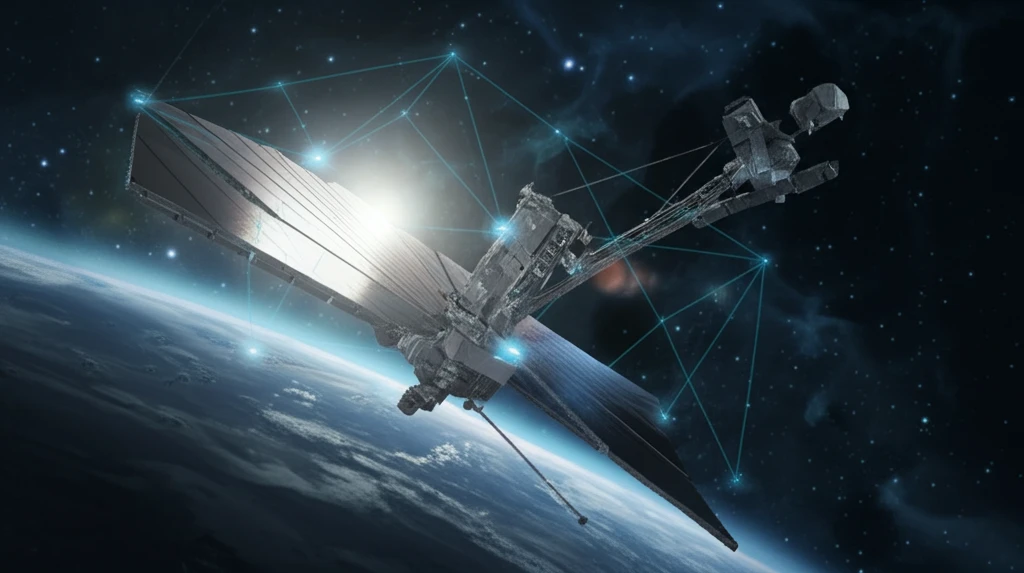
Space Tech Revolution: How Genetic Algorithms Could Keep Future Solar Power Satellites Healthy

"Deployable antenna health monitoring in space is getting a smart upgrade."
Imagine a future where clean, limitless energy beams down from space. Space-based solar power satellites (SSPS) are a promising concept. The idea is to collect solar energy in space and wirelessly transmit it to Earth. However, the harsh reality of space means these satellites face potential damage over their long lifespans. This is where a clever solution comes in: using genetic algorithms to optimize sensor placement for health monitoring.
Think of structural health monitoring (SHM) as a satellite's regular check-up. By strategically placing sensors, engineers can detect early signs of damage or degradation. The challenge lies in determining the best locations for these sensors, especially on complex, deployable antenna modules. Traditional methods often fall short, which leads researchers to explore the use of genetic algorithms for optimal sensor placement (OSP).
Genetic algorithms, inspired by natural selection, offer a powerful way to tackle this optimization problem. They can efficiently explore a vast number of sensor placement options, considering factors like antenna characteristics and sensor reliability. This article dives into this innovative approach, explaining how genetic algorithms are enhancing the health and longevity of future space-based solar power systems.
Defining Space and the Final Frontier
Space is defined as a three-dimensional continuum containing positions and directions, and in classical physics it is often conceived in three linear dimensions, with modern physicists considering it, together with time, as part of a boundless four-dimensional continuum known as spacetime. Outer space, by contrast, refers specifically to the expanse that exists beyond Earth's atmosphere and between celestial bodies. Being essentially empty, this region allows the earliest galaxies to be observed without obstruction, as demonstrated in the Webb telescope's First Deep Field image. Ongoing spaceflight, exploration, and astronomy coverage tracks humanity's continued expansion across this final frontier.
News Coverage as the Core Observational Method
Staying current with space technology depends heavily on continuous reporting of spaceflight activity, and Space.com positions itself as a primary source for the latest astronomy news and space discoveries. Its coverage spans live reporting of space flights, the science of space travel, and the progress of space exploration and innovation. This news-driven approach reflects how accepted methods in the space sector are typically tracked through unfolding missions and discoveries rather than through standardized metrics.
A General Look at Spaceflight's Foundations
A detailed timeline of spaceflight milestones is not covered by the sources available for this section, so only a general framing is offered here. It is nevertheless widely understood that the history of space exploration is marked by early rocket experiments, the first satellites, and the first crewed missions. These foundational achievements established the orbital infrastructure and engineering knowledge upon which proposed projects such as space solar power satellites would later build. Specific dates and milestones should be verified against dedicated historical references, as none are cited here.
Why is Sensor Placement So Critical for Space-Based Antennas?
Deployable antenna modules are vital components of SSPS. They need to be lightweight and unfold to a massive size in space. The problem is that these antennas face a lot of stress from extreme temperatures, radiation, and potential micrometeoroid impacts. The integrity of these antennas is essential for the continuous and reliable transmission of solar energy.
- Maximizing Coverage: Ensuring sensors cover all critical areas of the antenna.
- Minimizing Redundancy: Avoiding overlapping sensor data to reduce unnecessary information.
- Accounting for Deployment: Factoring in the unique challenges posed by deployable structures.
- Enhancing Reliability: Placing sensors in locations with the highest chance of survival and accuracy.
An Emerging Field in Specialized Literature
Current research into using genetic algorithms to keep solar power satellites healthy is concentrated largely in specialized engineering and aerospace literature rather than in general news coverage. Reviews in this area generally emphasize optimization, fault diagnosis, and adaptive control as promising application areas. Because this remains an active and quickly evolving field, any specific findings should be treated as provisional until confirmed in peer-reviewed publications.
Skepticism on Cost and Technical Risk
Critics of space-based solar power frequently point to the enormous cost of launching and assembling large orbital structures as a central objection. Technical risk factors, such as the efficiency of wireless power transmission and the long-term resilience of satellites in the harsh space environment, also feature prominently in skeptical assessments. Genetic algorithms are not a cure-all: like any optimization method, they depend on accurate models and can converge on suboptimal solutions when their parameters are poorly chosen or the search space is badly characterized.
Orbital Power Versus Ground-Based Renewables
Compared with ground-based renewable energy, space-based solar power offers the theoretical advantage of near-continuous sunlight that is unfiltered by atmosphere or weather. Terrestrial solar, wind, and energy storage systems, however, benefit from far lower infrastructure costs and a mature industrial base. Under a balanced comparison, genetic algorithms are best understood as a complementary engineering tool for managing orbital assets rather than as a technology that would displace existing renewable energy solutions.
The Future is Bright for Space-Based Solar Power
The application of genetic algorithms to sensor placement marks a significant step forward in ensuring the reliability of space-based solar power systems. As technology advances, these optimization techniques will become even more sophisticated, promising a future where clean, space-based energy is a tangible reality.
Cautious Optimism from Early Stage Commentary
Expert commentary at this early stage tends to be cautiously optimistic: genetic algorithms are regarded as a plausible approach for optimizing satellite operations, but they are unlikely by themselves to resolve the economic and logistical hurdles that dominate space solar power debates. Synthesis of this research is still emerging, and no consensus exists on optimal algorithm configurations or expected performance gains. The practical value of such tools may ultimately hinge on how well they integrate with broader spacecraft and mission design.
Demonstration Missions and Autonomy Ahead
The next frontiers for space solar power likely involve demonstration missions that test wireless power transmission in orbit, together with increasingly autonomous spacecraft operations. Genetic algorithms could play a role in enabling spacecraft to re-plan and self-manage as components degrade or suffer damage. A credible pathway forward will require sustained investment, and near-term expectations should be grounded in incremental progress rather than immediate large-scale deployment.
Constraints Beyond the Algorithm
The broader context includes systemic challenges such as launch costs, space debris, the complexities of producing and deploying orbital infrastructure at scale, and regulatory questions around beaming energy back to Earth. Policy, funding, and international coordination are as critical to success as any individual algorithm. Making space solar power practical will likely depend as much on resolving these systemic constraints as on advancing the underlying optimization software.
Serving Communities and Operators
The real-world impact of reliable space-based power would be most significant for regions that currently lack dependable electricity, with potential benefits for remote communities and disaster response. Realizing those benefits, however, depends on cost reductions and sustained public and institutional commitment. In the near term, the human element is perhaps most visible in the engineers and mission operators whose decisions determine whether algorithmic tools such as genetic algorithms deliver genuine operational value.