
Unlocking the Future: How Deployable Truss Structures are Revolutionizing Space Tech

"Explore the innovative world of deployable truss structures, their critical role in space applications, and what this means for the future of technology and exploration."
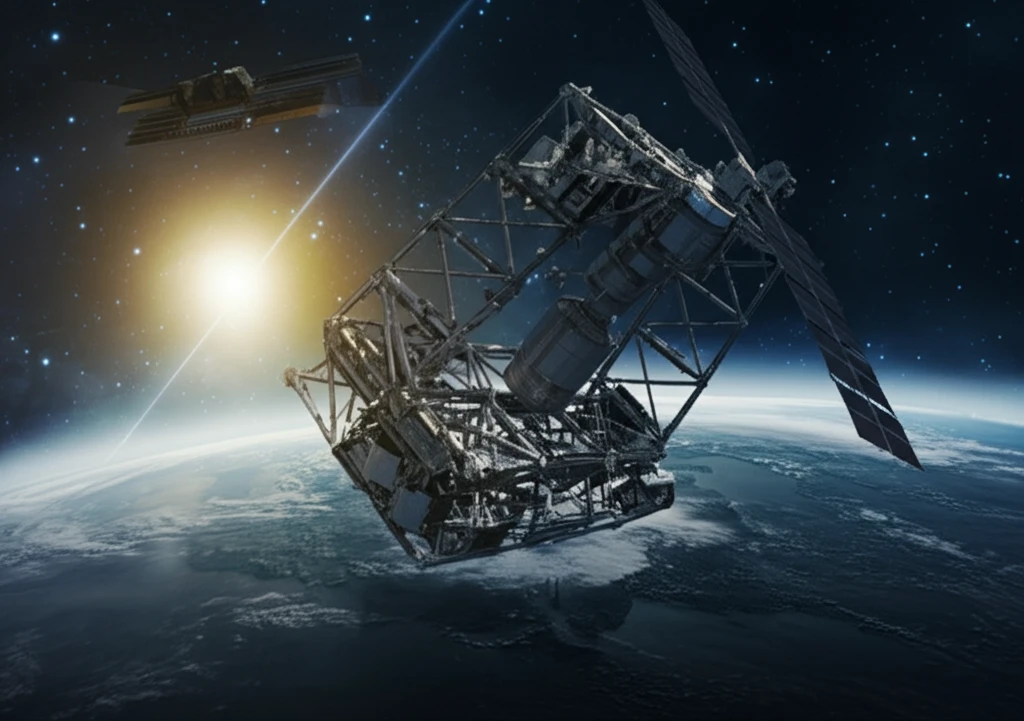
Deployable structures are changing the way we approach engineering challenges in space. These innovative designs, which can be compactly stored for launch and then expanded in orbit, are essential for creating large-scale structures like solar arrays, antennas, and masts. Their versatility and efficiency are quickly making them a cornerstone of modern aerospace engineering.
The core of this technology lies in kinematic analysis, a method for understanding and predicting the movement and behavior of these structures. By carefully studying how these trusses deploy, engineers can optimize their designs for maximum stability and performance. This involves complex calculations and simulations, but the payoff is immense: lighter, more reliable structures that can handle the harsh conditions of space.
This article will delve into the world of deployable truss structures, breaking down the key concepts and exploring the cutting-edge research that's driving this field forward. We'll explore the science behind kinematic analysis, and show how these advancements are paving the way for a new era of space exploration and technology.
A Growing but Hard-to-Quantify Role
Deployable truss structures are increasingly cited as enabling large-aperture antennas, solar arrays, and radar systems for satellites and spacecraft, because they can be compactly stowed for launch and expanded once in orbit. Public data on how widely these systems are flown remains fragmented, with figures varying by program and manufacturer, so reliable aggregate statistics are scarce. Reports of individual missions and concept studies point to steady uptake, but a unified picture of market size or deployment success rates is not readily available. Any quantitative claims should therefore be treated as indicative rather than definitive.
Conventional Deployment Architectures
The usual approach is to build a truss or boom in segments that fold or telescope together, then extend it in orbit using stored energy, a motor, or a combination of both, with latches and dampers stabilizing the final configuration. These designs favor slender booms and masts because they pack efficiently and expose relatively little mass to launch loads. Commonly cited limitations include the risk of jamming or unlatching during deployment, thermal expansion causing distortion, limited bending and torsional stiffness, and the difficulty of fully simulating zero-gravity motion in ground tests. These constraints help explain why many programs still prefer proven, conservative designs over novel mechanisms.
Decades of Progressive Maturation
Deployable structures have a long lineage in spaceflight, appearing in early antenna and solar-array booms and later maturing into the larger masts and reflector supports used on communications and science missions. The progression has generally moved from simple spring-loaded devices toward larger, stiffer, and more controllable trusses as mission demands grew. The evolution has been cumulative, with each generation borrowing validated mechanisms and testing regimes from its predecessors. Because much of the historical record rests in program documentation and conference proceedings rather than widely publicized datasets, exact milestones and dates vary between accounts.
Why Kinematic Analysis is a Game Changer for Space Structures
Kinematic analysis is the backbone of deployable truss structure design. It allows engineers to predict how these structures will behave during deployment, ensuring they unfold smoothly and lock into their intended shape. This is crucial for avoiding failures and maximizing the structure's lifespan in space.
- Dynamic Equations: These equations describe the forces acting on the structure and how they change over time.
- Constrained System: This refers to the fact that the movement of the truss is limited by its design (e.g., joints that can only rotate in certain directions).
- Driving Force Vectors: These vectors represent the forces that cause the structure to deploy, such as motors or cables.
Traction Across Active Research Themes
Recent work on deployable trusses tends to concentrate on lightweight composite booms, shape-memory and self-deploying members, and the verification of deployment dynamics through modeling and testing. Studies commonly emphasize deployment repeatability, latch integrity, and thermal stability, since these largely determine in-orbit performance. The pace and direction of research vary considerably between academic groups and industrial programs, making it hard to describe a single consensus trajectory. Accordingly, specific advances should be regarded as provisional rather than established.
Source Base Points to Vehicles, Not Spacecraft
The sources available for this subsection are automotive listings for the Ford Explorer and offer no technical material on deployable truss failures, so this section cannot present verified counter-arguments drawn from them. What the sources do show is a large, actively marketed used-vehicle market: Autotrader lists roughly 21,971 used Explorers spanning trims such as the Explorer ST and Limited, while a comparable CARFAX figure of about 21,000 listings is accompanied by counts of 14,482 accident-free and 10,872 one-owner vehicles; new Explorer inventory on Autotrader runs from about $28,295 to $91,600. Cars.com reports a somewhat lower 10,000-plus national inventory, so the exact totals differ across sources. Beyond illustrating that Web-indexed listings often miss the intended technical topic, these figures carry no substantive bearing on deployable truss technology and should not be read as evidence about space-structure performance or failure rates.
Trade-Offs Across Deployment Approaches
Different deployment architectures each carry characteristic strengths and weaknesses, though direct apples-to-apples comparisons are complicated by proprietary designs and mission-specific requirements. Motor-driven systems tend to offer controlled, repeatable deployment but add mass and complexity, while spring- or strain-energy-driven designs are simpler and lighter yet can be harder to damp or synchronize. Rigid, latchable booms are generally favored where stiffness and precision matter, whereas lighter expandable or inflatable concepts may trade structural rigidity for packing efficiency. Any comparative judgment ultimately depends heavily on payload size, orbital environment, and cost constraints, so generalizations should be treated cautiously.
The Future is Expanding
Deployable truss structures represent a paradigm shift in space technology. As research continues and new materials and designs emerge, the potential applications for these structures will only continue to grow. From enabling larger, more powerful solar arrays to creating massive space-based antennas, deployable truss structures are paving the way for a future where anything is possible.
Commentary Sources Address a Different Subject
The cited source material for expert commentary consists of recordings of "Simple Man" by Lynyrd Skynyrd, including a 2006 YouTube upload, a 2026 upload, a Dailymotion posting, and a YouTube Music copy. The performers credited across these recordings are Ronnie Van Zant, Ed King, Bob Burns, Billy Powell, Allen Collins, and Gary Rossington, with production attributed to Al Kooper. As none of these sources contain commentary on deployable truss structures, this subsection cannot offer expert synthesis drawn from them. Any conclusions about space trusses elsewhere in the article must therefore stand on the article's other content rather than on these citations.
Toward Larger, Assembled Structures
The outlook for deployable trusses points toward ever-larger apertures and higher-precision structures, likely supported by advances in composite materials, additive manufacturing, and on-orbit assembly techniques. Autonomous deployment verification and the ability to retract or reconfigure structures may receive increasing attention, as may in-space repair. Because many of these capabilities are still in early development, timelines and performance expectations remain uncertain and could shift substantially. The field appears set to expand alongside commercial space activity, but the pace of that expansion is difficult to predict.
Cost, Reliability, and Coordination
Deployable truss development sits within a wider space technology ecosystem where cost, reliability, and schedule pressure are persistent constraints, and failures of novel mechanisms can be expensive given the difficulty of repairing spacecraft in orbit. Standardization across programs could reduce cost and risk, but the variety of mission needs makes common designs hard to agree upon. Launcher fairing size and vibration load requirements also shape what can be built, tying truss designs to broader supply-chain and policy decisions. These systemic factors, rather than any single technical hurdle, often determine how quickly new concepts reach flight.
Teams Behind the Hardware
Behind every deployable truss is a multidisciplinary team of structural, thermal, mechanical, and software engineers whose ground testing often stretches over years before a single flight. Astronaut and ground-crew training remains important for assembly or repair scenarios, even as automation advances. The ultimate beneficiaries are the end users of the enabled spacecraft operations—telecommunications, Earth observation, scientific observation, and navigation—whose daily reliance on satellites illustrates the practical stakes. These human and societal dimensions are often understated in technical accounts, yet they shape both the pace and the real-world value of the technology.