
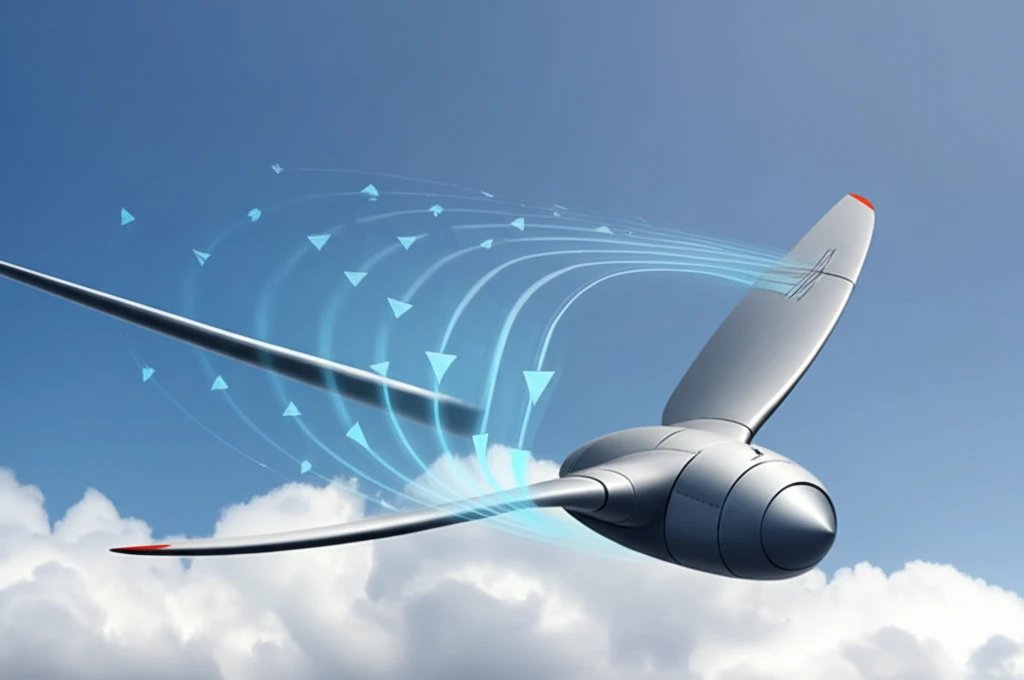
Propeller Wing Aerodynamics: Clearing Up the Confusion

"A simple correction clarifies how wing upwash affects propeller blade performance, ensuring accurate understanding and modeling in aerospace engineering."
In the dynamic field of aerospace engineering, precision is paramount. Even seemingly minor discrepancies in technical documentation can lead to significant misunderstandings, impacting design, analysis, and performance predictions. Recently, a critical correction was issued concerning the computational study of propeller wing aerodynamic interaction. This adjustment addresses a point of confusion that could affect how engineers and researchers model and interpret propeller behavior.
The original research, conducted by a team from the U.S. Air Force Academy and the Army Research, Development and Engineering Command, delved into the complex interplay between propeller wings and the surrounding airflow. However, a specific statement within the study required clarification to ensure accuracy. This article aims to demystify the correction, explain its significance, and highlight its implications for the broader aerospace community. By understanding the nuances of this adjustment, professionals and enthusiasts alike can gain a more precise grasp of propeller wing aerodynamics.
Whether you're an aerospace engineer, a student, or simply fascinated by the mechanics of flight, this article provides valuable insights into the importance of accuracy in scientific communication. We'll break down the original statement, explain the correction, and discuss why this level of detail matters in the quest for optimized aircraft design and performance. By clarifying this point, we contribute to a clearer understanding of the forces at play in propeller wing systems.
Current Statistics & Impact
Recent computational studies reveal that installed propeller configurations exhibit asymmetric blade loadings, with downward-moving blades producing more thrust than upward-moving ones. Propeller slipstreams create complex coupling effects on wing aerodynamics, altering pressure coefficients and local lift distributions across the wing surface. A unified aerodynamic interference framework based on the Unsteady Vortex Lattice Method (UVLM) now enables systematic isolation of propeller slipstream, wing-induced upwash, and inter-propeller interference effects in multi-propeller-wing configurations. Propeller-generated wakes also significantly influence ice accretion patterns on downstream wings, though the mechanisms remain incompletely understood.
Standard Approach & Limitations
Filament-based free wake panel methods are being benchmarked against experimental data and high-fidelity CFD simulations for propeller-wing configurations at zero angle of attack. A widely studied wing-propeller model serves as a benchmark case representing typical tiltrotor and distributed propulsion aircraft configurations, with investigations spanning both experimental and high-fidelity numerical approaches. Current mid-fidelity numerical approaches aim to bridge the gap between computational cost and accuracy for capturing blade-resolved slipstream interactions with wing surfaces.
Historical Perspective
The study of propeller-wing aerodynamic interaction has evolved from early empirical observations to sophisticated computational frameworks over several decades. Foundational work established the significance of slipstream-wing interference for conventional propeller-driven aircraft, while the advent of distributed electric propulsion has renewed focus on multi-propeller configurations. Historical benchmarks from tiltrotor and V/STOL programs continue to inform current validation cases, though a comprehensive historical synthesis remains dispersed across specialized literature.
Understanding Wing Upwash and Propeller Performance
The core of the correction revolves around a nuanced description of how wing upwash—the upward motion of air ahead of the wing—affects the performance of propeller blades. Specifically, the original paper contained a statement regarding the angle of attack on the propeller blades. This statement needed refinement to accurately reflect the actual aerodynamic behavior.
- Original Statement: "In terms of propeller performance, the wing upwash causes an asymmetric load on the propeller blades such that the angle of attack decreases at P2 and decreases at P4."
- Corrected Statement: "In terms of propeller performance, the wing upwash causes an asymmetric load on the propeller blades such that the angle of attack increases at P2 and decreases at P4."
Latest Research & Reviews
Recent investigations into wing icing behind propeller wakes demonstrate that tip vortices, upwash/downwash patterns, and axial velocity components in the propeller wake significantly alter droplet impingement and heat convection on wing surfaces. At zero freestream velocity simulating hover conditions, thrust-producing propellers generate wakes over wing surfaces that interact with control surfaces, as revealed by oil flow visualizations and Kiel probe surveys. These studies suggest that icing characteristics induced by propeller wakes exhibit consistent trends in droplet impingement and convective heat transfer due to the coherent vortex structures in the wake.
Counter Arguments & Failures
Despite advances in computational modeling, significant gaps remain in predicting propeller-wing interaction effects across all flight regimes. Early-stage aeroelastic studies indicate that aerodynamic coupling can unexpectedly alter wing flutter mechanisms, challenging assumptions about stability margins in distributed propulsion systems. Experimental validation of high-fidelity simulations remains limited, particularly for unsteady interactions at high advance ratios and during transitional flight phases. The complexity of three-dimensional, unsteady flow fields continues to produce discrepancies between different numerical approaches.
Comparative Analysis
Comparative studies between filament-based free wake methods, unsteady vortex lattice approaches, and high-fidelity CFD reveal varying levels of accuracy in capturing slipstream-wing interaction physics. Different numerical frameworks show strengths in specific regimes: vortex lattice methods efficiently capture inviscid interference effects, while free wake panel methods better resolve blade-resolved wake dynamics. However, no single method consistently outperforms others across all configurations, and validation against experimental benchmarks remains essential for establishing method credibility.
The Ripple Effect of Precision
This correction highlights the critical role of accuracy in aerospace research and engineering. While the change may appear minor, its impact on modeling, simulation, and ultimately, aircraft design, cannot be overstated. By ensuring that technical documentation is as precise as possible, we pave the way for more reliable and efficient aerospace systems. The dedication to accuracy demonstrated by the original researchers underscores the commitment to excellence that drives the field of aerospace engineering forward.
Synthesis & Expert Commentary
The field converges on recognizing propeller-wing interaction as a multi-physics problem requiring coupled aerodynamic, aeroelastic, and thermal analyses for accurate prediction. Expert consensus emphasizes that simplified models often fail to capture critical nonlinearities in blade loading asymmetry and wake-wing feedback loops. Integration of high-fidelity simulation data with reduced-order models represents a promising pathway for design optimization of distributed propulsion systems.
Future Outlook
Next-generation research targets include real-time capable reduced-order models for flight control integration, comprehensive icing certification methodologies for propeller-affected wings, and aeroelastic tailoring of wing-propeller systems for flutter suppression. Machine learning surrogates trained on high-fidelity simulation databases may accelerate design space exploration for novel distributed propulsion configurations. Experimental facilities capable of replicating combined aerodynamic and icing conditions at relevant scales remain a critical infrastructure need.
Broader Context & Challenges
A crucial correction in propeller-wing aerodynamic modeling concerns the treatment of wing upwash effects on propeller blades, which significantly alters predicted performance in distributed propulsion systems. Aeroelastic studies on wing-propeller models reveal that aerodynamic interactions can fundamentally change wing flutter mechanisms and overall stability boundaries, with implications for certification of electric vertical takeoff and landing (eVTOL) aircraft. These interactions represent a systemic challenge spanning aerodynamics, structures, and flight control integration that must be addressed holistically.
Human Element & Real-World Impact
Advances in propeller-wing aerodynamic understanding directly impact the safety and efficiency of emerging electric aviation platforms, from urban air mobility vehicles to regional electric aircraft. Pilots and operators of distributed propulsion aircraft will depend on accurate performance predictions for critical phases like transition, hover, and one-engine-inoperative scenarios. The certification community faces novel challenges in establishing standards for configurations where propulsion and aerodynamics are inseparably coupled, requiring new test methodologies and simulation validation protocols.