
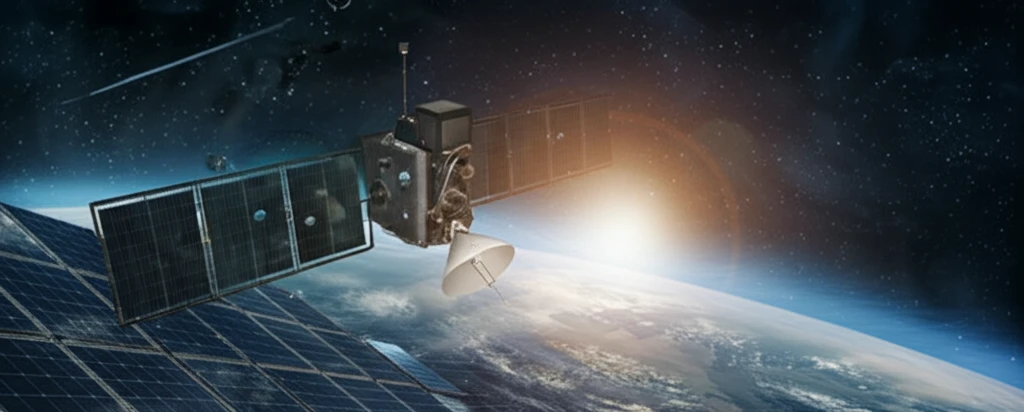
Smart Health: How AI Could Monitor the Health of Satellites

"Deployable antenna technology gets a boost with AI-driven sensor placement for proactive structural health monitoring in space."
Space-based technology is essential for communications, weather forecasting, and countless other services that we depend on daily. As satellites become more complex, ensuring their reliability becomes a critical challenge. Structural Health Monitoring (SHM) offers a solution by applying continuous diagnostics, catching issues before they escalate into mission-threatening failures. Now, cutting-edge research explores the potential of AI to enhance SHM systems in space.
Recent innovations focus on space-based solar power satellites (SSPS), which promise a sustainable energy source by capturing solar energy in space and transmitting it to Earth. These massive structures require durable, long-lasting components. Regular health checks are necessary because the satellites use deployable antenna modules, which are prone to in-orbit damage. This is where AI and advanced sensor technology come into play, offering new methods to monitor and maintain these vital systems.
The integration of AI, specifically genetic algorithms, provides a sophisticated way to optimize sensor placement on these satellites. This approach enhances the effectiveness of health monitoring systems. By strategically positioning sensors, SSPS can improve their capacity to detect and address structural issues. This ensures that these satellites remain operational and efficient over their expected lifespans.
Why Satellite Health Monitoring Matters Now
As launch costs decrease and the number of satellites in orbit grows steadily, autonomous health management and monitoring have become increasingly important for space missions. Critical satellite components require continuous monitoring to ensure long-term mission stability, and telemetry data from satellite sensors is characterized by its large scale and high complexity. Early warning capabilities and remaining useful life prediction under resource-constrained conditions are essential to maintaining reliable satellite operations. Monitoring impact forces and angles from space debris is also becoming an important element in providing data support for satellite damage assessment.
Traditional Monitoring Paradigms
Traditional satellite health monitoring has largely relied on ground-based telemetry analysis, where engineers manually review downlinked data streams to detect anomalies. While rule-based systems and threshold alerts have been standard practice, these methods struggle to scale with the growing volume and complexity of data from modern multi-sensor satellite architectures. Human-in-the-loop approaches introduce latency that can be critical when decisions need to be made in real time aboard the spacecraft itself.
From Sputnik to Smart Constellations
The history of satellites traces back to 1957, when Sputnik 1 became the first artificial satellite launched into orbit, marking the dawn of the space age. Over the following decades, satellites evolved from simple radio beacons to sophisticated platforms serving communication, navigation, weather forecasting, and Earth observation roles. A significant turning point came in the early 2000s with the development of miniaturised satellite technology such as CubeSats and smallsats, making space more accessible than ever before. By the mid-2020s, mega-constellations like Starlink demonstrated how modern satellite networks have grown in scale and complexity far beyond what early space pioneers could have envisioned.
AI-Driven Sensor Placement: A New Frontier in Satellite Maintenance
Traditionally, ensuring the structural integrity of satellites has been a complex task. Now, there's an innovative approach that is based on genetic algorithms. This method is designed to pinpoint the best spots for placing sensors on deployable antenna modules, which are critical but vulnerable components of space-based solar power satellites. By carefully selecting these sensor locations, it's possible to dramatically improve how effectively we can monitor a satellite's health, spotting potential problems before they cause serious damage.
- Effective Independence Method (EfI): Maximizes linear independence in targeted modes, ensuring comprehensive data capture.
- Effective Interval Index (EII): Avoids redundant information by strategically spacing sensors, reducing overlap.
- Combined Fitness Function: Integrates EfI and EII to maximize data quality while minimizing redundancy.
- Reliability Considerations: Accounts for the reliability of sensors in vulnerable locations, like deployable mechanisms.
Emerging Directions in AI-Driven Satellite Health Research
Research at the intersection of AI and satellite health monitoring is an active and rapidly evolving field, with studies exploring autonomous anomaly detection, predictive maintenance, and real-time decision-making frameworks. Advances in edge computing and machine learning are enabling onboard processing of telemetry data, reducing reliance on ground stations for time-critical health assessments. While this area is progressing quickly, the field remains relatively young, and many proposed approaches have yet to be validated at scale on operational satellite constellations.
Challenges and Skepticism
Despite the promise of AI-driven health monitoring, several practical challenges temper enthusiasm. Autonomous systems must contend with limited onboard computational resources, radiation-induced hardware errors, and the harsh thermal environment of space, all of which can degrade the reliability of AI models themselves. There is also a trust deficit: satellite operators may be reluctant to cede decision-making authority to algorithms, particularly for high-value assets where the consequences of a false positive or missed detection could be catastrophic. Without robust validation across diverse mission profiles, the risk of overfitting to narrow training datasets remains a concern.
Spacecraft vs. Astronaut Health Monitoring
Health monitoring in space extends beyond satellites to include the astronauts who operate them, and recent research highlights both parallels and key differences. A 2025 review of astronaut health monitoring systems emphasizes wearable sensors, telemetric technologies, and data processing frameworks, identifying critical gaps for long-duration missions. Meanwhile, machine learning and data mining techniques are increasingly being applied to satellite health monitoring problems, including anomaly detection and predictive diagnostics. Nature has also reported on biomonitoring and precision health technologies needed for deep-space exploration, where systems must function independently from Earth-based support. Across these domains, the common challenge is extracting actionable insights from high-volume, complex data streams in real time under severe resource constraints.
Future Directions and Implications
AI-enhanced sensor placement offers a promising path for ensuring the durability and effectiveness of space-based assets. As the technology improves, it will play a key role in preserving and optimizing satellite performance. This will lead to more reliable communication networks, better environmental monitoring, and push forward space exploration efforts. This fusion of AI and space tech marks a significant step forward, boosting the capabilities and lifespan of satellites that our modern world increasingly relies on.
Converging Toward Smarter Space Systems
The growing body of research suggests a broad consensus that AI-driven health monitoring represents a significant step forward for satellite operations, though no single approach has yet emerged as the definitive standard. Experts across multiple studies emphasize that the key to success lies in combining reliable anomaly detection with meaningful prognostics — not just flagging problems, but predicting when components will degrade beyond acceptable thresholds. The challenge of validating these systems on real-world satellite data, under real operational constraints, remains a central focus of current research.
What Comes Next for Autonomous Space Health
Looking ahead, the integration of edge AI and autonomous health management into satellite systems is expected to deepen as launch cadences increase and constellations grow larger. Future missions — particularly those venturing into deep space — will demand health monitoring systems that can operate entirely independently of ground-based support, with no possibility of human intervention during communications delays. Advances in miniaturized sensor technology and more efficient onboard processing will likely expand the scope of what satellites can monitor about themselves, potentially enabling real-time structural health assessments that go beyond traditional telemetry.
Scaling Health Monitoring Across the Space Sector
As the space industry moves toward operating thousands of satellites simultaneously, systemic challenges around data management, standardization, and inter-operator coordination become increasingly pressing. No widely accepted framework currently exists for how satellite health data should be collected, processed, or shared across operators and mission types. The diversity of satellite designs, sensor suites, and mission profiles makes it difficult to develop one-size-fits-all monitoring solutions, and interoperability between different health management systems remains an open problem.
People Behind the Satellites
Ultimately, the push toward smarter satellite health monitoring is driven by the needs of the engineers, operators, and scientists who depend on these assets for critical services like communication, navigation, and Earth observation. Reducing the burden of manual telemetry review allows mission teams to focus on higher-level decision-making and strategic planning rather than routine data triage. As autonomous systems become more capable, the relationship between human operators and satellite health systems will likely shift from reactive oversight to proactive partnership.