
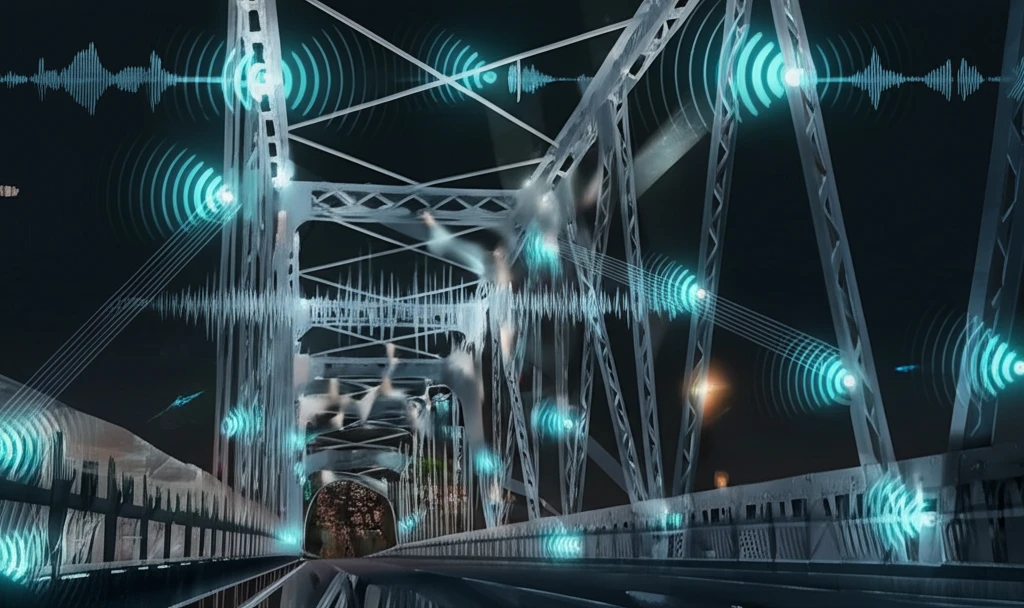
Decoding Steel Fatigue: How Acoustic Emission Can Save Infrastructure

"Learn how cutting-edge acoustic emission techniques are revolutionizing the detection of structural weaknesses in aging steel infrastructure, ensuring safety and longevity."
Our world relies on vast networks of steel structures—bridges, pipelines, pressure vessels—that silently bear immense loads every day. But what happens when these materials, subjected to relentless stress and environmental factors, begin to weaken? The answer could lie in an innovative technology known as acoustic emission (AE), a method that 'listens' to the subtle sounds of material degradation, offering a proactive approach to infrastructure maintenance and safety.
For decades, industries have grappled with the challenge of detecting hidden defects and fatigue in steel components before they lead to catastrophic failures. Traditional inspection methods often involve costly and time-consuming shutdowns, and even then, they might miss critical flaws. Acoustic emission technology provides a real-time, non-destructive way to monitor the health of steel structures, promising to revolutionize maintenance practices and extend the lifespan of critical infrastructure.
This article delves into the science behind acoustic emission, exploring how it is used to identify the telltale signs of damage in carbon steel and ferritic alloy-steel. We'll examine real-world applications, discuss the benefits and limitations of the technology, and look at the future of acoustic emission as a vital tool in safeguarding our infrastructure.
Current Statistics & Impact
Steel fatigue arises from repeated cyclic loading that gradually degrades material integrity across infrastructure components. The consequences of undetected fatigue range from costly unplanned downtime to catastrophic structural failure endangering public safety. However, the true magnitude of fatigue-related risks varies significantly depending on loading patterns, material composition, and environmental conditions, making generalized statistics difficult to establish.
Standard Approach, Accepted Methods & Their Limitations
Acoustic methods are grounded in the science of sound propagation and its interaction with physical media. In engineering contexts, this scientific foundation supports the use of sound-based techniques for internal structure assessment. Conventional approaches such as visual inspection and scheduled testing operate at discrete intervals, potentially missing gradual damage development between examinations.
Historical Perspective, Milestones, Foundational Discoveries
The systematic study of material fatigue emerged during the industrial revolution as repeated stress cycles were observed to cause progressive crack growth in machine components. Early theoretical work established relationships between stress amplitude and fatigue life, forming the basis for design standards still in use today. Subsequent advancements in fracture mechanics have refined understanding of crack initiation and propagation under varied loading regimes.
What is Acoustic Emission and How Does it Work?
Acoustic emission is a phenomenon where materials release energy in the form of acoustic waves when they undergo stress or deformation. These waves, though often imperceptible to the human ear, can be detected by highly sensitive sensors. In the context of steel structures, acoustic emission occurs when tiny cracks form, grow, or when there's movement at grain boundaries within the metal. Each of these events generates a unique acoustic signature, providing valuable insights into the material's condition.
- Real-Time Monitoring: AE allows for continuous, real-time assessment of structural health, enabling immediate detection of emerging issues.
- Non-Destructive Testing: Unlike some traditional methods, AE doesn't require taking the structure out of service or causing any damage.
- Early Detection: AE can detect damage at a microscopic level, long before it becomes visible or causes a significant problem.
- Comprehensive Assessment: AE provides a holistic view of the structure, identifying areas of high stress and potential failure points.
Latest Research and Reviews
Contemporary research into damage assessment techniques spans multiple disciplines, reflecting the complexity of detecting incipient fatigue in real-world structures. Review literature acknowledges the promise of emerging methods while highlighting persistent challenges in signal interpretation and threshold determination. Interdisciplinary efforts continue to bridge gaps between laboratory findings and field-deployable monitoring solutions.
Counter Arguments and Failures
Critics of acoustic emission-based assessment raise concerns about signal interpretability when background noise and complex loading histories obscure the link between detected emissions and material state. Skeptics argue that without rigorous calibration against known references, observed phenomena may reflect operational variables rather than genuine structural degradation. These counter arguments highlight the need for validated, application-specific methodologies before widespread deployment.
Comparative Analysis
Comparative evaluations of fatigue monitoring strategies typically weigh continuous acoustic techniques against periodic inspection methods such as ultrasonic testing or magnetic particle examination. Each approach presents distinct trade-offs regarding sensitivity, cost per assessment, and disruption to ongoing operations. The selection of an optimal methodology depends on structural type, service environment, and the specific failure risks confronting the asset in question.
The Future of Infrastructure: A Sound Investment
As our infrastructure continues to age, the need for innovative and reliable monitoring techniques will only grow. Acoustic emission technology represents a significant step forward in ensuring the safety and longevity of steel structures. By 'listening' to the subtle signs of material degradation, we can move from reactive repairs to proactive maintenance, saving lives, reducing costs, and building a more resilient future.
Synthesis & Expert Commentary
Synthesizing perspectives from materials science, structural engineering, and field practice suggests that acoustic emission can serve as a valuable adjunct to, rather than a complete replacement of, existing fatigue monitoring protocols. Expert consensus tends to favor integrated monitoring frameworks that combine multiple sensing modalities for improved reliability. Ongoing knowledge exchange between research and practice continues to shape the evolving methodological landscape.
Future Outlook & Next Frontiers
Anticipated developments include the application of machine learning algorithms for automated signal classification, the expansion of wireless sensor networks for distributed damage mapping, and the emergence of standardized data formats for cross-study comparison. These advances aim to reduce the manual expertise required for interpretation while improving early-detection sensitivity across diverse infrastructure categories. Field validation remains a critical bridge between laboratory innovation and operational readiness.
Broader Context & Systemic Challenges
Deploying advanced monitoring technologies at scale introduces systemic considerations beyond engineering performance, including data governance, cybersecurity safeguards, and institutional acceptance barriers. Retrofitting legacy structures can incur substantial capital costs that affect cost-benefit calculations for owners and regulators alike. Addressing these multifaceted challenges requires coordinated engagement across technical, policy, and financing domains.
The Human Element & Real-World Impact
The practical significance of improved fatigue monitoring translates directly into enhanced safety for workers and the public, reduced economic disruption from unplanned outages, and extended service life for critical assets. By enabling more informed maintenance decisions, acoustic emission and related techniques have the potential to prevent failures that would otherwise impose human and financial costs. The broader societal benefit underscores the importance of continuing to advance and validate monitoring capabilities.