
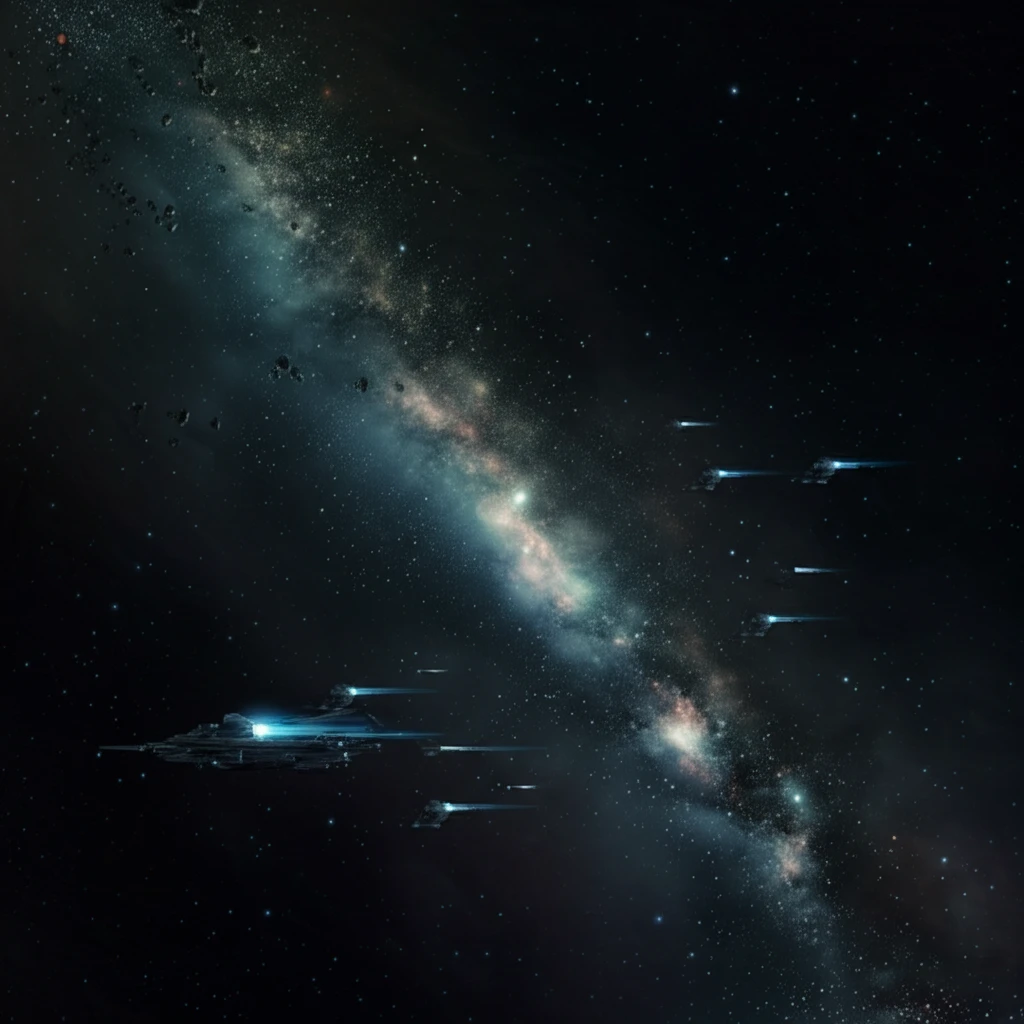
Spacecraft Harmony: How Swarm Tech Keeps Satellites in Sync

"Explore the innovative techniques ensuring spacecraft formations maintain perfect attitude synchronization even with communication delays and potential failures."
In the vast expanse of space, the idea of multiple spacecraft working together like a well-oiled machine is quickly becoming a reality. Spacecraft formations promise to revolutionize everything from Earth observation to deep-space exploration. But how do you ensure that these spacecraft stay perfectly aligned and synchronized, especially when things go wrong?
Maintaining the precise attitude (orientation) of spacecraft in formation is no small feat. It’s like trying to conduct a symphony orchestra where the musicians are miles apart and sometimes can’t hear each other clearly. Add to that the possibility of equipment malfunctions, and you have a recipe for potential chaos. That's why scientists and engineers are developing sophisticated control systems that allow spacecraft to maintain their orientation even when faced with limited communication and unexpected failures.
This article explores the innovative techniques that enable spacecraft to work together in perfect harmony. We'll dive into the challenges of attitude synchronization, the solutions being developed, and what the future holds for spacecraft formation technology.
Attitude Synchronization: A Critical Formation-Flying Requirement
Spacecraft attitude synchronization — the problem of achieving a common orientation among multiple spacecraft — is a critical requirement for missions involving synthetic aperture radar, in-orbit servicing, and spacecraft formation flying. Follower spacecraft in these formations must coordinate their attitudes even when they cannot communicate directly with the leader, requiring distributed state estimators to relay target attitude information. Real-world formations face simultaneous challenges including parameter uncertainty, actuator saturation, external disturbances, and time-varying communication delays, all of which complicate synchronization efforts across the swarm.
Prevailing Control Paradigms and Their Trade-offs
Most spacecraft attitude synchronization strategies today build on distributed control architectures in which each follower spacecraft adjusts its own orientation based on locally shared information rather than centralized commands. While these approaches can scale to large formations, their effectiveness hinges on the reliability of inter-spacecraft communication links and the fidelity of onboard disturbance models. In practice, achieving both fast convergence and robustness to uncertainties simultaneously remains an open challenge that no single method has fully resolved.
From Continuous Control to Event-Triggered Mechanisms
Early distributed attitude coordination strategies for spacecraft relied on continuous sliding mode control to handle unknown disturbances and modeling uncertainties, establishing a robust foundation for subsequent work. A significant milestone was the shift toward event-triggered control mechanisms, which reduced the demand on limited onboard energy and computational resources by updating control signals only when triggered by specific state conditions rather than continuously. Building on these ideas, state-irrelevant event-based methods were later developed for formations with indirect information flow, broadening applicability to more complex communication topologies.
The Challenge: Keeping Spacecraft Aligned
Imagine trying to hold a perfect formation while running a marathon, but you can only talk to your teammates sporadically and some of you might have a limp. That's the essence of the spacecraft attitude synchronization problem. Several factors make this incredibly challenging:
- Actuator Faults: Spacecraft components, such as reaction wheels, can fail or lose effectiveness, making it difficult to control the spacecraft's orientation.
- External Disturbances: Space is not a perfectly still environment. Spacecraft are constantly buffeted by solar wind, gravitational forces, and other disturbances that can knock them off course.
Recent Advances in Heterogeneous and Reduced-Attitude Synchronization
A 2025 study on reduced attitude synchronization of rigid spacecraft targets pointing and tracking missions where full three-axis attitude alignment is unnecessary, expanding synchronization theory to more practical mission profiles. Meanwhile, recent work on heterogeneous spacecraft formations — where leader and follower vehicles have different dynamic properties — has proposed distributed backstepping-based control algorithms defined on SO(3) to handle asymmetries in mass, inertia, and actuator capability. These advances reflect a broader trend toward tailoring synchronization strategies to specific mission constraints rather than relying on one-size-fits-all approaches.
Open Questions and Known Failure Modes
Despite substantial progress, spacecraft attitude synchronization research still contends with unresolved failure scenarios, particularly when actuator faults occur mid-mission or when communication links degrade unpredictably. Most proposed controllers have been validated primarily through numerical simulation rather than orbital demonstration, leaving real-world robustness partially unverified. The gap between theoretical convergence guarantees and actual hardware performance under combined fault conditions remains a recognized limitation across the field.
Trade-offs Across Synchronization Approaches
Attitude synchronization strategies vary significantly in their convergence speed guarantees, with finite-time controllers offering predictable settling times but requiring greater control effort than asymptotic or fixed-time alternatives. Energy-constrained missions may favor event-triggered architectures that reduce communication and computation at the cost of transient performance, while high-precision missions often demand continuous sliding mode approaches despite their higher resource consumption. No single control framework dominates across all mission profiles, and selection ultimately depends on the interplay of accuracy requirements, hardware limitations, and communication topology.
The Future of Spacecraft Swarms
As technology advances, spacecraft formations will likely become more common and more sophisticated. Improved communication technologies, more robust components, and more intelligent control systems will enable spacecraft to work together in even more complex and challenging missions. From exploring distant planets to monitoring our own world, the future of space exploration is looking more collaborative than ever before.
Fixed-Time Control Under Directed Topologies
A 2022 study on fixed-time coordinated attitude tracking under directed communication topologies demonstrated that follower spacecraft can achieve synchronization with a dynamic leader even when the communication graph is not bidirectional, broadening applicability to asymmetric network designs. The fixed-time framework ensures convergence within a predetermined bound regardless of initial conditions, offering a practical guarantee absent from purely finite-time or asymptotic methods. This work synthesizes elements of state estimation, distributed consensus, and robust control into a cohesive architecture for complex formation scenarios.
Toward Ambitious Swarm Missions
The advancements in spacecraft formation attitude synchronization are expected to enable more complex and ambitious missions by overcoming persistent challenges such as actuator faults and limited data communication bandwidth. As control strategies mature, future swarm-based architectures could support large-scale distributed aperture telescopes, coordinated planetary observation, and autonomous in-orbit assembly of ultra-large space structures. These innovations suggest a trajectory toward increasingly autonomous spacecraft collectives that require minimal ground intervention.
Resource Constraints and Systemic Scalability
Spacecraft formation flying with desired attitude coordination must contend with fundamental systemic challenges including limited onboard energy, constrained computational capacity, and the scalability of distributed algorithms to ever-larger swarms. Event-triggered control has emerged as a promising paradigm for addressing energy and computation limitations, but its deployment at scale introduces new questions about network reliability and the aggregate behavior of many independently triggered agents. Bridging the gap between small formation demonstrations and operational large-scale swarms remains one of the field's most significant systemic hurdles.
Bridging Theory and Operational Practice
While the mathematical foundations of spacecraft swarm synchronization are advancing rapidly, translating these control laws into reliable onboard software that operators can monitor and override remains a largely underexplored challenge. Ground teams must trust that autonomous synchronization routines will behave predictably under nominal conditions while remaining testable and debuggable in simulation prior to deployment. The human dimension — from mission planning and anomaly response to crewed spacecraft coordination — will ultimately determine whether these elegant algorithms achieve their transformative potential.