
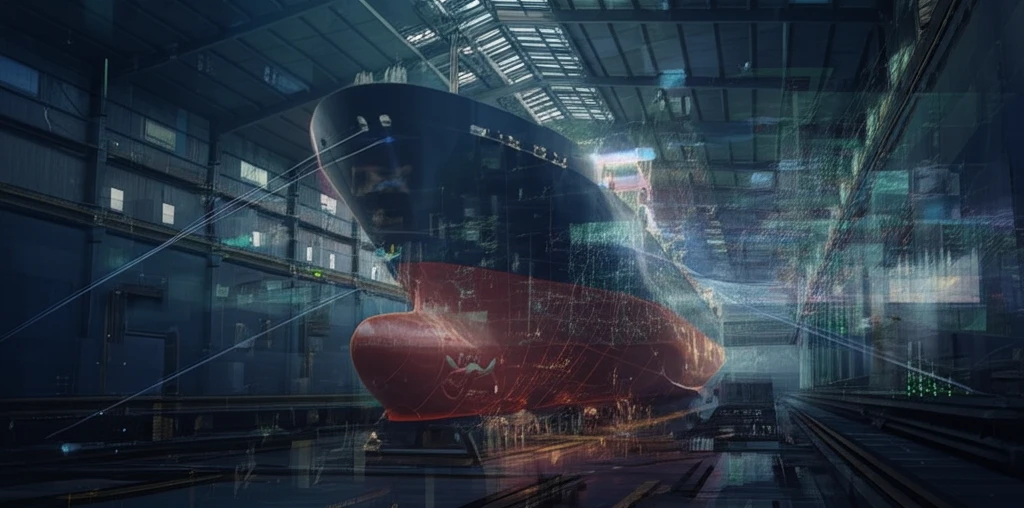
Smooth Sailing Ahead: How Simulation and Reverse Engineering are Revolutionizing Ship Retrofitting

"Discover how cutting-edge simulation tools and reverse engineering technologies are making ship retrofitting more efficient, cost-effective, and environmentally friendly, ensuring smoother operations for years to come."
The maritime industry is under constant pressure to evolve. Growing environmental concerns, stricter regulations from classification societies, and the relentless march of technological advancement mean ship owners must regularly retrofit their vessels. Retrofitting, the process of updating older ships with new technologies and systems, is no longer a matter of choice but a necessity for staying competitive and compliant.
However, retrofitting is a complex undertaking, fraught with challenges. Unexpected delays, cost overruns, and the need for extensive re-planning are common pitfalls. A significant hurdle is the often limited or unreliable information available for older ships. Original design documents may be missing, outdated, or inaccurate due to undocumented modifications over the years. This lack of precise data can lead to significant rework during the retrofitting process, inflating costs and extending downtime.
Fortunately, innovative solutions are emerging to tackle these challenges. Simulation tools and reverse engineering technologies are revolutionizing the way ship retrofits are planned and executed, offering a pathway to greater efficiency, accuracy, and ultimately, a smoother, more profitable journey for ship owners.
A Growing Global Industry
Ship retrofitting has grown into a sizeable global industry. StartUs Insights counts more than 840 organizations worldwide and spotlights 10 standout innovators drawn from over 40 new ship retrofitting solutions spanning smart navigation systems and unmanned surface vessels. SAFETY4SEA describes retrofitting as offering the possibility to remain flexible on the transition pathway, tailoring vessels to meet global standards and adapt to fuel availability. The practice is also framed as an opportunity for existing vessels to meet the latest legislation and improve greenhouse gas emission performance.
Planning-First Retrofits and the Hurdles Ahead
The standard approach begins with identifying and analysing the cost benefit of retrofitting an existing vessel versus acquiring new fleet, with planning identified as the key to success — the Global Maritime Forum reports that 12 to 14 months are needed upstream to prepare a vessel to be retrofitted. The process is deliberately flexible: Bureau Veritas notes owners can decide case-by-case and even upgrade beyond minimum compliance to add value. Yet DNV warns that a number of administrative and practical hurdles stand in the way of converting the existing fleet to dual-fuel capability. On the technical side, viscous flow CFD methods have been used to enable optimized, design-driven retrofits of ships in operation for improved energy efficiency and reduced emissions.
From Compliance Necessity to Business Asset
The foundational idea behind modern ship retrofitting has evolved from meeting regulatory mandates to preserving vessel value. A webinar on the future of retrofitting ship engines frames the practice as an opportunity for existing vessels to meet the latest legislation, improve greenhouse gas emission performance by burning a new generation of zero-emission fuels, and remain attractive as a business asset. In parallel, DTU researchers have approached retrofitting technologies for eco-friendly ship structures from a risk analysis perspective, signalling that the field has matured into a structured discipline. Both threads converge on the same premise: retrofitting keeps existing tonnage relevant amid tightening environmental rules.
Simulation and Reverse Engineering: A Powerful Partnership
Imagine being able to test different retrofit scenarios virtually, predicting potential problems and optimizing the process before a single wrench is turned. That's the power of simulation. By creating a digital twin of the ship, engineers can model the impact of various upgrades, assess the performance of new equipment, and fine-tune the entire retrofitting plan in a virtual environment. This minimizes surprises, reduces risks, and ensures a more streamlined execution.
- Accurate Assessment: Laser scanning creates precise 3D models of existing structures, overcoming the challenge of missing or outdated documentation.
- Virtual Testing: Simulation tools allow engineers to test different retrofit scenarios, predicting potential issues and optimizing the plan before physical work begins.
- Informed Decisions: By analyzing simulation results, ship owners can make data-driven decisions about the most effective and cost-efficient upgrades.
- Reduced Downtime: Efficient planning and execution minimize delays, getting ships back in operation faster.
Lloyd's Register's Retrofit Research Programme
Lloyd's Register has established a dedicated Retrofit Research Programme exploring cutting-edge ship retrofit enhancements to improve fuel efficiency and reduce emissions. The programme showcases advanced retrofit technologies and the benefits they bring to existing tonnage. As a research-driven initiative, it positions retrofitting as a systematic engineering pursuit rather than an ad hoc fix, reflecting the industry's broader move toward evidence-based decarbonization strategies.
Risk, Readiness, and Outdated Tonnage
Counter arguments emphasize that retrofits are neither risk-free nor automatically successful. A detailed risk assessment framework tailored to eco-friendly retrofits argues that a critical gap exists in current research, proposing a comprehensive strategy that integrates technical, environmental, economic, and regulatory considerations. Lloyd's Register adds that multiple factors must be evaluated — fleet readiness, engine technology, regulatory drivers, and alternative fuel availability — before engine retrofits become a viable long-term approach to emission reduction. A separate analysis points to the blunt reality that many ships are outdated, making retrofitting compulsory to install needed systems such as ballast water treatment, which is why risk-based design concepts and failure tree analysis are being applied to operating systems.
Retrofit Versus Replace: The Cost Calculus
Cost is one of the most critical factors in the retrofit-versus-replace decision, and both sources agree retrofitting is the cheaper route on paper. Ship Universe warns that while retrofitting a ballast water treatment system may seem like the cheaper option upfront, hidden expenses can pile up. MaritimEducation reports that a new dual-fuel vessel can cost 20–40% more than a conventional ship of similar size, a premium that may reach $15–30 million for large containerships or tankers. By comparison, retrofitting existing engines is presented as the more economical path — though Ship Universe cautions the apparent savings can be eroded by unexpected costs.
Looking Ahead: A Future of Efficient and Sustainable Shipping
The integration of simulation tools and reverse engineering technologies marks a significant step forward in the maritime industry. By embracing these innovations, ship owners can navigate the complexities of retrofitting with greater confidence, ensuring their vessels are not only compliant and competitive but also more efficient and environmentally sustainable. As these technologies continue to evolve, the future of ship retrofitting promises to be smoother, smarter, and greener, benefiting both the industry and the planet.
De-Risking the Fleet and the Ammonia Promise
Expert commentary positions retrofitting as a fleet-level de-risking tool. Lloyd's Register's retrofit options analysis helps owners understand and manage their carbon footprint, make sound investment decisions to cut fuel usage and emissions, and comply with tightening regulations. Supporting the business case, BusinessGreen reports on a study claiming that ships purpose-built, fully or partially retrofitted to run on ammonia could operate at lower fuel costs than fossil-fuelled vessels and cut carbon by up to 77%. Both perspectives converge on retrofitting as a financially and environmentally defensible path forward.
Propulsion and Electrification as the Next Frontier
The future of retrofitting is increasingly defined by propulsion and electrification. IEEE Xplore describes the development of retrofitting solutions to increase the fuel efficiency and environmental sustainability of vessels as a hot topic, with research outlining the advantages, technological challenges, and possible future developments of both solutions. Sea Force similarly examines future trends in ship propulsion retrofitting alongside the economic benefits, environmental impact considerations, and the specific challenges of retrofitting older ships, citing successful retrofit case studies. Together, the two sources point to propulsion-system upgrades as the sector's most active next frontier.
Disruptions, Integration, and Uncertain Economics
Broader systemic forces shape whether retrofitting can be delivered at scale. Business Research Insights reports that the COVID-19 pandemic greatly impacted the ship retrofitting market, as global shutdowns and border closures stalled the delivery of retrofitting components and created operational logistics and supply-chain challenges. Beyond one-off disruptions, integrating the wider fuel system into existing vessels poses significant system integration challenges. The cost of retrofitting also remains uncertain, which directly impacts the business case for owners and operators weighing the decision.
Supply Chains, Regulation, and Quieter Seas
Retrofitting's impact reaches well beyond the vessel itself. A case study of ship retrofitting services examines eco-innovation drivers within value-creating networks, showing how green retrofitting of vessels can be customized across a multi-tier supply chain and how incumbent players such as the IMO categorize technologies that tackle the environmental impact of ships. On the real-world side, a Scripps-led study of retrofitted shipping vessels identified retrofit-induced changes in ships' radiated noise levels and monopole source levels. The interaction between retrofit and speed was also noteworthy, with the effect of retrofitting on monopole source level greatest at slower speeds.