
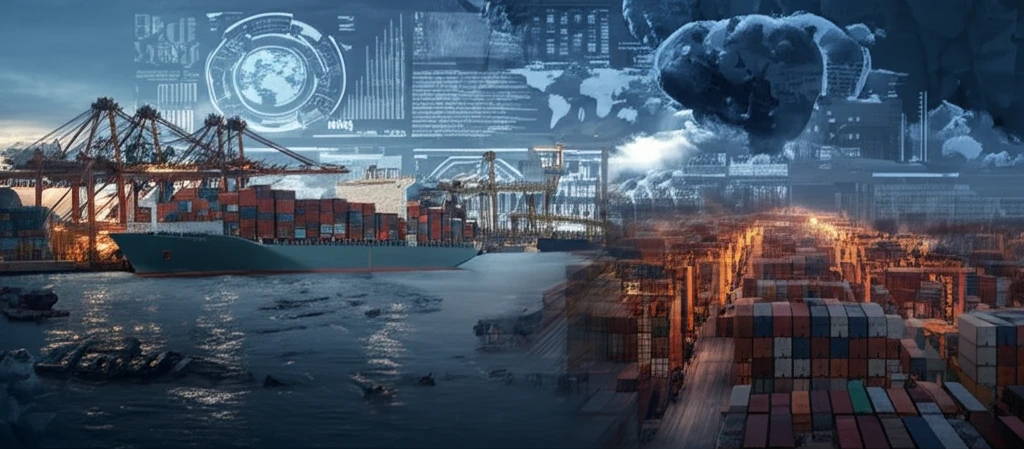
Navigate the Future: How Port Simulation Models are Revolutionizing Maritime Safety and Efficiency

"Discover how cutting-edge simulation technology is reshaping port operations, making them safer, more efficient, and ready for tomorrow's challenges."
Globalization has dramatically increased maritime transport, leading to larger vessels and higher traffic volumes. Ports, often constrained by inflexible infrastructures, face the challenge of accommodating this growth without compromising safety or efficiency. The rise in vessel movements has made vessel navigation related processes critical for port performance.
Maritime transportation simulation models have emerged as essential tools for optimizing port operations and assessing performance. These models allow port authorities and planners to evaluate different scenarios, identify potential bottlenecks, and implement strategies to improve safety and capacity. From simulating vessel traffic in straits to assessing maritime risks, these models offer valuable insights into complex port environments.
This article explores the state-of-the-art in port simulation models, focusing on their application for risk and capacity assessment. By examining various models and their capabilities, we aim to provide a comprehensive overview of how these technologies are shaping the future of maritime navigation. We delve into the key navigational processes, infrastructure considerations, and simulation techniques that are driving innovation in port management.
The Data Behind America's Ports
The U.S. Maritime Administration curates port-related data and analytical resources—curated datasets, dashboards, and reports—that illuminate how America's ports move freight, create jobs, and support national security. The Bureau of Transportation Statistics' Port Performance Freight Statistics Program complements these efforts by providing nationally consistent performance measures on capacity and throughput for the Nation's seaports. Simulation research specifically addresses the challenge of ports with limited visibility and data on their operations. Because port data is published through a patchwork of authority and terminal operator sources, statistics programs and simulation methods together give operators and policymakers a more complete evidence base for improving port performance and safety.
Conventional Modeling Approaches and Their Limits
No dedicated source material was available for this subsection, so the following is a general, appropriately hedged summary. Established approaches to port planning and optimization typically rely on statistical analysis, queuing concepts, and static capacity calculations, often supported by spreadsheet-based forecasting of cargo volumes and berth utilization. These methods are commonly valued for their simplicity and ease of communication, but they can struggle to capture the many interacting factors—vessels, equipment, labor, and terminal infrastructure—that shape real-world port performance. Simulation-based techniques are meant to address these gaps, though the appropriate approach depends on data availability, project scope, and the specific planning questions being asked.
A Brief Evolution of Port Modeling
No dedicated source material was available for this subsection, so this should be read as general background rather than a documented timeline. Port and terminal modeling has evolved over recent decades in step with advances in computing power and operations research techniques. Early efforts tended to focus on isolated elements of port activity, such as berth allocation or cargo handling, before more integrated, whole-system representations became practical. The overall trajectory is one of growing ambition, though the milestones and pace of that evolution are not documented in the available material for this article.
Decoding Port Simulation Models: A Comprehensive Guide
Ports are intricate networks where seamless coordination is crucial. Port simulation models aim to replicate the complex interactions between vessels, infrastructure, and operational processes to enhance safety and efficiency. These models consider a wide array of factors, from vessel arrival patterns to the impact of weather conditions.
- Nautical Infrastructure: The model should include all relevant parts of the port infrastructure, such as channels, inner basins, manoeuvring areas, and berths.
- Anchorage: Accurate modeling of anchorage areas is crucial, considering factors like vessel allocation and waiting times.
- Berthing Processes: The simulation should realistically represent berthing times and manoeuvring, as these can significantly impact port efficiency.
- Terminal Operations: While not always detailed, terminal operations must be included to provide a complete picture of port activities.
- Tug and Pilot Assistance: Restrictions on navigation and the availability of tugs and pilots play a vital role in ensuring safe vessel movements.
- Traffic Rules: Adherence to international and port-specific traffic rules must be incorporated to simulate realistic navigation scenarios.
What Recent Research Shows
A systematic review of port performance literature found that studies were predominantly based on data envelopment analysis (DEA) to compute port efficiency, followed by simulation modeling, with research concentrated on dimensions such as port competitiveness, port performance, sustainability, and port governance and strategy. This publication volume has grown significantly because the maritime sector has evolved as a crucial link in countries' economic development, with most cross-region trade moving by sea. Recent work has also turned to data-driven machine-learning-based simulations, which the researchers report drastically improve the precision of intersection simulations in container port logistics. Multidimensional reviews of simulation technology likewise highlight practical impact in maritime network optimization, port operation efficiency, and supply chain integration.
Risks, Failures, and the Limits of Traditional Planning
Counterweighting the optimistic case, research examines how failure risk factors in automated container port logistics systems correlate with one another, analyzed explicitly from a resilience perspective. Other reviews argue that traditional maritime logistics planning relies heavily on human experience and simplistic models, which limits its ability to address complex systems and real-world uncertainties. Simulation is offered as a corrective because of its advantages in virtual environment modeling and in lowering trial-and-error risk, and simulation tools have been used in ports and terminals since the mid-twentieth century. Case-based assessment has also shown how computer simulation can investigate port logistics system behavior under different risk scenarios and evaluate system reliability and resilience.
Comparing Modeling Approaches
No dedicated source material was available for a systematic comparative analysis in this subsection, so this should be read as general and hedged framing. Different approaches—from analytical calculations to discrete-event, agent-based, and machine-learning-driven simulations—each carry trade-offs in complexity, data requirements, and fidelity to real operations. Simpler tools tend to be quicker and cheaper to deploy, while richer simulation methods can represent more interactions and uncertainties at greater cost and effort. The most suitable choice depends on a port's objectives, available data, and the specific decisions at stake.
Charting the Course for Future Port Simulations
The assessment reveals that current port simulation models still have room for improvement in accurately representing vessel navigation and assessing capacity and risk. Future models should prioritize detailed infrastructure, explicit tug and pilot assistance, and comprehensive traffic rules. Leveraging AIS data and incorporating human behavior models will further enhance the realism and reliability of these simulations. By embracing these advancements, port stakeholders can unlock new levels of safety, efficiency, and resilience in the face of growing global trade demands. The future of maritime navigation depends on our ability to simulate and optimize port operations for a safer, more efficient tomorrow.
Why Simulation Is a Prerequisite for Port Planning
Expert commentary in the literature holds that simulation modeling of shore- and sea-side port operations constitutes a fundamental prerequisite for effective project planning in port development. This is because numerous, often interactive parameters must be addressed at an early stage to ensure the optimum supply of port facilities and services for current and future demand. Researchers also describe research combining scenario analysis developed in collaboration with the port authority with logistics system simulation. Together, these practices position simulation as a central, early-stage planning tool rather than an optional afterthought.
The Road Ahead: Smart Ports and Digital Twins
Multiple outlook reports converge on three forces shaping the maritime industry's near future: stricter climate rules, faster digital adoption encompassing AI, IoT, and smart ports, and rising geopolitical risk on key trade routes. Emerging technologies highlighted include blockchain, digital twins, the Internet of Things, and cybersecurity, alongside AI-driven decarbonization tools and 5G-enabled smart ports. The industry is described as moving toward comprehensive digital twins for port planning and widespread adoption of edge computing for real-time operations. Forecasts extending to 2030 similarly emphasize cybersecurity, green technologies, AI integration, and workforce digital skills as defining priorities.
Systemic Pressures on the Maritime System
No dedicated source material was available for this subsection, so this is offered as a general, hedged framing. Port simulation operates within a wider maritime system subject to interconnected pressures, including shifting trade patterns, tightening environmental regulation, and security concerns. Translating modeling advances into systemic improvements will depend on data sharing, standardization, and coordination across ports, terminals, and regulators. These structural factors provide important context for interpreting the results of any single simulation project.
From Models to Working Ports
Real-world case studies show simulation applied to concrete port problems, such as a model of a multipurpose regional seaport in Delaware, USA that was implemented to identify possible bottlenecks and optimize port operations. Agent-based modeling has likewise been used to simulate port nautical services at the Port of Rotterdam. A library of industry case studies documents how organizations have used simulation software to provide effective solutions to real-world challenges across ports and terminals. These examples illustrate the practical payoff of simulation in improving everyday port performance and safety.