
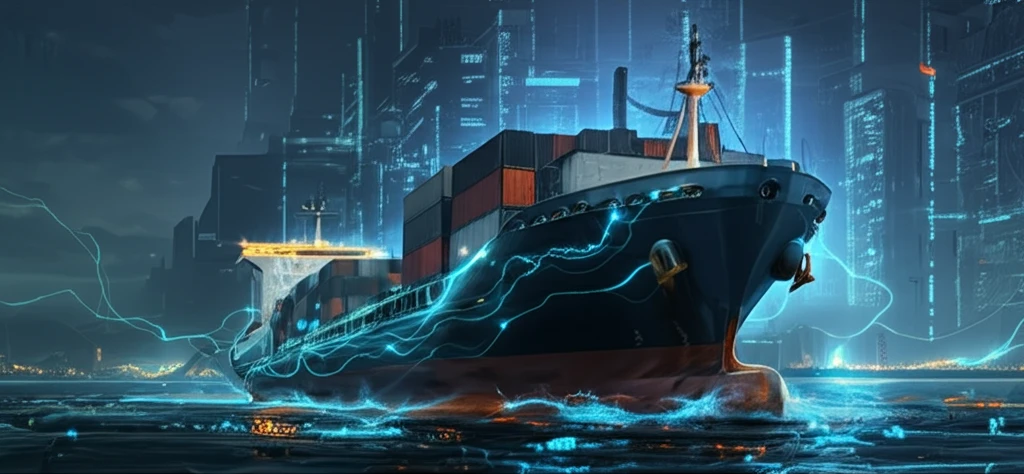
Future-Proofing Fleets: How Simulation and Reverse Engineering are Revolutionizing Ship Retrofitting

"Discover how cutting-edge technologies like simulation tools and reverse engineering are making ship retrofitting more efficient, cost-effective, and sustainable."
The maritime industry is undergoing a significant transformation, driven by the need to adopt more efficient and environmentally friendly technologies. Ship owners are under increasing pressure to retrofit their vessels to comply with stringent emission regulations and to take advantage of the latest technological advancements. This drive for modernization has led to a growing demand for innovative approaches to ship retrofitting.
Retrofitting, the process of upgrading existing ships with new equipment and systems, is crucial for extending the lifespan of vessels, improving their performance, and reducing their environmental impact. However, retrofitting projects can be complex and costly, often requiring extensive planning and precise execution to minimize downtime and ensure optimal results.
Fortunately, advancements in simulation tools and reverse engineering technologies are revolutionizing the field of ship retrofitting. These technologies enable ship owners and shipyards to plan, execute, and validate retrofitting projects with unprecedented efficiency and accuracy, unlocking new possibilities for sustainable and competitive maritime operations.
The Retrofitting Imperative
Global fleet retrofitting activity appears to be accelerating, driven by tightening environmental regulations and the push toward digitalization in maritime operations. While precise industry-wide figures on retrofitting investment remain difficult to consolidate, the sector is widely understood to be undergoing a significant transformation. Simulation tools and reverse engineering techniques are increasingly positioned as key enablers in this shift, offering pathways to modernize aging vessels without full replacement.
Traditional Retrofitting Workflows
Conventional ship retrofitting typically involves detailed on-site surveys, manual documentation of existing systems, and iterative design cycles that can be both time-consuming and costly. These methods, while well-established, often struggle with incomplete or outdated vessel documentation, leading to design uncertainties and potential rework. The limitations of purely physical inspection approaches have driven interest in digital alternatives such as 3D scanning and simulation-based design validation.
Evolution of Retrofitting Practices
Ship retrofitting has evolved from basic structural modifications to sophisticated system-level upgrades reflecting broader technological advances in maritime engineering. Early retrofitting efforts were largely reactive, addressing immediate compliance needs or operational failures. The integration of computational modeling and digital twin concepts represents a more recent milestone, enabling predictive approaches to fleet modernization rather than purely reactive ones.
Why Simulation and Reverse Engineering are Game-Changers for Ship Retrofitting?
Traditional ship retrofitting often involves significant uncertainties due to the limited availability of accurate data and documentation for older vessels. This lack of information can lead to costly delays, rework, and suboptimal performance. Simulation and reverse engineering address these challenges by providing:
- Reduced Risks: By simulating different retrofitting scenarios, ship owners can assess the potential impact of various upgrades on vessel performance, fuel efficiency, and emissions. This reduces the risk of investing in technologies that may not deliver the desired results.
- Faster Turnaround Times: Simulation and reverse engineering streamline the retrofitting process, enabling shipyards to complete projects more quickly and efficiently. This minimizes downtime for ship owners, reducing revenue losses.
- Enhanced Sustainability: By optimizing retrofitting designs for fuel efficiency and emissions reduction, these technologies contribute to a more sustainable maritime industry.
Emerging Tools and Approaches
Recent developments in simulation technology and reverse engineering are creating new possibilities for fleet retrofitting, with research exploring how digital replicas of existing vessels can accelerate design and validation processes. These approaches appear to offer significant potential for reducing both the time and risk associated with complex retrofit projects. However, the field is still evolving, and the maturity and scalability of these methods vary across different applications.
Complexity and Inherent Limitations
Ships are inherently complex structures designed for specialized purposes, and this complexity poses fundamental challenges to retrofitting approaches that rely on simplified models or assumptions. The Wikipedia entry on ships emphasizes their purpose-driven design, noting that vessels are distinguished by size, load capacity, and function - factors that make each retrofitting project highly context-dependent. Critics may argue that simulation-based approaches risk overlooking the nuanced physical realities of diverse ship types, from cargo vessels to specialized warfare and oceanography platforms. Even with advanced tools, the gap between digital models and real-world ship conditions remains a point of concern.
Evaluating Approaches Head-to-Head
Comparing simulation-driven retrofitting methods against traditional approaches involves weighing factors such as upfront investment, project timeline, and long-term adaptability. Digital methods may offer advantages in handling complex geometries and system interactions, while conventional techniques bring deep practical expertise and established workflows. The optimal approach likely depends on vessel age, retrofit scope, and available documentation, though direct comparative data across projects remains limited in the public domain.
The Future of Ship Retrofitting
As environmental regulations continue to tighten and technological advancements accelerate, simulation and reverse engineering will play an increasingly vital role in ship retrofitting. These technologies empower ship owners and shipyards to make informed decisions, optimize retrofitting designs, and ensure that vessels remain competitive, compliant, and sustainable for years to come.
Integrating Data and Decision-Making
Tools like VesselFinder, which provide real-time AIS vessel tracking and marine traffic monitoring, illustrate how data-rich environments are becoming integral to fleet management and retrofitting strategy. The availability of live positional and operational data can inform decisions about which vessels to prioritize for upgrades and when to schedule interventions. This data-driven perspective complements simulation and reverse engineering approaches by grounding digital models in real-world operational patterns.
Looking Ahead
The convergence of simulation, reverse engineering, and real-time fleet data suggests a future where retrofitting decisions are increasingly proactive and optimized. Emerging technologies such as AI-assisted design and autonomous inspection drones may further transform how aging fleets are maintained and upgraded. While these frontiers hold promise, their practical adoption at scale will depend on factors including regulatory acceptance, industry investment, and workforce readiness.
Wider Implications and Barriers
Fleet retrofitting does not occur in isolation - it intersects with global supply chains, environmental policy, shipyard capacity, and economic pressures across the maritime industry. Systemic challenges such as inconsistent documentation standards and fragmented supply networks can hinder even well-planned retrofitting initiatives. Addressing these broader issues will likely require coordinated action across stakeholders, from shipowners and regulators to technology providers and classification societies.
People Behind the Processes
Ultimately, the success of any retrofitting approach depends on the expertise and adaptability of the people implementing it, from naval architects and engineers to yard workers and crew. Training and knowledge transfer are critical as new digital tools are introduced into traditional workflows. The real-world impact of these technologies is measured not just in efficiency gains, but in improved safety, reduced downtime, and the continued viability of maritime careers in an evolving industry.