
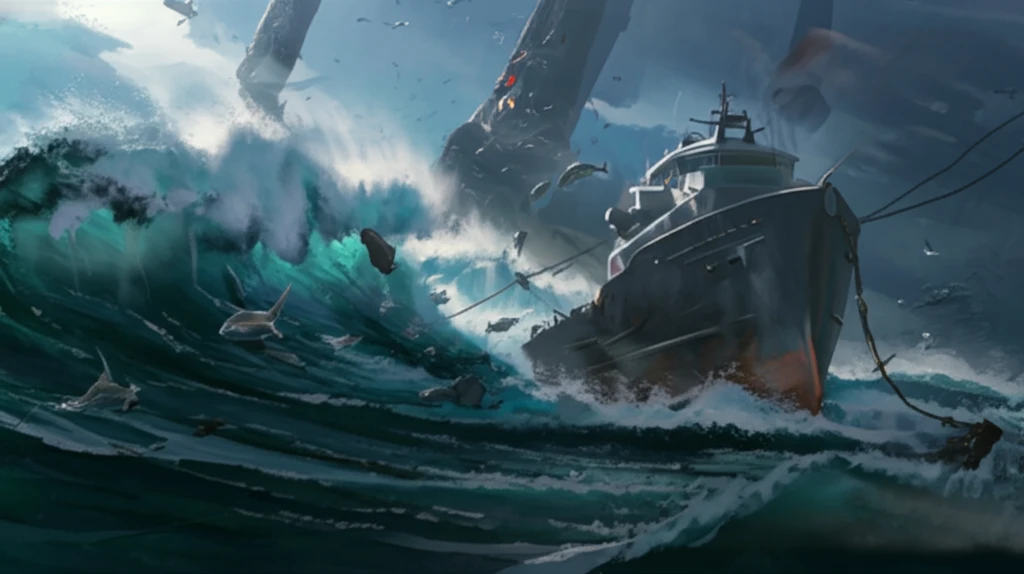
Aquaculture Under Pressure: Can Fish Farms Weather the Storms?

"New research reveals the hidden dangers of coupling well boats with fish farms in rough seas, threatening the stability of the aquaculture industry."
The aquaculture industry is a vital source of seafood, but its growth faces increasing scrutiny. Sustainability is paramount, and understanding the environmental impact of fish farms is crucial for securing the industry's future. A key aspect of this involves examining the interaction between fish farms and the vessels that service them, particularly well boats, which transport live fish.
Traditionally, well boats and fish farms were studied separately. However, recent research highlights the need to analyze them as a coupled system, especially when operating in challenging marine conditions. Irregular waves and strong currents can significantly impact the structural integrity of fish farms and the operational safety of well boats. Ignoring these factors could lead to catastrophic failures.
A new study published in the Journal of Fluids and Structures dives deep into the dynamic response of a coupled well boat-fish farm system in long-crested irregular waves and current. Using advanced numerical simulations, researchers investigated how the presence of a well boat affects the fish farm's structural loads and operational limits. The findings reveal some alarming insights that could reshape how aquaculture operations are managed.
The Scale of U.S. Aquaculture
The USDA's 2023 Census of Aquaculture provides detailed data on the value of aquaculture products sold, food fish production by species and size category, sport fish and baitfish production, and ornamental fish sales across the United States. According to the Economic Research Service, the Census expands on aquaculture data collected in the broader Census of Agriculture, covering production methods, surface water acres and sources, inventory, sales, and point of first sale. The ERS also tracks statistics on domestically grown catfish and trout, as well as U.S. imports and exports of fish and shellfish that may be aquaculture products, such as salmon, shrimp, and oysters. These data sources collectively illustrate the scope and economic significance of aquaculture in American food production.
How Fish Farms Operate
Aquaculture encompasses a range of farming methods, from open-water net pens and ponds to more controlled recirculating aquaculture systems (RAS) and flow-through operations. Common approaches include raising finfish in coastal or freshwater enclosures, culturing shellfish on underwater racks or lines, and farming aquatic plants in designated zones. While these methods have enabled scalable seafood production, each carries inherent trade-offs in terms of water quality management, feed sourcing, energy use, and waste disposal. No single method is universally optimal; the choice depends on species, local environmental conditions, regulatory frameworks, and economic goals.
Aquaculture Through the Ages
Aquaculture has ancient roots, with evidence of fish and shellfish cultivation dating back thousands of years in Asia, the Mediterranean, and other coastal regions. Modern industrial aquaculture began gaining momentum in the mid-20th century, driven by innovations in feed formulation, selective breeding, and water quality monitoring. Key milestones include the development of artificial fish feeds in the 1950s and 1960s, the scaling of salmon farming in Norway in the 1970s, and the global expansion of shrimp aquaculture in tropical regions during the 1980s and 1990s. These advances transformed aquaculture from a niche practice into a major global food sector, though they also brought new environmental and social challenges that continue to shape the industry today.
The Unexpected Impact of Well Boats on Fish Farms
The study employed complex numerical models to simulate the behavior of a well boat operating near a fish farm in various sea conditions. These models considered factors like wave height, wave period, current velocity, and the positioning of the well boat relative to the fish farm. The simulations revealed that the presence of a well boat can dramatically increase the loads on the fish farm's anchor lines and floating collar.
- Increased Anchor-Line Loads: Well boats add extra weight and drag to the system, pulling harder on the anchor lines that keep the fish farm in place.
- Amplified Floating Collar Stresses: The interaction between the boat and the fish farm can create concentrated stress points on the floating structure, potentially leading to fractures or complete failure.
- Resonance Effects: Certain wave frequencies can cause the well boat and fish farm to oscillate in sync, amplifying the loads on the system.
Cutting-Edge Developments in Aquaculture
Recent research highlights the growing integration of artificial intelligence in aquaculture, with studies describing how AI enables advanced data collection, real-time analytics, automated decision-making, and continuous optimization to enhance fish farming efficiency, sustainability, and productivity. Recirculating aquaculture systems (RAS) have also seen significant advancements, with reviews exploring new developments and potential future breakthroughs across leading aquaculture-producing countries. Frontiers in Aquaculture publishes ongoing research on production, sustainability, and economics, reflecting the breadth of current scientific inquiry. These developments suggest the industry is rapidly evolving toward technology-driven, more controlled production models.
Environmental Costs of Fish Farming
Critics argue that fish farms pose significant environmental risks, including water pollution from waste products and chemicals that seep into surrounding ecosystems, habitat destruction from coastal development, and disease transmission to wild fish populations. The Institute for Environmental Research and Education notes that the impact of aquaculture varies widely depending on the species farmed, methods used, and regulatory frameworks in place, making sweeping generalizations difficult. However, multiple sources highlight recurring problems such as nutrient loading in waterways, escapes of farmed fish that can disrupt wild populations, and the use of antibiotics and pesticides that may harm non-target organisms. These drawbacks have fueled ongoing debate about whether aquaculture's benefits outweigh its environmental costs.
Aquaculture vs. Wild-Capture Fishing
Aquaculture is widely presented as a potentially more sustainable alternative to wild-capture fishing, designed to increase seafood production to meet growing global demand while reducing pressure on marine ecosystems. Sources note that both wild-capture fishing and aquaculture can be practiced sustainably or unsustainably, with organizations like the Food and Agriculture Organisation promoting guidelines that encourage responsible practices in both sectors. Responsible fishing quotas and eco-friendly farming techniques represent parallel efforts to manage resources sustainably across each approach. Ultimately, sustainability depends not on the method itself but on how it is implemented within appropriate regulatory and environmental contexts.
Navigating the Future of Sustainable Aquaculture
These findings carry significant implications for the aquaculture industry. As fish farms move further offshore into more exposed environments, the need for robust structural designs and operational protocols becomes even more critical. Integrating well boats into the design phase and considering their impact on the overall system dynamics is essential for ensuring the long-term sustainability of aquaculture operations. Further research into alternative mooring systems, vessel designs, and operational strategies is needed to minimize the risks associated with coupled well boat-fish farm systems.
Industry Perspectives on Aquaculture's Path
Leading aquaculture industry publications such as Fish Farmer Magazine, The Fish Site, and Fishfarming Expert provide ongoing coverage of sector developments, including land-based salmon farm designs in China, investment decisions shaped by economic conditions, and metrics demonstrating aquaculture's commitment to sustainable feed. The Fish Site emphasizes supporting the sustainable growth of the aquaculture industry through expert insight and analysis from across the global seafood supply chain. These trade sources reflect a sector that is simultaneously expanding and grappling with the operational and reputational challenges of sustainable production. The breadth of coverage—from diesel cost concerns to new metrics for feed sustainability—illustrates the complexity of running modern aquaculture operations.
Technology-Driven Horizons for Aquaculture
Research from PMC reviews the application of fishery intelligent equipment, Internet of Things, edge computing, 5G, and artificial intelligence algorithms in modern aquaculture, framing intelligent fish farms as the future of the sector. Industry analysts identify five global trends shaping aquaculture's future: land-based aquaculture using RAS and flow-through systems, adoption of advanced technology, biosecurity and optimizing fish health, and rising demand. Projections from the World Aquaculture Society indicate aquaculture will surpass capture fisheries in total production by 2023 and represent 52% of all aquatic production by 2030. The AI-powered fish farming market alone is expected to reach USD 1,837 billion by 2034, expanding at a compound annual growth rate of 13.1%.
Welfare, Equity, and Ecological Limits
A systems-oriented synthesis of fish welfare in aquaculture consolidates current knowledge, identifies key challenges, and proposes actionable strategies to improve welfare standards across the industry, underscoring the growing policy relevance of this issue. Environmental and social impact analyses note that while often promoted as sustainable, fish farming can increase pressure on wild fisheries, deepen global food inequities, and damage marine ecosystems. Sustainable fish production research describes aquaculture's two-way relationship with environment and water systems through diverse factors and complex mechanisms. These broader challenges highlight that aquaculture's future depends not only on technological innovation but also on addressing governance, equity, and ecological boundary conditions.
Lessons from the Field
Case studies in sustainable aquaculture examine specific operations that prioritize long-term ecological balance, economic viability, and social responsibility, offering concrete models for responsible aquatic production. The Royal Society has documented approaches to reducing the negative ecological effects of fish farms, including increasing the use of vegetable-based proteins as fish food and farming non-carnivorous species such as tilapia that do not require wild-caught fish for feed. Further opportunities for minimizing impacts include changing human diets to reduce demand for environmentally intensive seafood products. These real-world examples demonstrate that sustainable aquaculture is achievable but requires deliberate choices about species, feed sourcing, and operational practices.