
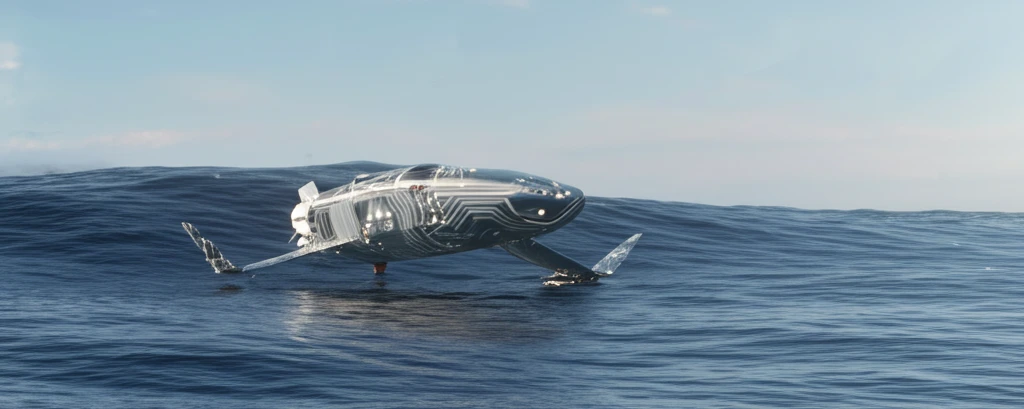
Wave Gliders: How AI-Powered Navigation Can Revolutionize Ocean Exploration

"Dive into the Future of Maritime Technology: Discover how artificial intelligence is optimizing unmanned wave gliders for efficient and eco-friendly ocean research."
Oceans, covering over 70% of our planet, remain largely unexplored. Traditional methods of ocean monitoring, reliant on fuel or batteries, are limiting due to energy constraints, high costs, and environmental concerns. This situation is driving the development of innovative technologies such as unmanned wave gliders (UWGs) to overcome these limitations.
Unmanned wave gliders represent a significant leap forward in maritime technology. They harness wave energy for propulsion, offering near-limitless endurance, reduced operational costs, and zero emissions. These advantages make them ideal platforms for various scientific and survey activities, from climate monitoring to marine resource management.
The integration of artificial intelligence (AI) is further enhancing the capabilities of UWGs. AI algorithms can optimize navigation, adapt to changing ocean conditions, and improve the accuracy of data collection. This article explores how AI is revolutionizing wave glider technology, making ocean exploration more efficient, sustainable, and insightful.
The Growing Demand for Ocean Data
Ocean exploration remains one of the most resource-intensive scientific endeavors, with vast stretches of the world's seas still unmapped and poorly understood. Traditional research vessels are expensive to operate, limiting the frequency and duration of data-collection missions. As climate change accelerates shifts in marine ecosystems, the need for continuous, large-scale ocean monitoring has become increasingly urgent. AI-powered autonomous systems offer a promising path toward making ocean observation more affordable, persistent, and scalable.
Traditional Ocean Observation Methods
Conventional ocean exploration has long relied on crewed research vessels, moored buoys, and satellite remote sensing to gather data. While effective, these approaches face well-documented limitations: ships are costly to operate and can only be at one location at a time, buoys are stationary, and satellites cannot penetrate below the ocean surface. Unmanned surface vehicles like Wave Gliders have emerged as a complement to these methods, but challenges around endurance, data transmission, and autonomous decision-making remain active areas of development.
Wave Glider Development Milestones
Wave Gliders, developed by Liquid Robotics, are autonomous surface vehicles propelled by wave energy, eliminating the need for traditional fuel sources. A key early milestone saw a pair of Wave Gliders travel from Hawai'i to San Diego in an 82-day voyage covering more than 2,500 miles. Since those initial long-distance demonstrations, Wave Gliders have collectively traveled over 1.4 million nautical miles across more than 32,000 vehicle-days at sea. Research institutions such as MBARI have deployed Wave Gliders equipped with scientific instruments for missions lasting weeks or months at a time, establishing them as a standard platform for persistent ocean observation.
How AI is Transforming Wave Glider Navigation
A significant challenge in UWG technology is motion control. Unlike traditional vessels, UWGs have unique structural and operational characteristics, making motion modeling and control particularly complex. Researchers are actively developing AI-powered solutions to address these challenges, focusing on optimizing navigation and adapting to unpredictable ocean conditions.
- Artificial Fish Swarm Algorithm (AFSA): Inspired by the foraging behavior of fish schools, AFSA is an AI technique used to optimize complex systems. In the context of UWGs, AFSA helps identify optimal parameters for heading control, allowing the glider to navigate efficiently.
- Model Identification: The AI algorithm uses data from tank tests and real-world trials to create a dynamic model of the UWG's motion. This model accounts for various factors, such as wave conditions, glider dynamics, and control inputs.
- Parameter Optimization: Once the model is established, AFSA optimizes the control parameters, enabling the UWG to maintain its desired heading with precision. This optimization process leads to improved energy efficiency and navigation accuracy.
Advances in Autonomous Navigation and AI Integration
While comprehensive, peer-reviewed surveys of the latest Wave Glider AI navigation research are still emerging, the trajectory of development points toward increasingly sophisticated onboard decision-making. Integrating AI into autonomous surface vehicles is expected to enhance their ability to adapt routes in real time based on oceanographic conditions, avoiding hazards and optimizing data collection. The broader field of marine robotics is seeing rapid growth in machine-learning applications for sensor fusion, anomaly detection, and mission planning, though translating these advances into reliable at-sea performance remains an ongoing challenge.
Challenges and Limitations of Autonomous Ocean Systems
Despite their promise, autonomous ocean vehicles face significant real-world hurdles. Harsh marine environments—saltwater corrosion, biofouling, storms, and equipment degradation—can shorten mission lifespans and compromise data quality. Communication bandwidth at sea remains limited, constraining how much data can be transmitted in real time and how quickly operators can intervene. Critics also note that autonomous systems cannot yet fully replicate the judgment and adaptability of human researchers, particularly in unexpected or complex scientific scenarios.
Wave Gliders Versus Other Autonomous Platforms
Wave-powered gliders occupy a distinct niche within the broader ecosystem of autonomous ocean vehicles. Compared to autonomous underwater vehicles (AUVs), which are battery-limited and must periodically surface to recharge, Wave Gliders can remain at sea for months by harvesting wave energy for propulsion. However, they are surface-only platforms and cannot directly sample subsurface water columns in the way AUVs or profiling floats can. The optimal approach likely involves deploying Wave Gliders alongside complementary systems, each contributing unique capabilities to an integrated observation network.
The Future of Ocean Exploration is Here
AI-powered wave gliders are poised to revolutionize ocean exploration, offering a sustainable and efficient alternative to traditional methods. As AI algorithms continue to evolve, we can expect even greater advancements in UWG technology, unlocking new possibilities for understanding and protecting our oceans. The combination of wave glider technology and AI not only improves operational efficiency but also promotes a more environmentally conscious approach to marine research.
Convergence of AI and Marine Robotics
Experts in ocean technology broadly agree that the combination of autonomous platforms and artificial intelligence represents a transformative opportunity for marine science. The ability to collect continuous, real-time data across vast ocean expanses could fundamentally reshape how researchers understand ocean systems, from biodiversity monitoring to climate modeling. However, realizing this potential will require sustained investment in both hardware reliability and the AI algorithms that make autonomous navigation and data interpretation truly intelligent.
What Lies Ahead for Wave Glider Technology
Looking forward, the next generation of Wave Gliders is expected to carry more advanced sensor suites and more capable AI systems, enabling higher-resolution environmental monitoring. Potential applications extend beyond research to include offshore energy inspection, maritime security, and disaster response. As costs decrease and reliability improves, fleets of coordinated autonomous gliders may one day provide persistent, near-real-time coverage of entire ocean basins—a capability that would be a first in the history of oceanography.
Scaling Autonomous Ocean Observation
Deploying autonomous ocean vehicles at scale introduces systemic challenges that extend beyond the technology itself. Questions of data governance—who owns the ocean data these platforms collect, and how it is shared—remain unresolved. International coordination will be essential, as ocean currents and ecosystems do not respect national boundaries. Additionally, the environmental footprint of manufacturing and deploying large numbers of autonomous vehicles must be weighed against the scientific benefits they provide.
Ocean Exploration's Human Dimension
Despite the emphasis on autonomy and AI, human expertise remains central to ocean exploration. Scientists design the missions, interpret the data, and make the critical decisions that guide research priorities. Autonomous systems like Wave Gliders are tools that extend human reach, not replacements for human insight. The real-world impact of these technologies will ultimately be measured not just in miles traveled or data points collected, but in the new understanding they enable about the ocean's role in sustaining life on Earth.