
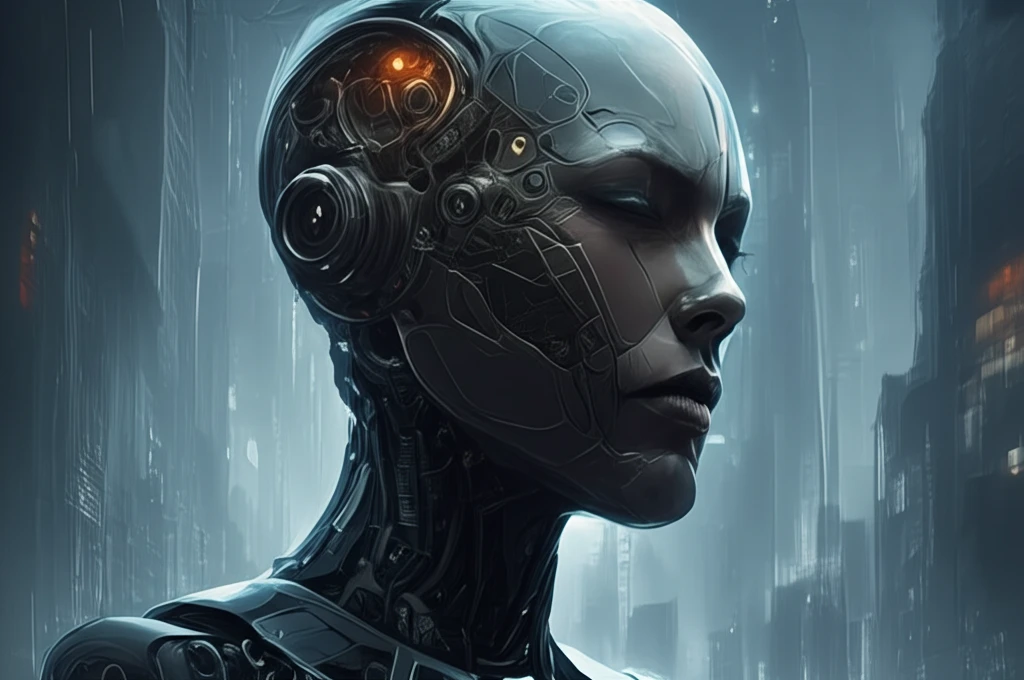
Decoding Robot Faces: The Surprising Science of Human-Robot Connection

"Explore the intricate world of robotic facial expressions and discover how they're shaping the future of human-robot communication, from healthcare to home assistance."
In a world increasingly populated by robots, the ability for these machines to communicate effectively is paramount. Nonverbal cues, especially facial expressions, play a crucial role in human interaction. Imagine a robot caregiver unable to convey empathy or a teaching bot with a perpetually blank stare. The emotional disconnect would be palpable. Recognizing this, researchers are pushing the boundaries of robotics to create machines capable of expressive and nuanced facial displays.
This journey into the world of robotic expressions is a blend of art and science. Engineers and designers are not only grappling with the technical challenges of mimicking human musculature but also considering the psychological impact of these expressions. The goal is to create robots that are not just functional but also relatable, fostering trust and understanding between humans and machines.
From healthcare to education, and even domestic care, the potential applications for expressive robots are vast. This article explores the cutting-edge research, innovative mechanisms, and future directions in the fascinating field of human-robot communication. Get ready to discover how a simple change in a robot's expression can change everything.
Robots Learning to Show Emotion
Facial expressions are fundamental to human emotional communication, conveying approximately 55% of emotional information according to research reviews. Android robots have been designed to express basic emotions such as happiness, anger, sadness, fear, and surprise, though achieving natural performance remains challenging. Studies evaluating human perceptions found that in trials, robots performed different emotions incorrectly in 9.6% of cases and required expression redo in 3.4% of cases, demonstrating the difficulty of reliable emotional display.
From Hand-Tuned to Automated Methods
Traditional approaches to robotic facial expression generation have relied on hand-crafted methods using fixed joint configurations, which often yield rigid and unnatural behaviors. Researchers have developed automated systems like ExGenNet and HAPI models to learn robotic facial expressions rather than manually programming them. These automated methods aim to overcome the limitations of hand-tuned approaches by learning from human facial expression data.
Evolution of Robotic Facial Expression
Early robotic facial expression research relied on hand-coded methods, while newer approaches leverage machine learning and AI to generate expressions automatically. Researchers have developed robots capable of predicting human smiles and animating their faces accordingly, advancing user-friendly robotic technologies. The progression from simple hand-tuned expressions to predictive, AI-driven facial animation represents a significant milestone in human-robot interaction.
The Quest to Replicate Human Emotion
The human face is a complex canvas, capable of displaying a vast range of emotions through subtle movements of its 46 mimic muscles. Replicating this complexity in a robot is no easy feat. Early attempts often resulted in stiff, unnatural expressions that could be off-putting. However, advancements in materials, actuators, and AI have led to significant breakthroughs.
- Human-like Expressions: Robots with realistic skin that deforms in a natural way to create facial expressions.
- Symbolic Expressions: Robots with rigid surfaces that move facial parts to show expressions.
- Exaggerated Expressions: Some robots can produce facial expressions not seen on humans, inspired by comics or animation.
- LED and Projection: Using light and displays to create dynamic facial expressions.
AI-Driven Expression Interaction
Recent reviews highlight that realistic-faced humanoid robots are increasingly essential for emotional bonding, as facial expressions convey the majority of emotional information. Researchers are developing AI-driven expression interaction systems that enable robots to recognize and generate appropriate facial responses. Studies on social robots emphasize that facial expressions are key to establishing rapport and building trust in human-robot interactions.
Mechanical and Social Limitations
Physical humanoid robots struggle to express and communicate using facial movement, relying primarily on voice instead. The challenge is twofold: the actuation of an expressively versatile robotic face is mechanically challenging, and there are social limitations to consider. Research has found that robots with facial expressions are actually perceived as less competent in assisting with light physical exercises compared to non-expressive robots.
Minimalist vs. Complex Facial Systems
Researchers have developed various robotic face systems ranging from minimalist designs to complex android robots. The MiRAE (Minimalist Robot for Affective Expression) demonstrates that basic social behavior can be achieved with simpler robotic faces capable of detecting faces, motion, and making facial expressions. This suggests that effective emotional communication doesn't necessarily require the most complex or realistic facial mechanisms.
The Future of Robot-Human Connection
As technology continues to advance, we can expect to see even more sophisticated and expressive robotic faces. These advancements will not only improve communication but also foster deeper connections between humans and machines. From personalized healthcare to educational companions, the potential for expressive robots to enrich our lives is immense. The key lies in responsible design, ensuring that these technologies are used to enhance human well-being and promote understanding in an increasingly automated world.
Optimizing Trust Through Expressions
Research demonstrates that robot facial expressions are essential for human emotional communication in everyday life. Studies on medical robots show that robots with happy or smiling faces are generally accepted and trusted more by humans. This suggests that optimizing facial expressions can significantly impact how humans perceive and interact with robots, particularly in healthcare applications.
Flexible Electronics and Embodied AI
Recent developments in humanoid robot heads combine AI-assisted flexible electronics for natural facial expression recognition and generation. Researchers are addressing major challenges in embodied AI and flexible electronics to improve how robots recognize and generate human-like expressions. Future trends point toward more sophisticated integration of flexible electronic materials with AI systems to create robots with more natural and responsive facial capabilities.
Cultural and Gender Considerations
Research reveals that the impact of robot facial expressions varies significantly across different demographic groups. Studies indicate that robot expressions have mixed effects depending on participant gender, with different responses observed between boys and girls. Context congruency and cultural factors also influence how robotic facial expressions affect human perceptions, suggesting that effective expression design must account for diverse user populations.
Children's Preferences for Robot Expressions
Studies with children reveal important insights about how young users interact with expressive robots. Research found that children wanted the robot to move during storytelling activities, indicating that facial expressions alone aren't sufficient for engaging interactions. The conversational validation highlighted the need for more subtle emotions achievable through multi-modality, suggesting future robot designs should combine facial expressions with other communication channels.